




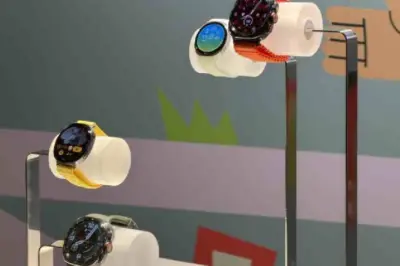

For years, Samsung has been encouraging people to get up and move, ensuring long-term health goals are maintained. As important as the top-notch hardware the electronics giant offers are the software chops, which are in plenty on the new Galaxy Watch Ultra2 and Galaxy Watch9. But how does the company manage to turn everyday biometric data into personalised, actionable health guidance and shift users from reactive treatment towards proactive, round-the-clock care?
That ambition formed the backdrop for a recent conversation at Samsung Research Institute-Noida (SRI-Noida), where two senior executives of the company - Kyungyun Roo and Dr Amitabh Thapliyal - set out how the devices came together and where the company's digital health push is headed.
The Galaxy Watch Ultra2 is pitched as Samsung's most powerful Galaxy Watch to date, aimed at outdoor adventurers and high-performance athletes who need durability and precision tracking in demanding conditions. A new Trail Run feature tracks elevation, climbing progress and terrain impact, helping runners pace themselves and reduce injury risk, and is paired with a Nutrition Alert that estimates sweat loss relative to body weight and advises users on when and how much to hydrate. The watch also caters to professional divers as it is rated IP69K, 10 ATM and EN13319 certified. It packs an 800 mAh battery, runs on the Snapdragon Wear Elite platform, and reaches 5,000 nits of display brightness.
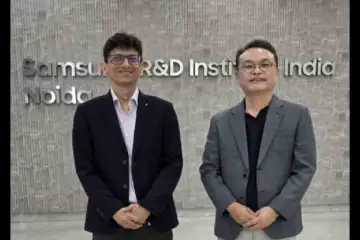
Kyungyun Roo (right), managing director, SRI-Noida, with Dr Amitabh Thapliyal, vice-president, service development, SRI-Noida
AI is a critical topic
The Galaxy Watch9 takes a different approach, positioned as an everyday health companion for users who want to build healthier habits through continuous activity and sleep tracking.
It uses a lightweight aluminium casing that keeps the Galaxy Watch's familiar cushion silhouette, alongside interchangeable, soft-touch bands, and runs on the same Snapdragon Wear Elite platform, with a 390mAh battery and a 3,000-nit display that keeps readings legible in most lighting conditions.
Kyungyun Roo, managing director, SRI-Noida, opened with a broader introduction to the facility's history and mandate. Roo has spent more than 25 years at Samsung Electronics across leadership roles spanning operations and software development, and has headed SRI-Noida since December 2020, overseeing teams focused on AI and service innovation.
"AI is a critical topic today, and we have registered many global intellectual properties (IPs), particularly in AI and health domains. We also publish papers in high-value conferences related to AI, health, and networking," he said, adding that the centre runs training programmes for employees, including an AI certification course at IIT Ropar and its own SRI-N University. Roo said the centre's ambition is to be the global leader in AI-native innovation, working closely with Suwon R&D on flagship development for the Galaxy S and Z series. "Our team contributes significantly, especially in health, AI frameworks, Knox, and applications. Digital health, including watch-related features, is a key focus area," he said.
On India-specific work, Roo pointed to a string of local launches over the past few years. "The first was the personal health record, developed in collaboration with EkaCare based on the government's Ayushman Bharat Digital Mission (ABDM). Next, we partnered with Tata 1mg to launch a medication service in Samsung Health. This year, we introduced FindCare, which enhances health services further," he said. Samsung also supports Hindi and Gujarati languages in India, developed by SRI-Noida, alongside PayNow, an India-specific on-device AI engine in the Galaxy Z Fold8 for payment integration with Samsung Wallet, and ongoing work on agentic AI features. "Flagship development, health services, and AI features are our R&D centre's three key domains," he said. Away from the lab, Roo is known for a passion for photography and a close interest in emerging technologies and new device form factors.
Dr Amitabh Thapliyal, vice-president, service development, SRI-Noida, who holds a PhD in computer science and engineering and has more than 26 years of experience in software development, leads the Digital Health team and took the discussion deeper into the technology behind Samsung Health. He explained that the health platform syncs data between mobile phones and wearables, and that his team manages sync frameworks, data platforms and health-tracking applications focused on wellness and preventive care - part of what he describes as a broader mission to enrich people's lives by integrating technology into everyday experiences. For Galaxy Watch9 and Galaxy Watch Ultra2, the team worked on the vitals tracker, daily cardio load and hearing health.
"Our Hearing Health feature monitors surrounding noise levels and alerts users when noise exceeds the recommended safe range, improving hearing health. This feature tackles urban noise pollution by monitoring sound exposure and alerting users before dangerous levels cause permanent hearing loss," he said.
Thapliyal described Samsung Health as built around five categories: activity, sleep, nutrition, mindfulness and vitals, each providing personalised insights through biosensors. "While you sleep, all your vitals - like heart rate, heart rate variability, your skin temperature, your respiratory rate, how many times you breathe in and breathe out, and your SpO2, your blood oxygen - are tracked with the help of the vitals tracker. And if any of these vitals are out of range, it tells you the reason why it is out of range, and also gives you some recommendations on what you can do so that you can get these vitals within the range," he said.
On daily cardio load, Thapliyal said the feature accounts for the fact that every individual's physical limits differ, based not just on body type, age or vitals but also on recovery. "It tells you your personalised limit. So, there are three segments: the optimal range, under range and over range," he said, adding that it recommends how much and what kind of exercise to do based on a user's training goal, while also flagging when someone is overexerting and needs to ease off before resuming the next day.
Returning to the Trail Run feature that opens the Ultra2's pitch to outdoor athletes, Thapliyal called trail running "the purest form of running", noting that it differs from road running because runners often need to climb, descend and double back in loops, making tracking and navigation critical. "With Watch Ultra2, you have this right on your wrist. It gives you uphill guidance, and a very interesting feature is the hydration alert. Based on your body sweat, how much you have sweated during that trail, it will give you a real-time alert for hydration so that you can have a sip of water or so on and then again restart your training," he said.
Knox protects your data
Asked about lessons India had offered the rest of the world, Thapliyal said demographic profiles and regional behaviours are considered while designing solutions. "We rigorously test and validate our software under all conditions. In India, we conduct user trials, which allows us to verify the technology's functionality before it reaches the market. Our strong validation and testing teams ensure accuracy, visibility, and overall quality," he said.
On whether clinical-grade validation was being pursued given that doctors typically treat wearable data as indicative rather than clinical, Thapliyal was clear the devices are not diagnostic tools. "All of our watches are designed as preventive and wellness devices. We have never claimed that they can diagnose conditions or replace doctors and their services. Instead, our goal is to improve the lives of our users," he said, adding that recommendations are tailored based on longitudinal data rather than a single day's activity.
A recurring example concerned a feature called auto cycle detection, cited as an illustration of how Indian conditions have shaped a global Samsung product. "The challenge was: how do we accurately detect when a user is riding a bicycle using our sensor technology? During development, we encountered a unique issue in India. Here, auto-rickshaws often travel on bumpy roads. Initially, our system falsely detected these slow-moving auto-rickshaws as bicycles. To resolve this, our engineers and validation team conducted real-world field tests to identify such problems," he said, adding that the improvements were folded into the global product.
Seamless, proactive healthcare
On India-specific features, Thapliyal highlighted the health record system's compliance with the Ayushman Bharat Digital Mission, and services such as FindCare, developed with Tata 1mg and PharmEasy, that let users order medicines, book doctor appointments and schedule lab tests, with a FindCare prescription extracted automatically by Samsung's AI Vision Parser and fed into a medication tracker, while the interaction is captured in the user's ABDM-linked Health Record. "The friction points that have plagued Indian healthcare-manual prescription entry, fragmented medical records, difficulty accessing medicines, medication non-adherence, and lost health history-are systematically eliminated. Users now experience a continuous, intelligent journey where healthcare becomes seamless, proactive, and empowering," he said.
Questioned on data privacy, Thapliyal said all health data stored on the device is protected by Knox, and that data transmitted to the cloud is end-to-end encrypted and shared only with user consent. "Without user consent, neither Samsung nor any third party can access this data. We adopt a hybrid approach, focusing on building secure technology while emphasising on-device processing," he said. He added that ABDM's own consent framework separately allows users to share their documents with ABDM-compliant hospitals, with doctors then able to review records and send prescriptions back through the same system.
Asked about SRI-Noida's role in India's Make in India push, Thapliyal said the centre is primarily a software development R&D facility rather than a hardware production one. On whether anxiety some users feel around health metrics might push demand towards screenless devices such as the Galaxy Ring, he said this falls within Samsung's future strategy, centred on building AI-based technology that understands users better over time by leveraging longitudinal health data, whether from watches or rings.
His own favourite feature among the new watches, Thapliyal returned to trail running. "I am a marathoner, so I find the trail running feature amazing, especially for runners and marathoners like me who aspire to take on trail running and improve their performance on challenging terrains. As someone who is currently preparing for an ultra marathon, I see this feature not just from a developer's perspective but also through the lens of a runner," he said. "What makes this particularly special for me is that at Samsung, we are not only developing these experiences for consumers; we are also among their first users and everyday testers. We experience the technology ourselves, understand how it performs in real-world situations, and constantly think about how it can make a runner's journey safer, smarter, and more rewarding. For me, that is the most fulfilling part of building technology: seeing something we develop move from an idea on a screen to something I can actually use on my own running journey," he said.