




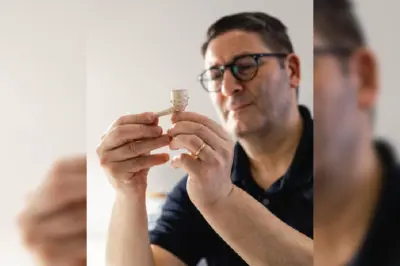

Over the last three decades, Sean Kingsley has poked around some 350 sunken sites from the shallow, sun-bleached waters off Israel to the bruising, deep-sea trenches off the Irish coast.
With a doctorate from the University of Oxford, he is an independent scholar and the founder and editor of , both a quarterly and a popular YouTube channel.
Nassau, the capital of the Bahamas,Prate has long traded on its reputation as the world's premier pirate sanctuary, but its waters never yielded an authenticated brigantine - a two-masted sailing ship - until now. During an undersea expedition off the island of New Providence last fall, a research team led by Kingsley and Michael Pateman, the director of the Bahamas Maritime Museum, discovered - but did not touch or disrupt - six shipwrecks, three of which date back to the golden age of piracy, from 1690 to 1725.
The debris field was a textbook spread of freebooter booty: iron cannons, musket balls, swivel cannons, ballast stones, glass wine bottles and 143 clay tobacco pipes stamped with the royal crest of England. But the real prize was a wooden hull burned down to the waterline - a classic pirate trick for torching evidence. Kingsley suspects that this charred skeleton is none other than the Fancy, the 46-gun flagship of Henry Avery.
In 1695, Avery, known as the King of Pirates, pulled off history's most outrageous high-seas heist, ambushing a Mughal Empire fleet and vanishing with a haul worth roughly $150 million today. To secure Nassau as a safe haven, Avery apparently took his cut of the plunder and gave the vessel to the local proprietary governor as a glittering bribe.
Kingsley and his colleagues combined local maritime lore with cutting-edge tech to map Nassau's sunken history.
q , the Robert Louis Stevenson novel, depicted the pirate base in Nassau as a desperate web of untrustworthy murderers and alcoholics. But you have written that it was more a mix of cowboy frontier town and 18th-century holiday camp.
A: You can read all the history you like, but only when you sail around New Providence do you appreciate the true way of the pirates. Anchored above the cannon wreck's ruins in the middle of nowhere was when reality hit me. Avery, Blackbeard and the Flying Gang could pillage an ocean of bottomless loot. But they knew the odds of getting out of piracy with their heads attached to their necks were small. Piracy was escapism from the system, living in a small shantytown, sticking it to the man and the ultimate freedom of the high seas. The pirates lived for today, and damn tomorrow - a merry life and a short one.
q Nassau Harbor has been heavily gouged and modified by modern dredging. Were you surprised to find intact pirate-era wooden hulls surviving beneath such heavy industrial disturbance?
A: I wouldn't have been surprised if nothing survived and our team left empty-handed. Underwater trophy-hunting found important relics in the years before laws came into effect in the 1990s. On-the-spot accounts leave no doubt that eye-watering underwater heritage was chewed up and lost since 1969.
q So, you're underwater beneath Nassau's old bridge, battling strong currents and dodging an aggressively moody bull shark. How exactly do you still manage to get the mapping done?
A: In the end, the bark was worse than the bite. The twice-daily riptides were managed by precision dives in slack water. When visibility was poor, the team relocated to quieter parts of the harbor. Much to my delight, the grumpy bull sharks decided we were small fry and left us to it.
q Your team uncovered iron cannons and rail-mounted swivel guns - devastating antipersonnel weapons. What does the positioning of the swivel gun mounts on the wreck site reveal about how the crew structured its deck defenses?
A: Not much. Swivel guns were the antipersonnel artillery of choice for pirates to fire on boarding parties and enemy cannon crews. But the shallow cannon site is poorly preserved on an exposed coral reef, ripped by hurricanes. Nassau was also the Caribbean epicenter of the wrecking industry, and salvors undoubtedly "fished" the wreck in the 18th or 19th century. Archaeologists are left with cultural breadcrumbs and the miracle that anything survives.
q One of your premier finds is a large hull burned down to the waterline. Are there specific structural anomalies or patterns of charred wood that differentiate an accidental ship fire from a pirate's effort to destroy evidence?
A: The archaeological magic relies on overlapping evidence, firming up proof with each layer. The wooden hull was burned, seemingly stripped of shipboard items, and was built with wooden treenails, a shipbuilding philosophy largely tied to the 1690s through the first half of the 18th century. Of the 504 ships that historical accounts show were lost inside the harbor, 89 per cent date to after 1750. The combination tentatively suggests that the burned hull went down before then, in the golden age of piracy.
q If Avery's ship, Fancy, truly met its end in the harbour, what evidence would turn a compelling match into an absolute certainty?
A: An elephant tusk from Avery's pretend slaving venture to the African coast. A merchant's seal stamped "H.A." A loose Indian ruby lost in the bilges. But the tree species of the ship's timber needs to be of a British or European genus. A dendrochronological tree-ring reading from around 1690 would also be compelling.
q Films like have turned historical privateers into cartoon cutouts. Did the rogues of the open waters really swagger through history in crushed velvet and rakish eye patches?
A: The pirates of the Hollywood imagination were devilishly handsome, well-to-do swashbucklers who overcame moral challenges to return to their rightful place in society. The wrecks we explored are real, gritty touchstones of how life almost always ended brutally for these sea dogs. Almost all were hanged or died in sea storms. There was no Hollywood happy ending.