




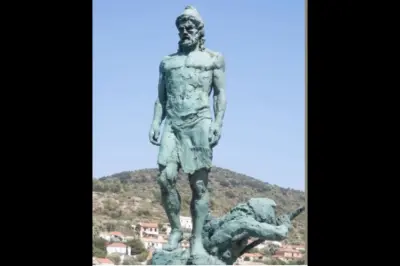

For nearly 3,000 years, Homer's has reigned as literature's ultimate road trip. It's a sweeping tale of a displaced king who fights wrathful gods and sea monsters to reclaim his throne on the Ionian island of Ithaca.
High on a rocky ridge, scientists have uncovered what might be antiquity's most devoted fan club: the ruins of a sprawling, 2,400-year-old sanctuary with details suggesting that King Odysseus was a figure of local worship.
The partly standing complex is carved directly into the terraces of Mount Exogi and has long been known locally as the School of Homer. Archaeologists have poked into the site for more than a century but largely dismissed any relation to The Odyssey.
Since 2018, however, Giannos G. Lolos, an archaeologist at the University of Ioannina in Greece, has led excavations at the site, building on systematic digs that were conducted there from 1994 to 2011. In a statement last summer, the Greek Ministry of Culture described major discoveries from the site, including a grand ceremonial hall, what may have been a strategic watchtower and an intact cistern built in the Mycenaean style.
Locals have long wondered if the ruins were the foundations of Odysseus' Mycenaean palace. But Lolos noted that his team had found nothing to indicate that the surviving parts of the complex dated as far back as 1200 BCE, when Odysseus' travels would have taken place.
"What these new pieces help us understand isn't the Bronze or Iron Age era of Homer," said Rachel Kousser, an archaeologist and art historian at the City University of New York, US, who was not involved with the project. "Instead, it is the way that the Hellenistic Greeks created an imagined Homeric past."
The School of Homer, which archaeologists refer to as the Odysseion, dates to about the third century BCE, roughly 500 years after Homer composed his epics, and a full millennium after the hero supposedly began his disastrous commute home from the war.
Deep in the soil of the Odysseion, Lolos and his colleagues discovered a remarkable trove of polished black cups, jewellery and private prayer vessels. But the true treasure lay in thousands of shattered pottery fragments. Among them were roof tiles etched with Latin and classical Greek, suggesting this remote site was a surprisingly cosmopolitan hub.
The team found more than 100 bronze and silver coins minted in city-states across the Hellenistic and Roman worlds.
"It points to a constant flow of sailors, merchants and pilgrims, even from distant places, to the Odysseion of Ithaca," said Christina Marabea, an archaeologist at Hellenic Open University in Patras, Greece, and a researcher on the site. In 2022, Marabea collaborated with Lolos and other scholars on a paper titled Emerging Evidence for Neolithic Ithaca that was published in the .
On three separate tiles, the name Odysseus was stamped or inscribed into the clay. One translates to "of Odysseus," implying that the mythical hero owned the grounds. Another reads "to Odysseus" - a direct gift to the king himself.
These rites were not reserved solely for the wayfaring hero. Across the excavation site, archaeologists found dozens of spindle whorls and pear-shaped loom weights - the everyday tools of a time-honoured craft. To Marabea, their presence strongly suggests that women played a leading role in the rituals.
After 20 years of brutal warfare and aimless drifting, King Odysseus finally made it home to Ithaca. Or did he?
Even ancient historians had their doubts. In Ithaca is described as a low-lying sanctuary sitting farthest to the west, where the sun sets into the gloom. Yet the modern Greek island bearing that name is decidedly mountainous, and it sits stubbornly to the east of its neighbour Cephalonia.
A long-running theory proposes that a Bronze Age channel once separated the Paliki peninsula from Cephalonia, making it a distinct island, a notion supported by researchers for decades. But 20 years of geological research yielded no evidence of this channel, prompting a reinterpretation by scholars.
In an article published recently in the online journal , James Diggle, a classicist, and John Underhill, a geologist, propose that early translators and mapmakers misunderstood the poet. A strict, literal reading of the original Greek text, they note, never identifies Ithaca as an island but rather in terms more suggestive of a peninsula.
The recent findings at the Odysseion may point the dispute back toward tradition. According to Lolos, the excavations strongly validate modern Ithaca as Homer's true Ithaca. He contends that the description "lying low and far to the west" was born of poetic perspective, not literal cartography. Seen from the sea, Ithaca's coastline mirrors Homeric vistas.
Lolos said the strongest proof of the island's mythic past were the artefacts retrieved from its soil. For instance, a fragment of a late Hellenistic clay prayer mask, scratched with a blunt vow to Odysseus. Or a small bronze bust, found in 1904, that echoes the hero's signature capped silhouette from antique Ithacan coins. Or a late third-century BCE decree that was recorded and preserved on stone walls in Magnesia (what is now western Turkey) - it was issued by the people of Ithaca and explicitly names the Odysseia, an athletics and cultural festival held to celebrate the king.
These objects do more than reshape archaeological timelines; they tie literature to landscape. For those who lived there, Lolos notes, modern Ithaca was indisputably home. Myth, it turns out, may just be history waiting to be dug up.