




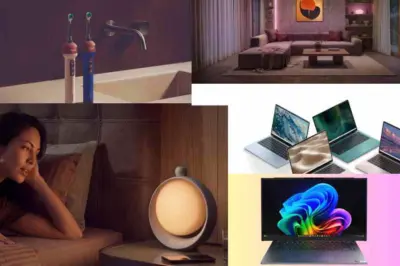

All roads for the tech community lead to Berlin at the moment as Internationale Funkausstellung Berlin (IFA) is on. Here are five gadgets that have caught our attention.
Cavity cam
Dyson has launched a $499 electric toothbrush, the CameraJet, that uses a built-in camera and artificial intelligence to locate gaps between teeth and fire jets of mouthrinse into them while the user brushes.

Dyson CameraJet
The CameraJet, which took six years to develop and involved 661 Dyson engineers, became available for preorder on Tuesday in two colours, Ceramic Ultra Blue and Ceramic Pink.
A macro camera below the brush head captures 28 images a second, analysed by an AI system Dyson calls Gap Optical Targeting, and fires mouthrinse into detected gaps within 100 milliseconds. Dyson said it worked with the Faculty of Dentistry at the National University of Singapore to develop a conical jet shape, which it said removes plaque more effectively and gently than the needle-shaped jets used by most water flossers.
"Flossing is an awkward and time-consuming chore," said James Dyson, the company's founder and chief engineer, adding that the team focused on seeing between teeth, removing plaque and improving brushing itself.
Dyson said the camera is active only during live viewing or jetting, with no images stored or sent to the cloud. At $499, the CameraJet costs about $100 more than the Philips Sonicare Prestige 9900 and Oral-B iO Series 10.
Sleep tech from Anker
Anker has announced two bedside sleep-tracking speakers, the SleepLab and SleepLab Pro, alongside two sleep-focused earbud models, at IFA 2026. The company said none of the new devices will require a subscription.
The SleepLab Pro uses 60GHz millimetre-wave radar to monitor sleepers without a wearable, tracking heart rate and breathing to identify which of the four stages of sleep a user is in, then adjusts its audio output accordingly. Both the SleepLab and SleepLab Pro also play music and sleep sounds alongside a nightlight and alarm, and can be operated with a single button press, independently of a smartphone. The SleepLab Pro tracks only one person at a time, drawing its readings from whichever sleeper is closest to the nightstand unit, Anker said.

Anker SleepLab Pro
The SleepLab Pro is priced at $269.99 and the standard SleepLab at $169.99. Anker has not confirmed a release date for either speaker.
The company also announced the Sleep 4 and Sleep 4 Pro noise-cancelling earbuds. The Sleep 4 Pro adds a heart-rate and sleep-tracking system that automatically adjusts audio, plus a touchscreen charging case for controlling alarms and sounds. The Sleep 4 launches in October and the Sleep 4 Pro in November; pricing has not been announced.
Changing rope light
Philips Hue has launched a new line of architecturally styled smart lighting at IFA 2026 in Berlin, including a 360-degree colour-changing rope light called the Liane.
The Liane uses Hue's OmniGlow technology to emit diffuse light around its full circumference with no visible LEDs, and can be controlled through the Philips Hue app. It is sold in 3-metre and 5-metre lengths, is for indoor use only, and is available now in North America, priced from $399.99.
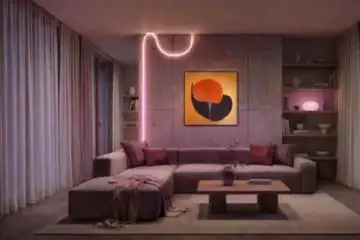
Philips Hue Liane
Hue has also added three fixtures to its Signe range: the Pendant, Pendulum and Pole, each with a slim black housing and a strip of coloured lighting. The Pendulum and Pole go on sale in October from $320; pricing and availability for the Pendant have not been announced.
Separately, Hue announced Custom AI Behaviors, a chatbot feature that lets users describe automations in natural language, arriving as a free Bridge Pro update in October.
Light and powerful
Dell Technologies has announced the Dell 14S, a lightweight Windows laptop for students and young adults, offering up to 21 hours of battery life on a single charge, at IFA 2026.
The laptop is a lower-cost complement to the XPS 13, Dell's premium ultraportable, and will go on sale in North America this autumn. Dell has not yet disclosed pricing.
The Dell 14S has an aluminium chassis and comes in four colours: Linen, Dusty Rose, Washed Denim and Velvet Green. It measures 13.5mm thick, weighs 1.15kg, and offers two 16:10 display options: a 2.8K panel at 120Hz or a 2K panel at 60Hz. It is powered by Intel Core 5 or Core 7 Series 3 processors.
"The Dell 14S expands that story for students and young adults who want a lightweight laptop they can carry all day," said Konstantin Tuv, head of consumer and gaming products at Dell Technologies.
Laptop that stretches
Lenovo has shown two laptop concepts at IFA 2026 in Berlin: Project Swan, a 14-inch laptop whose screen rolls out to 17 inches, and Project AeroBlade, a fanless cooling design.
Project Swan is Lenovo's first horizontally expanding rollable laptop built for work rather than gaming, unlike the company's Legion Pro Rollable, a gaming laptop with a similar rolling screen shown at CES 2026. The display extends at the touch of a button, unrolling to a 16:9 aspect ratio, with resolution rising from an effective 2,258x1,672 to 2,850x1,672, which a Lenovo representative described as "almost" a 4K display. Lenovo representatives said the design is less top-heavy than the company's previous vertical rollable, the ThinkBook Plus Rollable, which launched last year at $3,299. Lenovo has not disclosed pricing, configuration or a release date for Project Swan.
Project AeroBlade is a concept for a 14-inch ultraportable with a fanless cooling system that Lenovo said would not compromise performance. Instead of fans, it uses a single vent along the hinge and modules that move air using ultrasonic vibrations, called AirJet. A member of Lenovo's design team described the approach as more akin to "a bike pump than a leaf blower."