


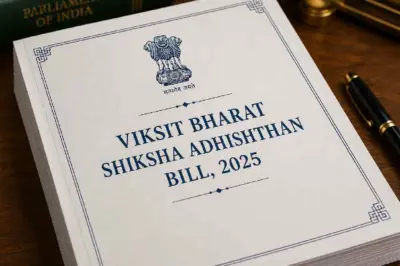

The proposed law to set up the Viksit Bharat Shiksha Adhishthan (VBSA), which will regulate higher educational institutions, has stoked concerns about the dilution of academic autonomy of premier institutes such as the IITs and Institutions of Excellence (IoEs).
The proposed VBSA will subsume the University Grants Commission (UGC), the All India Council for Technical Education (AICTE) and the National Council for Teacher Education (NCTE).
According to the bill, which has been referred to a joint parliamentary committee, the VBSA will be a 12-member commission with a regulatory council, a standard-setting council and an accreditation council. The VBSA will determine standards, accreditation and regulations for all higher educational institutions.
An academic from an IoE, who requested anonymity, said the VBSA was a big threat to the academic autonomy of institutions. Once the VBSA sets the standard for academic matters, all institutions must follow it or invite penal action. Some IoEs have communicated their concerns to the JPC.
An official with the education ministry said several IITs had similar apprehensions, which they had shared with former education minister Dharmendra Pradhan.
Prof. G.R.C. Reddy, former director of NIT Goa, said regulations had not helped institutions perform. The IITs, IIMs, the Indian Institutes of Science Education and Research (IISERs) and the NITs were never regulated by the UGC, but are doing better.
"Bringing all institutions under a single regulator is disastrous. Academic institutions need flexibility rather than rigid rules. They need good academic leaders who will set high standards and help in the institution's growth," Reddy said.
Prof. Sourav Pal, former director of IISER Kolkata, welcomed the idea of a single regulatory body while insisting that institutions should be allowed to enjoy freedom and autonomy in academic matters.
"A single regulator is a welcome move. I feel the regulator should recommend best practices of leading institutes such as IITs and IISERs to traditional universities to improve their teaching and research activities. But the autonomy in matters related to curriculum and syllabus should be retained. The new regulatory body should promote independence of institutions in academic affairs," Pal said.
Pal said there were some differences in nomenclature, course duration and teacher-student ratio among institutions. "If the proposed VBSA can standardise these issues by focusing on quality, all institutions can compete with each other to achieve excellence," he said.
Eminent educationist Anupam Basu, former director of NIT Durgapur, said the UGC had tried to impose rules and structures that stifled academic freedom and held universities back from achieving the excellence seen in IITs, IISERs, NITs and global institutes.
"Several regulations notified by the UGC are prescriptive and contradictory in nature. Institutions should get to decide on teaching hours or designing of courses. Uniformity brings mediocrity. If the VBSA operates like the UGC and the leading institutes like IITs, NITs and IISERs are brought under its ambit, quality will suffer," Basu said.