


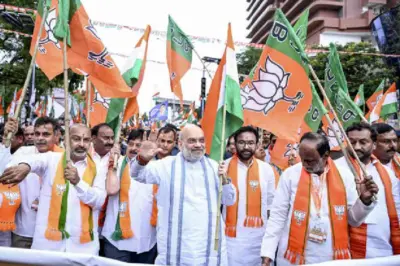

The threat of revenge and retribution that marked the speech of the leader of the Opposition at the Ramlila Maidan rally of the combined Opposition was, to say the least, unusual.
Apart from the Opposition's declaration of total war in June 1975 against the then prime minister, Indira Gandhi, in the aftermath of the Allahabad High Court judgment setting aside her election to the Lok Sabha, political battles have broadly adhered to the norms of the Constitution. The rhetoric of battle may often appear inflammatory but that, it has been well-established over the decades, is part of the shadow-boxing ritual.
Are there reasons to believe that the present kerfuffle, mainly centred on Delhi, is any different? Is the strong reaction of the prime minister and his party colleagues contrived or are there legitimate reasons to believe that the challenge mounted against the National Democratic Alliance is a grave threat to the democratic well-being of India?
For a start, it may be instructive to start viewing domestic politics as a cross-border exercise. Just as the ugly riots in Paris resulted in copy-cat disturbances in other parts of western Europe, it is tempting to see shades of the legendary 1968 slogan - "London, Paris, Rome, Berlin/We shall fight and we shall win" - in the events in Delhi. The lady from an ultra-Left organisation, who has been projected by gullible scribes as this generation's answer to Daniel Cohn-Bendit (the scourge of the bourgeoisie in 1968), was silly enough to let the cat out of the bag and boast that the regime change in Dhaka in August 2024 was an inspiration. The logic of that assertion was that a series of fraudulent elections, rampant corruption and suppressed religious impulses can lead to an explosive situation and unseat a regime. What was left unsaid was that the Bangladesh turbulence was also the outcome of targeted funding and generous assistance from outside forces.
It is impossible to not detect a few parallels with the recently-held elections in Israel. That the Israeli electoral system is infuriatingly complex and needlessly rewards fringe groups is well-known. In this election, thanks to the untiring efforts of the media and the international fraternity of bleeding hearts, it was suggested that Benjamin Netanyahu had lost the trust of all sensible Jews and was nurturing a genocidal and corrupt regime. The vilification of Bibi was relentless and did not ease even after Hamas carried out the worst massacre of Jews since the Holocaust. Most significant, this assault on the very integrity of Israel was endorsed by forces that were never reconciled to the Jewish State in the first place. In the aftermath of the election, it has been suggested by Israeli intelligence that foreign players were active in shaping people's voting preferences, and we await a full report that substantiates the claim. Pending this disclosure, what seems obvious is that the principle of non-interference in the internal affairs of a country has been relegated to the archives. Although the determination of Israeli patriots has ensured that Bibi will live to fight another day, it is apparent that in the garb of globalism and the internationalisation of information and of the media, national politics has become everyone's business.
The countries of the Indian subcontinent provide compelling case studies of the way borders are being undermined by players that don't lack resources. Maybe it is a bit far-fetched to believe that the situation in India resembles that of Bangladesh in the final months of the Awami League government. What is, however, pertinent is that like in Bangladesh, there has been a sustained attempt to delegitimise one of the main supporting pillars of democracy - popular faith in the electoral system. There may well have been a basis for popular disgust with guided democracy in Bangladesh, but it would be hard to find any significant body of opinion that believes the West Bengal election of 2026 was stolen from Mamata Banerjee by the Election Commission of India.
One of the features of the 2026 assembly election in West Bengal that may be overlooked in hindsight is that the Special Intensive Revision exercise did not provoke mass resentment. There was undoubtedly a large measure of irritation at having to prove your eligibility to vote to officials who were only too willing to be sceptical. However, once all the doubts were dispelled and the final electoral rolls published, normal politics took over. This included the perception that the SIR was one of the only ways to prevent West Bengal from becoming another Bangladesh.
There were some attempts by 'intellectuals' sponsored by the admirers of Mamata Banerjee to make SIR the main election issue. Travelling bands of notables and fading stars went round the state trying to prove electoral illegitimacy. Their overall impact was negligible and after the new government assumed charge, many of these so-called thought leaders changed their stripes quite effortlessly. It is no accident that the recent movement against the chief election commissioner has had the least impact in West Bengal, the state which was supposed to be in the eye of the storm.
By itself, the SIR issue has not resonated in India. Even the attempts by the Cockroach activists to make it their own have not yielded any tangible outcome. However, the objective was not to tell people that their rights have been undermined because the SIR deleted lakhs of names of people who had either died or shifted residence. By harping on the myth of stolen elections, the agitators had two objectives: casting doubts on the integrity of Indian elections and creating a false equivalence between the government and the Opposition. In a functioning democracy, the ruling side always enjoys an upper hand for the duration of the legislature.
The project was unquestionably audacious and those who plotted the enterprise must at least be complimented for securing international media attention and triggering the government's reaction. Whether the reaction was proportionate or flat-footed is a debate that will only be settled in hindsight. Just as the Likud Party under Netanyahu outperformed the gloomy prognosis of the media pundits and the liberal establishment, the Bharatiya Janata Party may well benefit from the flurry of activity that has greeted the Cockroach mobilisation. Moreover, since the battles and the tug of wars have been fought and decided in Delhi, casting the net wider is invaluable for the BJP. Under the guise of debunking the fringe, the BJP may have unwittingly begun shaking off the excess fat that accrues in any ruling party.
Swapan Dasgupta is the finance minister of West Bengal. The views expressed in this article are personal