





A team of researchers recently analysed fossils of Spriggina, an organism that resembled a leech. The scientists were surprised to find that many of these fossils were bent, providing evidence that Spriggina consistently favoured turning to the right as it moved.
In a paper published in Scientific Reports, the scientists propose that Spriggina presents the earliest evidence of behavioural "handedness" in animals despite lacking anything resembling a limb.
The findings reveal that handedness is an ancient feature among complex life. "As soon as you get something that has a left and a right side, like Spriggina does, you start to see evidence of it preferring one side over the other," said Scott D. Evans, a palaeontologist at the American Museum of Natural History and the lead author.
Handedness is practically everywhere. DNA's double helix twists to the right while the spin of particles like electrons determine whether they are right-handed or left-handed. Humans and other animals exhibit behavioural handedness, or the preference to use one body side or appendage over the other. Many types of plants do, too.
Fossils provide clues that these behavioural proclivities are ancient. The earliest known evidence of handedness in the human family tree is a right-handed Homo habilis that picked at its teeth, most likely with a stone tool, around 1.8 million years ago. But behavioural handedness evolved long before even hands themselves. Scars on the right flanks of trilobite fossils reveal that these ancient arthropods usually veered to the right when trying to escape predators.
Such ancient origins illustrate the clear benefits of choosing a side, according to Loren Babcock, a palaeontologist at Ohio State University, US, who was not involved in the paper. If an animal is fleeing a predator, for instance, "time is saved if you do not have to make a decision about which foot to place first, or which way to turn," he said.
Animals may have benefited from handedness since the Ediacaran, a geologic period that preceded the Cambrian explosion. Nilpena Ediacara National Park in South Australia preserves a snapshot of this key chapter in life's history. Over 550 million years ago, this area was a seafloor caked in microbial mats made of fleshy fronds, ruffled discs and spongy tubes.
Spriggina inhabited this embryonic ecosystem. The odd organism, which is South Australia's official fossil emblem, had an elongated body of symmetrical segments that culminated in a head-like portion resembling a medieval helmet.
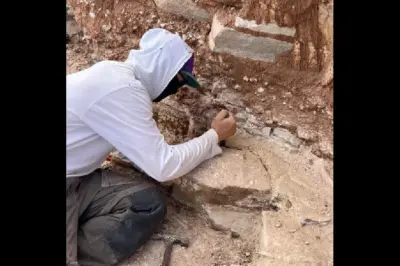
Palaeontologists have recently excavated entire slabs from Nilpena that are full of creatures that were rapidly buried during ancient storms.
Evans and his colleagues examined several slabs that collectively contain over 100 Spriggina specimens. Many of the fossils - impressions that mirror the final position of the living animal - were bent or curved as if the organism was slithering across the rock.
To understand these movements, the researchers photographed the fossils and made 3D scans, which allowed them to measure how much the Spriggina specimens deviated from a straight line. The work revealed that Spriggina was most likely more spry than previously thought. The team thinks they wriggled their bodies like living flatworms or nudibranchs.
The team also discovered that Spriggina favoured its right side. Roughly twice as many fossils represented animals bending to the right than those curving to the left. Evans warns that the fossils do not provide evidence of why Spriggina preferred to turn to the right instead of the left.
Because the animals inhabited the seafloor, it is possible that the position of their bodies may have been influenced by currents. Lidya Tarhan, a palaeontologist at Yale University, US, who was not involved in the study, says this is unlikely. If currents swept over these Spriggina, she said, they would probably be curved in the same way instead of bent in various positions.
The handedness of Spriggina also connects it to much later organisms, including humans. "Specialising one side of the body is a really beneficial part of this body plan," Evans said. "Spriggina has a front and a back and a left and right side - the same body plan that we all have."