




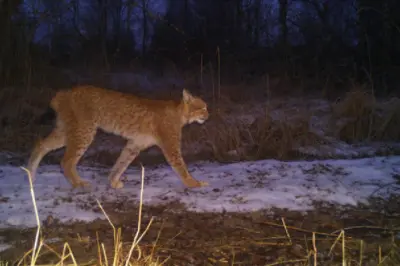

After the 1986 meltdown, nearly all local residents were evacuated and access to the area was tightly restricted. Forests regrew and populations of wild animals, including gray wolves and Eurasian lynxes, flourished.
In 2020, Svitlana Kudrenko, then a doctoral student in nature conservation, set out to study the abundance and diversity of these animals, installing wildlife cameras throughout the 1,000-square-mile Chernobyl Exclusion Zone.
And in early 2022, when Russian troops invaded Ukraine and occupied Chernobyl, the cameras kept running.
Now, Kudrenko and her colleagues have analysed the footage and found that even though the occupation of Chernobyl lasted just over a month, the war seemed to prompt significant changes in the behaviour of wild animals, altering their activity patterns. The scientists recently reported their findings in the journal .
The effects were complex, with various species responding to military activities in different ways; some animals fled, for instance, while others hunkered down in the forest. But the research provides a rare glimpse into the ecological effects of an armed conflict as it unfolded.
"Our results provide insights into how wildlife responds to armed conflict in real time," said Kudrenko, who is from Ukraine and conducted the research as part of her dissertation at the University of Freiburg in Germany. "Warfare does not affect only humans."
Russian troops occupied the exclusion zone in 2022 from late February through the end of March, using the area as a military staging ground. They drove tanks through the area, dug trenches, buried mines, blew up a bridge and engaged in other military activities. Dozens of Kudrenko's camera traps remained operational during that time.
For the study, the scientists analysed images from 31 camera-trap stations, logging each detection of 11 species - including lynxes, roe deer, red deer, red foxes and brown hares - before, during and after the occupation.
The scientists also surveyed 25 people, including some who still worked or lived inside the exclusion zone and local residents who lived just outside of it. They asked these people to rate the intensity of the military activities during each day of the occupation on a scale of 0 to 10. For instance, a 5 corresponded to the movement of military vehicles; an 8 meant cruise missiles; a 10 was reserved for "the noisiest and the most destructive type of armed conflict activity", such as aerial bombardments or artillery shelling, Kudrenko said.
They also used satellite data to identify days with "thermal anomalies" - sudden temperature spikes suggestive of fires.
The two most commonly detected species in the study were roe deer - small, solitary forest-dwellers - and red deer, which often gather in herds in open landscapes. But they seemed to react in opposite ways. As conflict intensity ramped up, detections of roe deer declined, while those of red deer increased.
Those opposing responses may stem from differences in the two species' basic behaviour and ecology, Kudrenko said.
Roe deer, which are known to be shy, tend to freeze when startled and often take shelter in their forest habitats. Red deer are more likely to run in the face of potential threats, and the open habitats they prefer also happened to have been the "epicentre of warfare activities" in the Chernobyl zone, Kudrenko said. That means that the red deer might have frequently been in flight - and thus captured more often on camera.
Overall, red deer appeared to increase their daytime activity and reduce their nighttime activity during the occupation, the researchers found.
The camera-trap images suggested that red foxes and brown hares might have also become less active at night. But on dates with thermal anomalies, nighttime detections of brown hares ticked up, perhaps because they were "trying to flee the fires", Kudrenko said.
In some species, such as lynxes and wolves, the scientists found few signs of significant behavioural changes. That could be because there simply weren't many camera-trap detections of these species. But it's also possible that some of the unique characteristics of the Chernobyl Exclusion Zone - it's enormous size and extremely restricted human activity - helped buffer the effects of armed conflict, Kudrenko said.
The study highlights the fact that there is rarely a "one-size-fits-all response" to warfare and provides valuable insight into wildlife responses on a day-to-day basis, said Kaitlyn Gaynor, an ecologist at the University of British Columbia, Canada, who was not involved in the new research.