




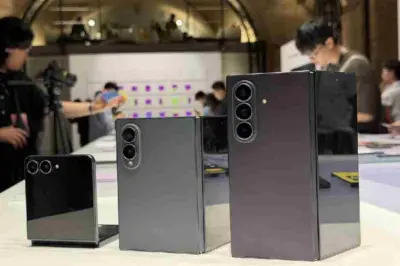

A couple of days after Samsung unfolded its eighth-generation foldables in London - the Galaxy Z Fold8, the Galaxy Z Fold8 Ultra and the Galaxy Z Flip8, alongside the Galaxy Watch Ultra2, the Galaxy Watch9 and an early look at its intelligent eyewear built with Google - a small group of journalists from India sat down with two of the men who are well versed with the ins and outs of the tech industry.
Jay Kim is corporate EVP, head of customer experience office, MX division, Samsung Electronics. He oversees product and experience planning across Galaxy devices, platforms and newer categories such as immersive products and AI, having earlier led the Strategic Partnership Team that built the Galaxy ecosystem alongside platform companies including Google, Microsoft and Meta. Keeping him company was JB Park, president and CEO of Samsung Southwest Asia, who had reason to feel over the moon: India returned more than 271,000 pre-orders in 72 hours, against the 15 days it took last year's Galaxy Z Fold7 and Z Flip7 to reach a comparable figure. Forty-five per cent of those pre-orders came from tier II cities and beyond.
The conversation gathered pace with a question from this newspaper about time, specifically, whose clock the industry is now running on. AI models are improving every six to seven months, while hardware changes are happening every year, maybe two years. Is that scenario encouraging Samsung to speed up hardware and software changes, or is it becoming a challenge to keep up with models that need more memory, or different hardware altogether?
Jay Kim laughed before answering. "I'm glad that you didn't say weeks…that's the pace that we're dealing with. If you say six months, it's actually very comforting."
Then he unpacked the problem. "This is a very interesting question because AI, depending on how you define AI - there's cloud-based AI, on-device AI, app-based AI, and there's OS-based AI," he said. "AI is depending on even the chipset, depending on what layer you're talking because AI affects every layer of the stack that we're working."
The answer, he suggested, is that no single company sets the tempo any more. "But the important part of the hardware is memory and AP and chipset - we work with partners so it's not just us looking at the industry. At Unpacked, you saw Qualcomm, Google, and Samsung working on how to bring AI into the Android ecosystem. And from the chipset to OS layer to hardware to UX and UI, we work with them and we plan ahead for year two to see how to sustain the pace of the evolution of AI."
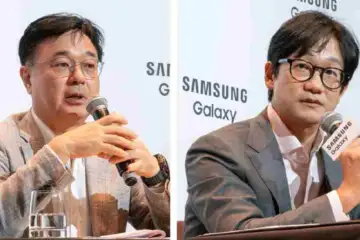
JB Park, president and CEO of Samsung Southwest Asia (left) and Jay Kim, corporate EVP, head of customer experience office, MX division, Samsung Electronics
Samsung's own approach, he said, has been to arrive ahead of the platform. "We did Android 17 this year. We applied it on Galaxy S26 before Android 17 came, which means that we're actually foreseeing what's coming next, and we're applying it earlier. So, we're actually moving faster than what the platform is doing, as we're moving first, and then applying that to the ecosystem, and then gradually going up."
But raw speed, he argued, is the less interesting half of the equation, and the list of devices to keep in step keeps growing. "Technology itself will move fast, but for that technology to apply to the features and get to the consumer, it takes time. So that area is more important," he said. "We are going to gradually manage how we bring AI to our device, not only mobiles, but there's wearables, and there're so many other devices that we need to manage."
His conclusion was almost a caution against being pulled along by the industry's own hype cycle: "We will continue to see how we pace it, not in a way that technology is moving along. We'll just make sure that it comes in the right way on devices for the consumers to use it more safely."
JB Park offered a historical parallel. "At the global unpack, we saw the partnership with Qualcomm and Google. What it reminded me is of the past years, when Intel and Microsoft used to always operate their clock speed and their OS on PC," he said. "How fast it will go is depending on the ecosystem or the industry or the software apps that are going to support the new tech. Samsung has partnered with Qualcomm and Google to create the best experience based on the technology advancement and I think that's how we have to cope with it."

Samsung Electronics has come up with intelligent eyewear in partnership with Google
Novelty versus habit
Two years on from the launch of Galaxy AI on the Galaxy S24, the more uncomfortable question is whether any of it has become habit rather than party trick.
"When we first launched Galaxy AI in 2024 on the Galaxy S24, we looked at three areas - are the AI features meaningful, are they easy to access and are they safe?" Kim said. "To understand these, we went through consumer studies basis which we applied AI features to our key services."
Partnerships came first. "We worked with partners, starting with Google because of the platform. Some of the most used AI features are related to Gemini. For example, the Circle to Search feature helps consumers search very intuitively on their screens and it is one of the most popular AI features." In-house, the pattern is broadly creative. "Among internal features, consumers are enjoying the way they can edit their photos with Photo Assist. The Creative Studio is helping consumers create new content based on their interests. Call Assist and Live Translate are also among the most used features globally."
Adoption data, he stressed, is a starting point rather than a scorecard, and not every feature gets judged by how often it is opened. "Not all features are measured in the same way. For some AI features, frequent usage is important, but some others may not be frequently used but are needed at important times. So, we're looking at different features in different ways to measure the success of the features."
Then came the line that explains Samsung's stand on the subject. "We don't need our consumers to understand whether this (benefit) is coming from AI. They just need to understand that what they want to get done, we just make sure that they get it done," Kim said. "So, we're not really focusing on AI per se. We're focusing on what consumers want and how can we get that task done without friction. Whether it's coming from AI or from simple structures, consumers don't care. That's our philosophical approach to AI - for the consumers to feel less obligated to think about AI."
Park picked up the thread with a concrete example from the newest device. "Consumer don't have to know about the functioning of AI, and that's why we call it Agentic AI. It's supposed to assist you based on your requirements - whether it's entertainment, productivity, or editing," he said. "For example, if you look at the just-launched Galaxy Z Fold8, we've introduced a new editing feature called My FanCam, which automatically analyses the movement of the main subject - for example your kid - that you selected and it intelligently reframes videos in a way that captures your kid in the center, providing an editing experience optimized for Fold8's large display. In the past, we had to rely on professionals to do these kinds of a job."

Samsung Galaxy Watch Ultra2 and Watch9
The memory crunch
The room turned to economics. With memory prices climbing, will flagship discounting shrink - and how ready is India for the festive season? Park was cautious. "There is about 15 per cent degrowth in the Indian market due to the rise in material cost in the first half of this year. The second half is expected to be challenging, too, as the memory crunch is getting severe," he said. "However, Samsung will try to absorb as much as possible, giving the best value of the product. During the coming festive season, we will try to provide affordable solutions to customers, whether it's interest-free EMI or a festive discount. We are focussed on offering as much support as we can to consumers in India."
The pricing of the new range sets the context. In India, the Galaxy Z Fold8 Ultra starts at ₹1,99,999, the Galaxy Z Fold8 at ₹1,79,999 and the Galaxy Z Flip8 at ₹1,24,999, all three available with a 30-month, zero-down-payment no-cost EMI option.
On-device, cloud, and the choice between them
As data regulations tighten across markets, does more of the processing inevitably move to the device? Kim's answer was that consumers, not manufacturers, set that direction - and that Samsung's own approach is deliberately hybrid. "Our approach to AI is hybrid, so a lot of our services run on local (on-device). Consumers are aware of this, but do they really care? Many times, they don't, but they're happy with the service. But we'll continue to improve so that consumers can feel safe that it's only running on-device."
Scaling that is the constraint. "But (improve) in a way that you need to actually upgrade the system - all the chips and everything that you run on the device. Then in order for us to scale it, it has to have a certain sort of criteria to scale the service," he said. The cloud, equally, is not going anywhere. "At the same time, there is a model where consumers need deeper thinking, referencing and getting access to the global data. And, that's more on the cloud side. So, that will also continue."
He didn't put a number on the split. "We don't think that we can actually define what percentage is on device and what percentage is in the cloud. I think that will depend on the consumer. Our job is to make sure that depending on what your need is, we provide whether it's on-device or in the cloud."
The same balancing act runs down the price ladder, where flagship silicon is not available. "If we focus too much on on-device then the hardware dependency becomes critical," Kim said. Samsung runs two tiers. "We have Galaxy AI (for flagships) and the we have Awesome Intelligence for mass tier and how do we manage in between. The flagships definitely have a lot of on-device capabilities based on the chipset. The Awesome Intelligence is more towards how do we manage it so that it connects to the cloud to leverage (AI) but at the same time the basic needs that we have (to address through on-device)." Internally, the company has a word for pushing flagship capability downwards: cascading.
Asked which Galaxy AI features Indian users have taken to, Park pointed away from the obvious answers. "The popular AI features used by Indian consumers are not limited to photo or video editing. One of the features built by our R&D centres in Noida and Bengaluru addresses the issue of background noise," he said. "When you take or make a call from an environment with loud noise, the Voice Focus mode detects and switches on the mode without the person to have to manually change the setting. That's being managed by AI."
The glasses, and the argument for eye level
Another area Samsung has its eye on involves smart glasses or intelligent eyewear. It is here that Kim, who has spent more than a decade watching the XR industry, became noticeably animated.
"I'm personally looking at wearables where AI is extending to the wearable devices. Not to move away from phones," he said. "It's more of providing consumers, different experience where you don't need to always go to the phone to get things done. We want consumers to use their time more in something that you want to use. So, glasses are a very good example."
Pressed on whether the smartphone remains the epicentre of AI, Kim widened the scope. "The mobile (phone) is definitely the one on the go but the PC is another area because you get a lot of things done more productively. So, these two devices are very important and I think they will continue as the primary hub as main devices." The watch, he said, earns its place through data: "The watches have a sensor that's always with you that collects a lot of data related to your health and that connects to managing your wellness and that's the one area that we think is very important and the industry will continue to evolve."
But none of this, he insisted, demotes the phone. "But in order for these devices to work and these devices to be comfortable and fit, the processing power has to be offloaded somewhere else. That's why the mobile phone is very important and it will continue to be there. But how do you interact with your mobile could change."
He finished with something close to a mission statement. "What we're trying to solve for consumers is how do we add value to your everyday life. That's more important than asking consumers to come to the phone every time you need something. So, we're just trying to make sure that we're addressing those issues and I think I can do it better than anybody else in the market. That's my excitement and that's what I want to do every day."