




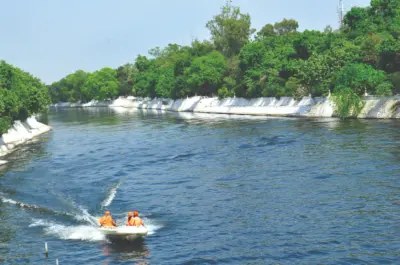

Twenty-five years after volunteers first descended into the sludge-filled Kali Bein, Punjab has little reason to doubt that community action can revive a dying rivulet.
The story of Kali Bein, however, is no longer merely about restoration, but about whether governments can sustain what volunteers have painstakingly undertaken.
As the iconic rejuvenation project completes a quarter century, the challenge has shifted from cleaning the rivulet to ensuring that it never slips back into the condition from which it was rescued.
The 165-km rivulet, revered as the place where Guru Nanak Dev attained enlightenment after remaining immersed in its holy waters for three days, had over the decades degenerated into little more than a drain carrying sewage, industrial effluents and solid waste. The transformation began in the summer of 2000 with the efforts of now Rajya Sabha MP and Padma Shri awardee Balbir Singh Seechewal.
Thousands of volunteers joined the kar sewa, removing silt, clearing encroachments and reviving the rivulet. In 2006, the Punjab government officially declared it the Holy Bein, acknowledging both its religious significance and the extraordinary public movement that restored it. While the revival succeeded, its long-term management remains heavily dependent on volunteers rather than institutions.
A continuous process
Environmental restoration is a continuous process and requires investment, monitoring and governance. Kali Bein is significantly cleaner than it was in 2000, but it cannot yet be described as consistently clean along its entire course. Originating from natural springs at Dhanoa village in Hoshiarpur district, the Bein flows through nearly 40 villages and seven towns before joining the Beas. For decades, these habitations discharged untreated wastewater directly into the rivulet. Although seven sewage treatment plants (STPs) have been set up at Dasuya, Tanda, Bholath, Begowal, Kapurthala, Saido Bhulana and Sultanpur Lodhi, untreated sewage continues to enter the rivulet from four villages - two each in Hoshiarpur and Kapurthala districts - because they still lack land for sewage ponds.
The Seechewal model treats wastewater through a series of filtration wells before diverting it to ponds and eventually to agricultural fields for irrigation. The system has attracted national attention for combining low-cost engineering with community participation.
Former President APJ Abdul Kalam, after visiting Sultanpur Lodhi in 2006, had urged that the model be replicated elsewhere. Former Union Water Resources Minister Uma Bharti had also sent panchayat members from Uttar Pradesh, Uttarakhand, Bihar, Jharkhand and West Bengal to study the initiative.
The biggest lesson from the Kali Bein project is that community participation alone cannot substitute state responsibility. No permanent institutional mechanism has been created for protecting it.
Khushal Lali, author of 'Babe da Mission', a book on Seechewal's efforts for Kali Bein, believes the movement succeeded because it drew upon the Sikh traditions of voluntary service and respect for nature. "Water resources require constant maintenance. Earlier generations revered water bodies, but that sentiment has weakened. Seechewal and thousands of volunteers demonstrated what community participation can achieve. The biggest shortcoming has been that the governments never became equal partners in sustaining the effort," he says.
Former Secretary, Water Resources, Punjab, Kahan Singh Pannu, also points to the absence of long-term planning and institutional accountability. "There is no dedicated budget or permanent investment plan for Kali Bein. Channelisation with concrete lining of embankments while leaving the riverbed natural can improve water flow. Similarly, periodic mechanical removal of water hyacinth can substantially improve ecological health if carried out consistently," he says.
Ecological threats remain
Intermittent discharge of untreated industrial waste and irregular release of water from the Mukerian Hydel Channel have periodically resulted in large-scale fish mortality. Thousands of fish died in separate incidents in 2012, 2013, 2015, 2017, 2021, 2022 and 2023, raising questions about enforcement and environmental monitoring.
Water hyacinth remains another recurring challenge. While some experts advocate mechanical removal, Seechewal opines, "The plant itself is not inherently harmful unless its unchecked growth obstructs the water flow and causes flooding." According to him, the regular release of water from the Mukerian project in the past three years has helped improve conditions significantly, with no major fish mortality reported since 2023.
Ironically, volunteers who once spent their time cleaning the river now devote much of their effort to monitoring whether sewage treatment plants are functioning properly. "When we started, there was not a single plant. Today, there are 168 across Punjab, including seven along Kali Bein. Our biggest challenge now is to ensure that these function efficiently. If local MLAs and civic authorities regularly monitor these, much better outcomes could be achieved," says Seechewal.
His remarks indicate how the nature of environmental conservation has evolved. The task is no longer simply about curbing pollution, but ensuring that the government infrastructure performs as intended.
The Kali Bein experiment offers valuable lessons at a time when rivers across Punjab face severe pollution. Most recently, National Green Tribunal expert-member Afroz Ahmad commented during the anniversary celebrations of Kali Bein: "Nearly 12,000 river pollution cases remain pending before the NGT, a pointer to the scale of the water crisis in India."
Barinder Kumar Goyal, Minister for Water Resources, Punjab, says the work done by Seechewal remains unmatched. "We contine to receive requests from him from time to time, including the need for more STPs, laying pipelines or building additional bridges. On our part, our teams have been regularly monitoring the functioning of STPs. Besides, we have also appointed two Superintending Engineers for every water body to keep checking the pollution levels and all vulnerable points."
Aashika Jain, Deputy Commissioner, Hoshiarpur, says, "The estimate for the regular cleaning of Kali Bein, covering a length of 54,000 feet, amounting to Rs 7.14 lakh, was prepared for execution through departmental machinery this time. Work has now commenced by deploying machinery that is otherwise reserved for use only during extreme emergencies."
The future of Kali Bein is closely linked with that of the Kanjli Wetland, Doaba's only Ramsar site, spread across 183 acres near Kapurthala. Once a thriving wetland supporting migratory birds and aquatic biodiversity, it has deteriorated over the years. The Punjab government has now sanctioned a Rs 19.56-crore project under the Centre's Swadesh Darshan 2.0 scheme to develop this wetland for eco-tourism. A similar proposal was launched in 2020; Rs 5 crore was spent on a ticket counter, bamboo restaurant and temporary structures, but most of it now lies neglected.
The first 25 years after the Kali Bein cleanup proved that citizens can rescue a dying rivulet. The next 25 will determine whether the government can preserve that one-time miracle through dedicated funding, monitoring, and enforcement.