
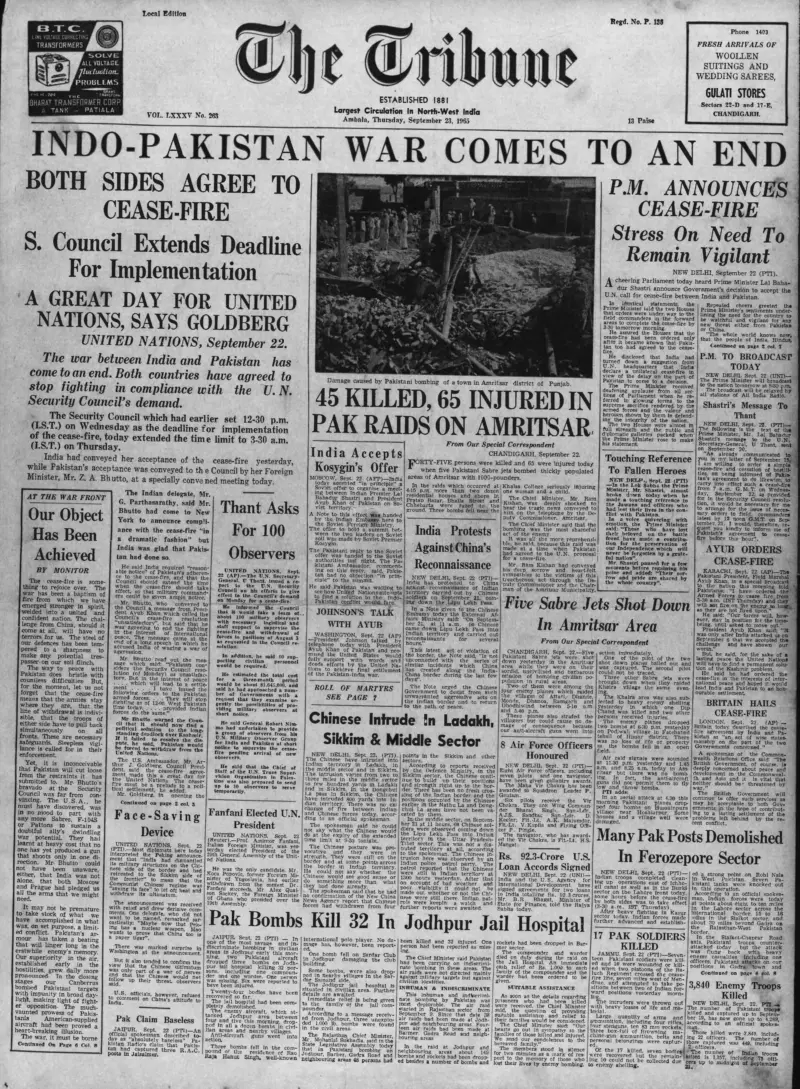

DURING the monsoon season of 1965, foot soldiers plodded and tanks rumbled across the plains of north-west India, largely reminiscent of battles in the Second World War, as the country went into its first full-scale war with arch rival Pakistan, after the localised conflict in Kashmir in 1947-48.
Sixty years later, amidst complex power dynamics surging across the globe, the two neighbours engaged in a brief but intense three-day military confrontation in May. Operation Sindoor achieved India's military objectives of striking multiple targets deep inside Pakistan as well as neutralised enemy attacks. There were no visible boots on the borders, nor did tanks criss-cross the frontlines - instead, operations were conducted in the skies. The subcontinent had never seen anything like this before.
As the nation commemorates the diamond jubilee of the 1965 war in September, it is time to reflect on the geopolitical shifts impacting the Indian subcontinent, and the way the nature of warfare has changed and evolved.
From conventional operations involving thrusts by the infantry and armoured corps with some air support, the spectrum of warfare today is technology-driven and multi-domain, involving not only precision military strikes but also sub-conventional, asymmetric and hybrid operations, information and psychological warfare, remotely-operated artificial intelligence systems and network-centric operations, involving real-time flow of information across operators and decision-makers. Added to this is the presence of nuclear weapons.
Compared to today, in 1965, the war-fighting equipment, communications, methods of information gathering and tools for decision-making were almost rudimentary. Armies relied on basic infrastructure for a hierarchical flow of information and the ability of ground forces to strike targets was limited to the range of their artillery guns. Mobilisation of troops from their peace locations to the frontline took several days. Tactical intelligence was primarily through human resources or recce flights.
The nature of warfare saw little change in the 1971 India-Pakistan war. Large-scale mobilisation of troops, intensive engagements between opposing infantry and armoured formations and strategic attacks in the enemy's hinterland by the Air Force or cross-border raids by the Special Forces marked the 1965 and 1971 wars.
Such military thinking continued till Operation Parakram in 2001-02, when there was large-scale mobilisation along the entire Indo-Pak border in the wake of the terrorist attack on Parliament in December 2001. It took about two weeks for troops and their equipment to be deployed to operational locations.
That was the last time the Indian Army undertook such a massive mobilisation along the western borders. The drawback of such an exercise led to a doctrinal rethink, resulting in the formulation of the Cold Start Doctrine and later in the concept of integrated battle groups.
Cold Start involved rapid, limited conventional military operations against Pakistan in response to provocations such as terrorist attacks or cross-border aggression, without escalating to full-scale war or triggering nuclear retaliation.
Between 1971 - the last major conventional war in the subcontinent - and the shift to a proactive strategy in the early 2000s, several events occurred that had a profound impact on the history, socio-economics, diplomacy and geopolitics of the subcontinent, some of which were characteristic of Pakistan's deep-rooted animosity towards India and its recurring attempts to foment trouble.
Terrorism in Punjab in the 1980s and insurgency in Jammu and Kashmir in the early 1990s stand out. Both states witnessed a heavy loss of lives and an adverse economic impact. The assassination of Prime Minister Indira Gandhi in 1984, under whose leadership India had liberated Bangladesh in 1971, was a fallout of terrorism.
Perhaps the most profound event to alter the strategic landscape was the nuclear tests conducted by India at Pokhran in May 1998. These tests marked India's emergence as a declared nuclear weapons state, reshaping its strategic posture and regional dynamics in accordance with emerging security challenges.
A few days later, Pakistan tested its own nuclear devices. This resulted in an environment of mutual deterrence, with the premise that it lowered the risk of a conventional war between India and Pakistan. While India adopted a no-first-use stance, Pakistan did the opposite, claiming that it would employ nuclear weapons first if its red lines were crossed.
It was the umbrella of nuclear weapons that emboldened Pakistan to intensify its proxy war and sub-conventional operations against India, supporting intrusions, terrorism and social destabilisation, even though, by all accounts, it teeters on the brink of collapse. India, on the other hand, has surged ahead economically and technologically.
The 1999 Kargil conflict should also be viewed through this prism. Many experts believe that it was the nuclear shadow that constrained India from escalating operations beyond the Line of Control (LoC) in the Kargil sector. Pakistan has, ever since, continued to keep the LoC active, with reports of firing coming in now and then.
This period was also marked by India's ballistic missile programme gaining speed. The Prithvi was test-fired in 1988, while the Agni demonstrator took flight in 1989. Since then, different versions of these missiles, along with a host of other missiles capable of carrying nuclear warheads over several thousand kilometres, have been developed.
Meanwhile, China - silent since the 1962 border conflict till the 2000s, barring isolated confrontations on the Line of Actual Control (LAC) like that at Sumdorong Chu in 1987 - began becoming belligerent and aggressive. From the mid-2000s, its transgressions across the LAC increased and face-offs with Indian troops became more frequent and at times violent, involving scuffles and the use of non-lethal weapons.
The rapidly growing Chinese economy provided ballast for its aggression.
Its actions, mirrored in other parts of the world like the South China Sea, are backed by its huge strides in economic, technological and infrastructural domains.
The most serious incident occurred in 2020 in the Galwan valley, when China made several incursions into Indian territory in eastern Ladakh, in which several soldiers on both sides lost their lives. A massive build-up of troops followed; the standoff continued till 2024, when troops disengaged at most places.
The continuous enhanced deployment of troops at places and at heights as never before, according to defence officers, is now the new normal in the security calculus.
Two other notable events also marked India's changing approach to terrorism. The first was the wide-ranging surgical strikes across the LoC, when Special Forces hit several terrorist camps inside Pakistan-occupied Kashmir (PoK) in September 2016, in response to a terrorist strike on an Indian Army camp at Uri that killed 17 soldiers.
The other was an airstrike by the Indian Air Force at a terrorist camp at Balakot in Khyber Pakhtunkhwa, west of PoK, in February 2019, after a suicide car bomber killed 40 CRPF personnel at Pulwama in Jammu and Kashmir.
Operation Sindoor was retribution for a terrorist attack at Pahalgam that killed 26 persons in April. It put the stamp on India's doctrinal shift from strategic restraint and cautious response to deterrence by punishment through a proactive strategy and swift military action.
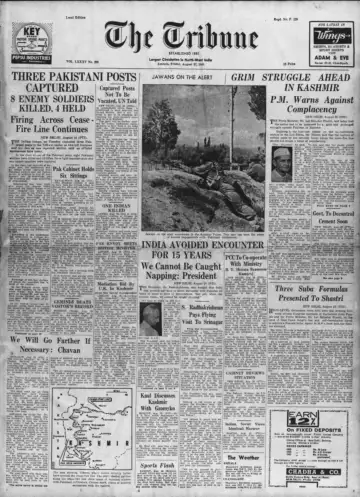
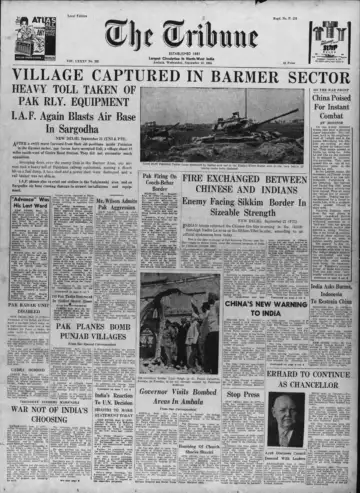
Compared to today's standards, in 1965, the war-fighting equipment, methods of information gathering and the tools for decision-making were rudimentary. The Tribune Archives
The initial phase of the operation marked India carrying out precision strikes at several terrorist camps deep across Pakistan, hitting targets in mainland Punjab - marking terrorist infrastructure in Muridke and Bahawalpur - for the first time since the 1971 war.
Pakistan responded with a barrage of missile and drone attacks at numerous places in India, from Baramulla to Bhuj - all were effectively neutralised. In retaliation, the Indian Air Force carried out precision strikes at 11 strategic sites in Pakistan, including airfields, drone bases and air defence sites. The targeting of the Nur Khan base, close to Pakistan's strategic and nuclear command, is said to have tilted the direction of the conflict. Pakistan sued for peace.
The enormous significance of these operations must be underlined. They showcased new-age warfare that in 1965 would have been considered stuff of a feverish imagination - involving air power, electronic warfare drones, loiter munitions and missiles in a digital environment backed by satellite-based communication and surveillance systems which provided real-time seamless inter-service integration and coordination.
India hit its targets inside Pakistan from within its own territory. There was no face-to-face combat. Alongside, information and disinformation campaigns on social media were mounted to change perceptions both inside the country and abroad.
It was also for the first time that the Indus Waters Treaty of 1960, which lays the framework for utilisation of waters from rivers flowing from India into Pakistan, came into active play. India suspended the treaty, not only depriving Pakistan of crucial hydrological data on water levels, but also enabling India to construct more power projects and water-storage facilities on rivers in J&K.
Notably, the China-Pakistan nexus also came to the fore in this operation. China, the major supplier of weapons to Pakistan and a diplomatic supporter at international forums for decades, provided real-time intelligence inputs as well as missiles to Pakistan's air force.
India's own military capabilities have undergone a sea-change since 1965. At the time, India had primarily relied on the erstwhile Soviet Union for its tanks, armaments and fighter jets - as much as 80 per cent of India's defence equipment was imported. The collapse of the Soviet Union in 1991-92 forced the government to overhaul its own public sector-dominated defence industry which had hitherto been restricted to low-technology items or manufacturing foreign equipment under licence.
A 'Make in India' mindset, before PM Modi came to power and after, has meant far greater focus on indigenous research and development, and the increasing participation of the private sector in producing warships, helicopters, fighter aircraft, artillery guns, missiles, communication equipment and electronic warfare suites. Domestic manufacturing now accounts for 65 per cent of India's defence equipment - even though larger defence systems, like the Rafale fighter jets, continue to be imported.
Sixty years after 1965, strategic experts say the global security matrix will only get more complex. Beyond building up military capability, India must strengthen its economic and scientific sectors and ensure social harmony and internal security.