






At a tiny Mumbai cafe, a struggling actress spends her days waiting tables, when one afternoon, she answers the phone of a man who has just died.
What begins as an innocent act soon draws her into the many lives he leaves behind, a world of fragile truths, shifting identities and unexpected connections.
Mohit Takalkar's latest Hindi play, 'Dil Ka Haal Sune Dilwala', uses this backdrop to talk about a city that is both restless and intimate. Based on American playwright Sarah Ruhl's 2007 dramatic comedy 'Dead Man's Cell Phone', it is the second production of this year's season of Aadyam, the Aditya Birla Group's theatre initiative. After its premiere at Kamani auditorium, New Delhi, on May 16 and 17, it will be staged at the Bal Gandharva Rang Mandir, Mumbai, on May 30 and 31, with two more shows at Mumbai's Nehru Centre on July 25 and 26.
This will be the third play that Pune-based Takalkar is doing for Aadyam, after 'Gajab Kahani' and 'Mosambi Narangi'. The co-founder of Asakta Kalamanch, he has directed over 30 plays, including a presentation of Girish Karnad's 'Yayati', the award-winning 'Hunkaro', and his more recent works, 'Love and Information', 'The Nether' and 'Anatomy of a Suicide'.
He has directed plays in English, Hindi, Marathi, Haryanvi, Marwadi and Kannada. "Emotional approach doesn't change with language, but there's a change in rhythm, humour and silence," he says.
In 'Dil Ka Haal Sune Dilwala', Dilnaz Irani plays the struggling actress named Asha Parekh. Why this name? Says Takalkar, "It carries memory, aspiration and also irony. The moment you hear 'Asha Parekh', it evokes a certain cinematic innocence, warmth, glamour and old-world charm. Our Asha also carries some of that emotional quality. She moves through this bizarre world with sincerity, openness and an almost old-fashioned belief in people. But there's also a contrast. The original Asha Parekh is an icon, while our Asha is a struggling actor, carrying ambition and dreams but not entirely knowing what to do with them."
Takalkar points out that he encountered the original Sarah Ruhl play as a text, never in performance. He adds, "That is actually more powerful because the world begins staging itself in your head while you read. What immediately struck me was its tonal complexity. It was absurd, funny, whimsical, but also carrying this quiet ache underneath. The central premise is deceptively simple. A phone keeps ringing beside a dead man and a stranger decides to answer it. But from there, the play slowly opens into questions about loneliness, identity, memory and the stories we construct about other people."
According to the director, adaptation is not about mechanically 'Indianising' a text. He says, "The deeper question is whether the emotional core survives the shift. Structurally, we haven't changed Sarah Ruhl's world drastically. What changed was the texture around it. The rhythms of speech, the humour, the cultural behaviour and the chaos of Mumbai. Chirag Khandelwal's adaptation played a huge role here because his language carries wit very organically. It feels lived-in rather than imposed."
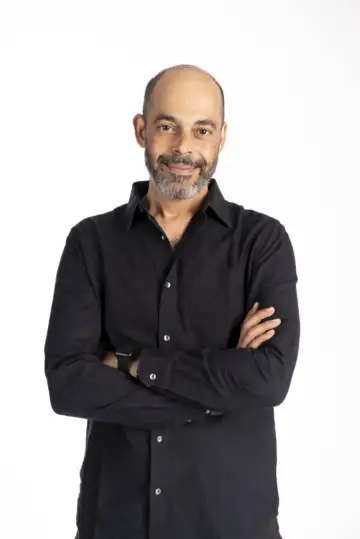
Mohit Takalkar points out that Aadyam Theatre is not just a funding body, as there is an entire ecosystem around the production.
On his journey, Takalkar says he was first attracted to theatre because of its sheer magic. He elaborates, "You begin with an empty space, almost a void. The moment actors enter, that emptiness starts filling with emotion, memory, rhythm, tension, imagination. A whole world begins to exist collectively between performers and audience. That transformation fascinated me very deeply. Theatre invites the audience to participate in creating the world. And because of that, every person experiences it slightly differently in their own imagination."
Takalkar's own influences were quite varied. He elaborates, "As writers, I was deeply drawn to Vijay Tendulkar and Mahesh Elkunchwar because they were unafraid of psychological complexity and human contradiction. Girish Karnad influenced me differently, more in the way he engaged with folklore, mythology and history without making them feel distant or decorative. At the same time, there were theatre groups like Sandesh Kulkarni's Samanvay and directors like Atul Pethe and Makarand Sathe whose energy was very influential in my formative years."
With experience, he learned as much from what he disliked as from what he admired. He says, "Very early on, I became aware of certain things I didn't want in my own practice. Sometimes it was the way the rehearsal process was conducted. Sometimes it was the unnecessary gloom and self-seriousness that theatre often romanticises. I also reacted strongly to how text is often treated in Marathi theatre almost like scripture. I don't believe that. For me, the text is not fixed. It keeps evolving in rehearsal. My influences were not just people or productions. They were also arguments I was having internally with the theatre I was watching around me."
The 'Dil Ka Haal Sune Dilwala' cast also includes Vrajesh Hirjee, Faezah Jalali, Sagar Deshmukh and Bhaskar Sharma. It comes two months after Aadyam's Season 8 kicked off with Vikranth Pawar's supernatural thriller 'Ankahi'.
Takalkar points out that Aadyam is not just a funding body, as there is an entire ecosystem around the production. He says, "They bring scale and visibility, which is important because theatre in India constantly struggles for infrastructure and reach. At the same time, every Aadyam production is very different from the next. So you still retain your voice as a director." And Mohit Takalkar's voice has had its own impact with each new production.