




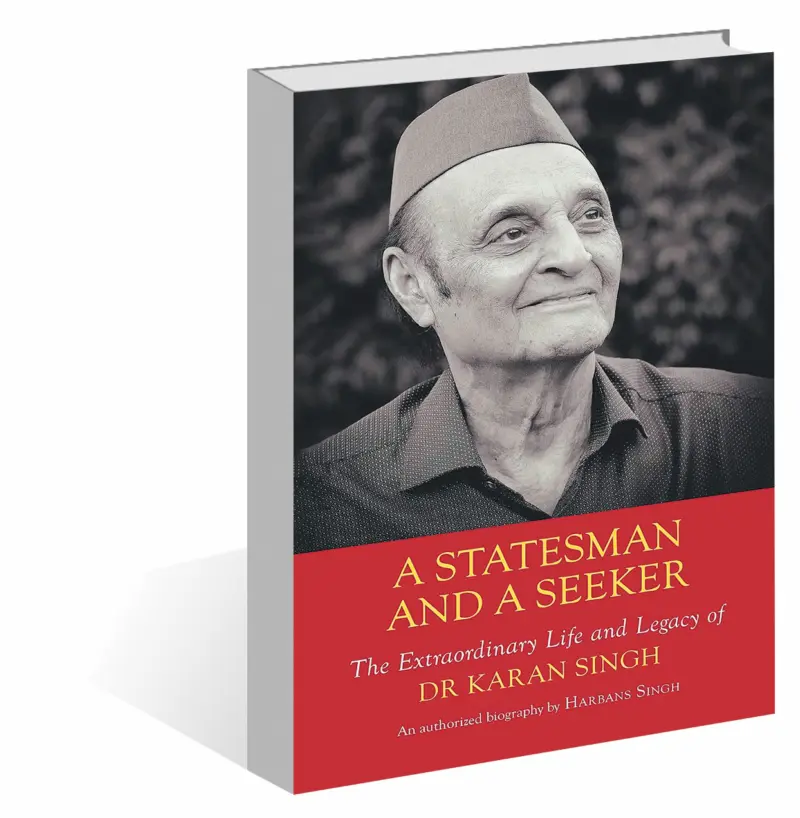

In the mid-1970s, Dr Karan Singh came to St Stephen's College, Delhi, to deliver a lecture. My fellow students were not known for patience and were often a difficult audience.
The lecture started with a recitation of shlokas in shudh Sanskrit, followed by an explanation in fluent English. He had us in the palm of his hand; we listened with rapt attention.
I had heard him earlier, and many times later, but that event is vivid in my mind because it demonstrated the effortless ease with which he could transcend languages and deliver the essence of his thought.
Through public and personal interactions, one had built up a collage of the person who has been brought to life in 'A Statesman and a Seeker'.
The subject of the book has been remarkably candid with the author, whose family background would make him a subject of the Maharaja of Jammu and Kashmir. Yet the freedom Harbans Singh was given while writing the book is reflected in the text.
From his birth at Cannes, to a strict princely parenting style (seems an oxymoron, but you have to read the book to understand it), Doon School schooling, sadly interrupted - many facets fill in the colours in the life of a person who is well known, but one we don't know well enough.
A painful hip injury took him to New York, where he would spend 11 months in the Hospital for Special Surgery and convalesce at Barclay Hotel thereafter. The surgery had been difficult, and his physiotherapy was long - he had been in a plaster cast for a year. Yet now he could explore the city, see the beautiful billboards, plays and other cultural offerings of Broadway, even as he keenly followed the 1948 presidential election. He would return as India's Ambassador in 1989 and, in the short time he was there, have a significant impact.
When Karan Singh landed in Bombay, the reality of the changed state of affairs was immediate. Maharaja Hari Singh had signed the Instrument of Accession, and his power was considerably diminished. In 1949, Sardar Patel forced him to step down. Thus, Yuvraj Sri Karan Singhji Bahadur became Regent of the State at age 18, a position he held until 1952.
His wedding to Yasho Rajya Lakshmi, daughter of Rana Sarada Sumsheer of Nepal, was a grand affair held in Bombay. Circumstances had made him a loner, but his wife changed him, even as she, over time, repaired the relationship between him and his father and proved herself indispensable in his personal, political, and family life. She was his "anchor and harbour".
The state's political life and its relations with the Centre were challenging. Maharaja Hari Singh passed away in 1961.
Jawaharlal Nehru's death prompted a move to Delhi and into Indira Gandhi's Cabinet. In 1967, at 36, Karan Singh was the youngest member of the Union Cabinet, serving as Minister of Tourism and Civil Aviation from 1967 to 1973. He helped to modernise tourism infrastructure and Air India. As Minister for Health and Family Planning from 1973 to 1977, he drafted India's first population policy.
In post-Emergency elections, he was one of the two Congress winners in North India.
Harbans Singh describes Karan Singh as an "ever-learner". His intellectual and spiritual progress forms an interesting strand in his life. At Doon, his refuge was the library, where he read voraciously. As Regent, he met Pandit Parmanand, who introduced him to Sanskrit. He also took steps to finish his interrupted formal education and received his degree from his mother, who was the Chancellor.
A doctorate on the political thought of Sri Aurobindo followed. He has written several books and is known for his company among intellectuals, his erudite lectures, and his support for cultural and interfaith activities.
The book is a treasure trove for people who want to know more about J&K and the man who was its Sadar-e Riasat.
Harbans Singh has avoided the temptation to succumb to obfuscation or sensationalism, even as he has explored the multifaceted Dr Karan Singh's life and times.
Five decades after I first heard him, I saw his recent interaction about the book at Chandigarh. Yes, at 95, he can still hold the audience in his hand, as can his biography.
- The reviewer is a senior journalist and author