
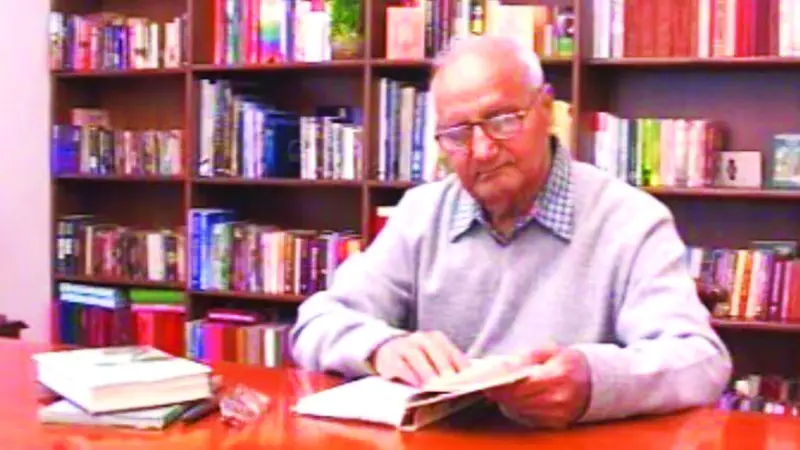

It is now more than 30 years since I would catch the overnight train to Lucknow, book into a cheap hotel near the railway station and then take a tonga to the Indiranagar home of Shrilal Shukla and his wife Girija.
They would welcome me and, over tea and biscuits, I would sit with the great man and ask all the questions I had about the task I had in hand - translating his classic Hindi novel of the 1960s, 'Raag Darbari'.
As many of you will know, 'Raag Darbari' has nothing to do with classical music. Its title is a metaphor for the story of Rangnath, a rather aimless but idealistic urban postgraduate, who comes to recover his health in the countryside in the house of his uncle, Vaidyaji. Vaidyaji is indeed a vaid and believes a man's health depends on his conserving his semen. But more than that, he is the local political boss and from the darbar in his front room run the politics and institutions of the village of Shivpalganj.
Shivpalganj itself is populated by a host of unforgettable characters all linked to Vaidyaji's darbar. Shukla's gentle satire spares no one - neither the political class nor the bureaucracy, nor the police nor the education system, nor attempts at rural development nor superstition masquerading as religion.
I had discovered 'Raag Darbari' well after the rest of India. It had won the Sahitya Akademi award in 1969 and already been translated into many Indian languages. But, luckily for me, never into English. I will never forget shaking with laughter as I read. There was nothing in English remotely like 'Raag Darbari'. It was funny and it was true. At university, I had approached translation as a chore; now I had suddenly found an entire novel I wanted to translate. David Davidar of Penguin India wanted to publish it, and so the work began.
There are many authors who are possessive about their works. Shrilal Shukla was not one of them. Born in 1925 in a village just outside Mohanlalganj, a town near Lucknow, in many ways he exemplified all that is best of Avadh culture - broadmindedness, innate civility and kindness, a very ready wit and a strong tendency to be very laidback. He readily agreed to me, a real beginner, translating his most celebrated work. The only thing he wanted to do, he said, was to check "for howlers".
He had become a bestselling author even before there were book launches, litfests or social media campaigns. Publicity stills were restricted to grainy black and white photographs, often not much bigger than a postage stamp, printed on a book's back cover. There were hardly any Hindi bookshops, certainly not in Delhi (the same is true today), and there was no Amazon or Flipkart. But there was room in newspapers and magazines for literature and a plethora of literary journals that were well and widely read wherever there were Hindi speakers.
Shrilal Shukla fitted naturally into this literary world and was a true 'sahityakar'. He wrote out of an inner compulsion. His day job as a civil servant was his living. Until his retirement in 1983, all of his writing was done in his spare time. One of his closest friends was Kunwar Narain, another of nature's gentlemen who was a well-known novelist and poet. Shukla told me how he and his friends would meet to discuss their work on the lawns of Lucknow's once palatial Carlton Hotel. 'Raag Darbari' had begun as a series of sketches he had read out there and his friends' encouragement made him carry on.
He also had a keen interest in literary criticism and published studies of three of Hindi's most loved literary men - Bhagwati Charan Varma (another author who had a gift for making readers laugh), Amrit Lal Nagar and the poet Agyeya. Neither was Shukla in any way parochial, avidly reading world literature.
The famous quote of Mahatma Gandhi seemed apt for him too: "I want the cultures of all lands to be blown about my house as freely as possible. But I refuse to be blown off my feet by any."
From the 1950s, Hindi novels of village India, like Phanishwar Nath's 'Maila Anchal' set in north Bihar, were pigeon-holed by the Hindi establishment as "anchalik". That implied, amongst other things, that the centre of Hindi literature was elsewhere. Shukla objected, saying that there was nothing peripheral about rural india and in fact stories set where most people actually lived were at literature's very heart. He pointed out that when he wrote what he called "high comedy", he did so because humour was the mechanism that village people themselves used to cope with the many difficulties they faced in life.
Shukla's own family had never been well-off. One of his earliest memories was of the distress caused by the crash in grain prices in 1929. His father died young and after Shukla had completed his course at Allahabad University, he needed to find a job. It was then that he joined the civil service.
He later described, with more than a hint of self-mockery, how he became a novelist. "I wrote my first book, 'Suni Ghati Ka Suraj', in 1955-56. The publishers called it a novel and printed it. Then I was in my thirtieth year and I was in a hurry to become a writer. So I dashed it off. It was painless… In fact, it wasn't a novel. It was a collection of material that would have made a good novel… I began my second novel by choosing the title 'Agyatvas'. It was 1960. Writing this, I first enjoyed or rather had a taste of the enjoyment of writing. It was a blessing that I completed it in only 100 foolscape pages. It was another matter that in the process I must have written a total of 400… Then 'Raag Darbari'. This novel kept me in a state of ill-health for about six years. Living with those ganvaar characters day and night made me speak like a lout. Respectable women at the dinner table sometimes raised their eyebrows at me, I began to avoid my family, and my family me. My misfortune was that I didn't seem to have any fitting place to write. So, for the sake of my wife and family… I would leave my home and take a separate flat, or for months would drive the car out to a deserted place and use it. I would tour the most remote dak bungalows - that is, I did everything that a responsible married man does for his lover… In the process, I wrote and then crossed out some 2,500 foolscape pages. After the novel was complete, I licked my wounds for three years."
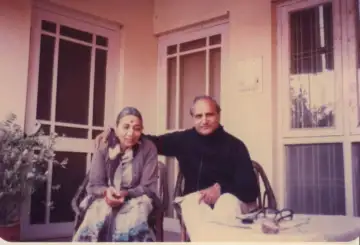 Shrilal Shukla with his wife Girija, whose contribution in allowing him the time and space to pursue his literary interests he readily acknowledged. Photos courtesy: Shukla family
From this, it's clear that Shukla's seemingly effortless, pared-down prose was very carefully crafted. And it's also clear that his creative work would never have been possible without his wife Girija taking on the task of managing the household and bringing up their four children whenever he was in the grip of a new book. This was a truth he readily acknowledged.
For an assessment of Shukla's overall contribution to Hindi literature, I turned to the Hindi poet, essayist and critic Ashok Vajpeyi. He told me, "At a time when there was a general euphoria about rural development, he was the first novelist to look critically at the ground reality, the underbelly, of the development process. And he did so in 'Raag Darbari' with humour and wit, creating a new narrative idiom with a twinkle in its eye. Until then, novels had been very serious affairs. And he never stood still. Throughout his literary career, he explored more areas of the reality of our times, a wide range of human experience, and continually experimented with narrative language."
Among Shukla's later novels was 'Bisrampur Ka Sant', set against the background of the Bhoodan Movement, when landowners voluntarily gifted land for the landless, whose early idealism ran into the sands and changed little. 'Aadmi Ka Zahar', written not long after 'Raag Darbari', was a new kind of urban murder mystery.
Over the years, Shrilal Shukla was showered with awards, among them the Padma Bhushan and the Jnanpith Award. By his death in 2011, he had published 10 novels, four collections of short stories, nine collections of satire and two memoirs.
But somehow it is 'Raag Darbari' that still steals the limelight. And it still finds new readers. A few months ago, a young MP asked me if I knew of a wonderful book he had just discovered called 'Raag Darbari'. A professor of political science recently sent me a chapter he had written for a new edited volume about the novel. For, 'Raag Darbari' long ago hopped over disciplinary boundaries to fascinate students of political science and development economics.
However, as we celebrate Shrilal Shukla's centenary, we should really do what he would have wanted us to do, and seek out his many other works. He still has so much to say to us.
- Gillian Wright is a British journalist, author and translator who has translated many Hindi literary works