
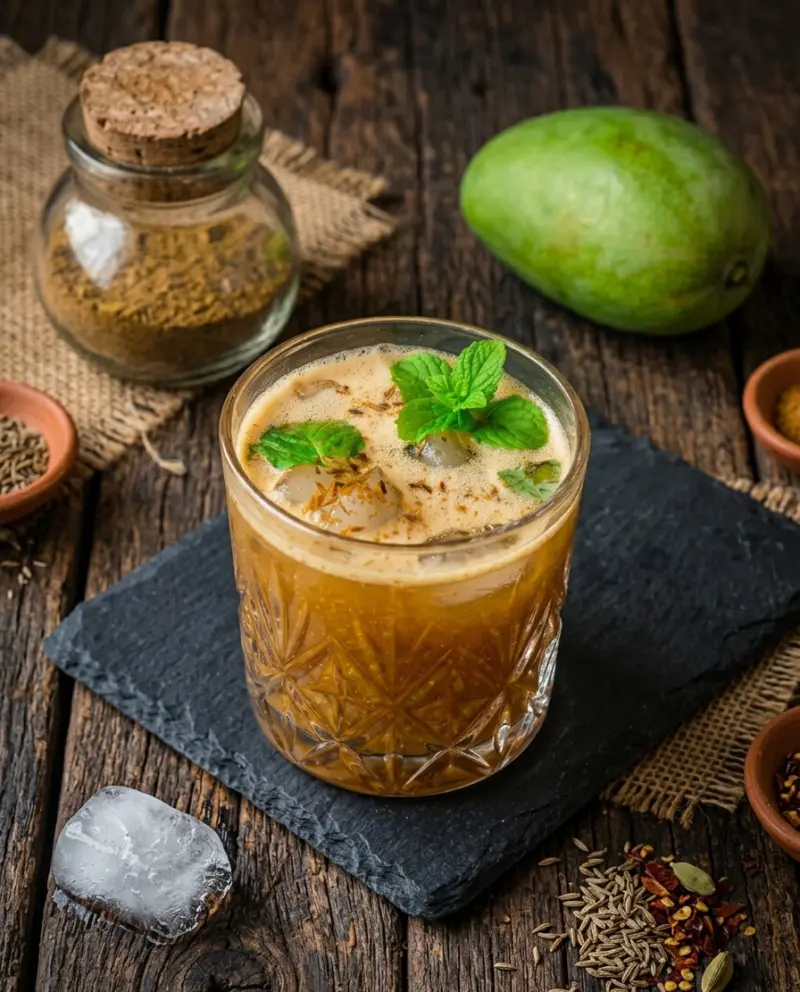

Some flavours don't just sit on your tongue - they settle into memory. For me, aam ka gudamba is not just a drink. It is a story - a Punjabi summer captured in a glass.
I remember those scorching afternoons when the sun blazed relentlessly, the fields shimmered, and even the birds seemed to fall silent. Outside, everything stood still. But inside our home, there was a quiet kind of magic unfolding. The kitchen would come alive - not with elaborate cooking, but with the promise of something cooling, comforting, that could soothe both body and spirit: aam ka gudamba.
Summer afternoons always circled back to one thing - my Bebe's gudamba. Back then, I didn't realise the word meant different things in different parts of India. In Maharashtra, gudamba is a sweet mango pickle, slow-cooked with spices. In Punjab, it becomes something entirely different - a rustic, refreshing drink with a character of its own. It all began with mangoes - not fully ripe, not entirely raw. I can still see my mother standing over a basket, choosing each one with care. "It should have a slight sweetness," she would murmur. The skin had to remain green, but the flesh inside needed just a hint of softness. That delicate balance, I now realise, was everything.
Then came the chulha. The mangoes were placed directly over the charcoal flame, turning slowly until their skins blackened and blistered. The air would fill with a gentle crackle and a smoky fragrance that drifted through the house. Inside, the pulp was transforming - the sharp sourness softening into something deeper, richer, more rounded. Once roasted, the mangoes were dropped into cold water. I would wait impatiently as my mother peeled away the charred skin and squeezed out the soft pulp.
I still remember her making it in a large steel haandi filled with ice - a simple, everyday scene that has stayed with me as one of my most cherished memories.
Then came the additions: jaggery for sweetness, kala namak for its earthy punch, a little salt, a touch of roasted cumin, sometimes a hint of saunf or elaichi. And finally, heaps of ice. She would stir it all together, and almost instantly, the kitchen felt cooler.
Unlike aam panna or even mango-flavoured shikanji, Punjabi aam ka gudamba stands in a league of its own. It is smoky, sweet, tangy, and deeply comforting. Even its name tells a story - gud and amba, jaggery and mango, brought together in perfect harmony. Even today, I can still taste that first sip - the smokiness hits first, then the tanginess dances on your tongue, and finally the sweetness settles in like a comforting hug. It doesn't just quench thirst; it travels through you, carrying with it the quiet magic of those long summer afternoons.
This is not your regular mango drink. This is rustic. This is raw. The raw mangoes - kacche aam - are firm, tangy, full of character. Just like the people of Punjab, they don't pretend to be sweet right away. They make you work for it. There is no pretence here - no artificial flavours, no shortcuts. The roasting, the mixing, the balancing of khatta and meetha - all of it teaches patience.
I can still see my mother sitting there, peeling those roasted mangoes with practised hands. No measurements, no fancy tools - just instinct. That pulp would go into a big paraat or a bowl, and then comes the whisking. With hands, with love, gently squeezing out the juice from the mangoes entirely, with a rhythm that only comes from experience.
Today, when I recreate gudamba in my own kitchen, surrounded by modern tools, I still try to hold on to that simplicity. And when I serve it to someone who has never tasted it before, I don't just offer a drink. I offer a piece of Punjab.
Aam ka Gudamba
Ingredients
Raw mangoes (medium, semi-ripe, sweet & a little tangy) 3
Jaggery (or sugar, adjust to taste) 3-4 tbsp
Black salt (kala namak) 1 tsp
Roasted cumin powder 1 tsp
Black pepper powder (optional, but recommended) ¼ tsp
Chilled water (adjust for consistency) 3-4 cups
Fresh mint leaves (optional, for freshness)
Ice cubes (optional)
Method
Place the raw mangoes directly over an open flame (gas stove works perfectly) and roast, turning occasionally, until the skin is completely charred and the mango softens from inside. This step gives gudumba its signature smoky flavour. Alternatively, you can boil the mangoes, but you'll miss that authentic smokiness.
Let the roasted mangoes cool down. Peel off the charred skin,
remove the pulp, and discard the seed. The pulp should be soft, smoky, and tangy.
In a large bowl, mash the pulp well. Add jaggery, black salt, roasted cumin powder and black pepper.
Mix thoroughly until everything is well combined. Taste and adjust - gudumba should be a balance of khatta (tangy) and meetha (sweet).
- The writer is a chef and entrepreneur