




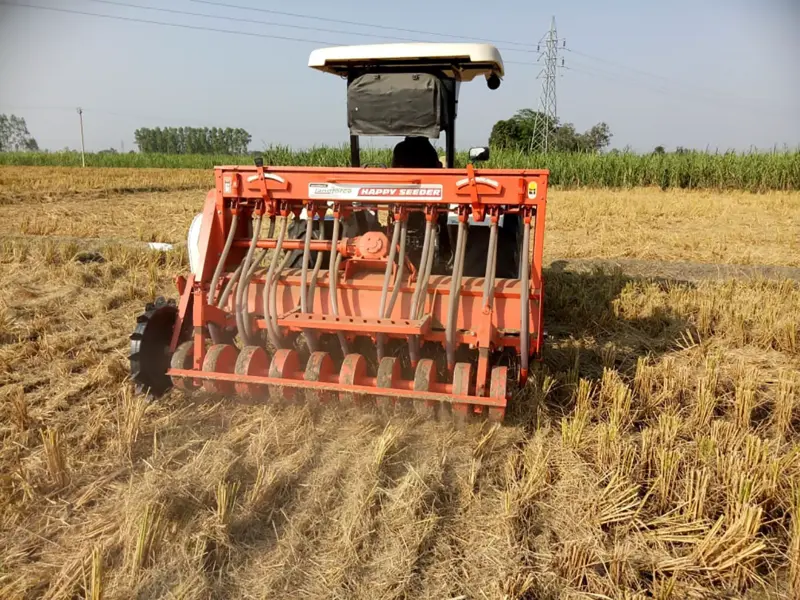

Once associated primarily with paddy management, Crop Residue Management (CRM) machines-also known as stubble management machines such as balers and rakers-have now joined combine harvesters in Punjab's wheat fields, opening new avenues for farmers.
Wheat residue, considered a nutritious cattle feed, is in high demand, and the mechanised collection of straw is transforming what was once seen as waste into a valuable resource.
Farmers can now be seen deploying combine harvesters alongside balers and rakers. While the harvester separates the grain, the stubble management machines quickly prepare bales and rakes, enabling efficient storage and sale of wheat straw.
Entrepreneur Sukhbir Singh Dhaliwal, who pioneered the stubble-to-energy model through his start-up Farm2Energy in 2016, said, "Stubble is not waste; it is wealth."
He added that farmers are building permanent sheds to store wheat straw, as traditional conical mounds (kupp) have become expensive to maintain due to rising labour costs.
Despite these innovations, farm fires remain a challenge. The Punjab Pollution Control Board (PPCB) reported over 10,000 wheat residue burning incidents last year. Data shows 14,511 cases in 2022, 11,355 in 2023, and 11,904 in 2024.
PPCB Chairperson Reena Gupta expressed optimism that the number of farm fires from Rabi crop residue may decline significantly this year, citing a sharp fall in stubble-burning cases during the Kharif season-down to 5,114, a 54 per cent drop from the previous year.
PPCB data also shows that stubble-burning cases during the Kharif season witnessed a steady decline, falling to 10,909 in 2024 from 36,663 in 2023 and 49,922 in 2022.
From 2018 to 2024, Punjab spent Rs 1,680 crore on subsidies for stubble management machines, while the Centre provided Rs 3,600 crore to Punjab, Haryana, Uttar Pradesh, and Delhi.
In Punjab alone, 1.48 lakh CRM machines have been distributed on subsidy, including 62,000 super-seeders over the past seven years.
Harminder Singh, Director of the Gadri Baba Dulla Singh Giani Nihal Singh Foundation in Jalaldiwal, Ludhiana, who runs a custom hiring centre, said that the mechanisation of wheat residue management could significantly reduce farm fires if adoption continues to rise.
He cautioned that awareness, affordability, and timely availability of machines remain critical to sustaining progress.