
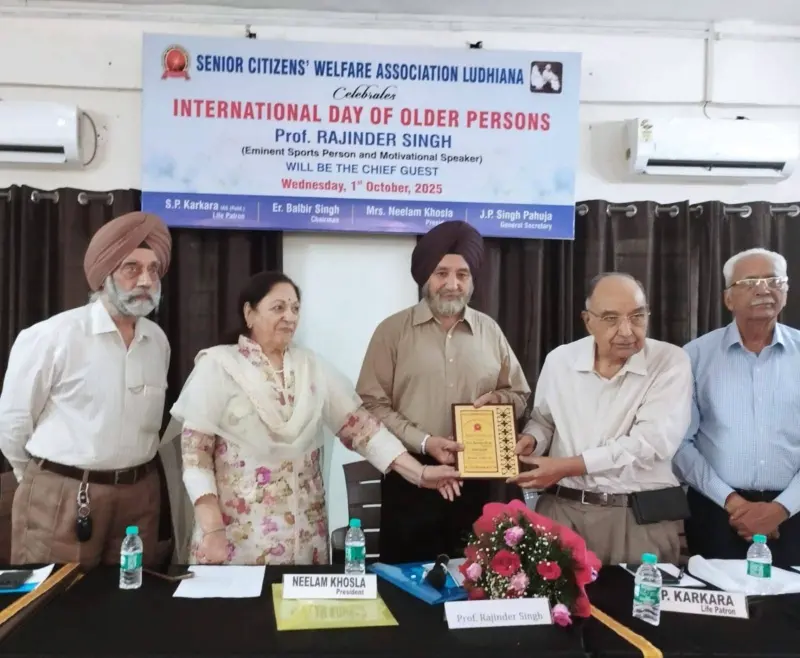

In an era where success is often measured in personal milestones, Prof Rajinder Singh Gill stands apart as a rare individual who has carved an extraordinary legacy spanning sports, education, social service and spirituality.
With a career marked by excellence and dedication, he is widely respected as a pioneering figure in Indian cycling and as a committed academician.
Prof Gill completed his matriculation from the Government High School, Pehowa (Haryana), and went on to pursue master's degree in physical education from the Government College of Physical Education, Patiala. He also did a certificate course in athletics from the National Institute of Sports (NIS), Patiala, and later registered for a PhD, reflecting his continued commitment to academic growth.
A distinguished sportsperson, Prof Gill represented India at the international level and set national benchmarks in cycling. He created national records in the junior section during the 1971 National Cycling Championship and went on to set a new record in the senior category at the 31st National Championship held in 1974. Remarkably, it was the only record across all four sections in that meet.
Over his illustrious career, Prof Gill won 35 medals in various national, inter-state and inter-zonal championships. In a unique feat in Indian cycling history, Prof Gill secured six medals in both junior and senior national championships while riding a standard Atlas cycle -an achievement rarely matched over the past century.
Professionally, Prof Gill (75) retired as head of the Physical Education Department from Gujranwala Guru Nanak (GGN) Khalsa College, Ludhiana, after 37 years of distinguished service.
Retirement did little to slow Prof Gill's commitment to his institution and students. After serving as head of the Physical Education Department, he chose to continue guiding young minds for three more years - accepting a purely symbolic honorarium of just Re 1 per month.
His colleagues recall that for Gill, playground was never a workshop, but a space of purpose and passion. "His decision to remain actively involved even after superannuation reflected a rare sense of duty and emotional bond with the college." they said.
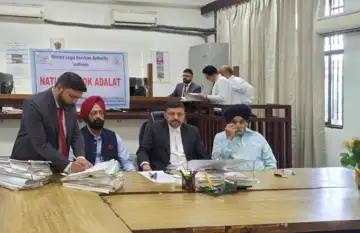
Prof Rajinder Singh Gill attends the National Lok Adalat proceedings as a member of the Marriage Dispute Cell in Ludhiana.
"At a time when most step away, Prof Gill stepped forward, mentoring students, shaping athletes and upholding the values he had championed for decades. His post-retirement years were not an extension of service, but a reaffirmation of his lifelong dedication to education and sport-a legacy that continues to inspire generations," said Prof RP Singh and Prof Manjit Singh Komal, both former principals of GGN Khalsa College.
Prof Gill's trainees speak highly of him, crediting his disciplined approach, personal mentorship and ability to inspire confidence both on and off the field.
Former international cyclist and captain of Indian team Pardeep Singh Sandhu, currently posted as SP in Abohar spoke of him with deep respect, remembering a mentor who shaped not just players, but character, discipline and lifelong values.
Another trainee Jagpreet Singh, DSP, Mohali, an international cyclist, described Prof Gill as a strict yet caring mentor whose influence extended far beyond the playing field.
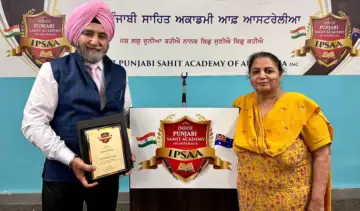
Prof Rajinder Singh Gill being honoured by the Indoz Punjabi Sahit Academy, Brisbane, Australia.
Prof Gill played a pivotal role in popularising cycling in North India. Through Prof Gill's efforts, the sport was introduced in six major universities teams with him as coach during their debut appearances in All India Inter-University Competitions. These included Panjab University, Chandigarh; Punjabi University, Patiala; Punjab Agricultural University, Ludhiana; Guru Nanak Dev University, Amritsar; Punjab Technical University, Jalandhar, and Kurukshetra University, Kurukshetra.
Highlights of Prof Gill's illustrious life
Prof Gill served as secretary of the Cycling Club of Panjab University, Chandigarh, for an impressive 31 years (1981-2012).
An active scholar, he presented research papers at national and international platforms. His paper on "Indo-Pak relations and strengthening the ties" presented at a national political science conference, received the best paper award along with a standing ovation.
Prof Gill also earned acclaim at the 9th World Punjabi Conference organised at the Punjabi University, Patiala, where his paper on "Baba Nanak: The scientific aspect of Anhad Naad in Gurbani" was adjudged the best among all presentations.
Prof Gill has been deeply involved in social service. His association as a counsellor with the Ludhiana Police in the Marriage Dispute Cell for 20 years has played a key role in resolving over 3,000 cases, helping families rebuild their lives.
He has also been active in teachers' unions, serving twice as president of the Ludhiana District Teachers' Union and twice as secretary of the Punjab and Chandigarh College Teachers' Union.
Through decades of public speaking, a sought-after speaker Prof Gill has delivered hundreds of lectures on Gurbani, health and motivation across India, the United Kingdom and Australia. His outreach has now extended to digital platforms, where his YouTube channel, "Spirituality, health and happiness," features around 40 videos extending his message on spiritual and physical wellness.
He also played a prominent role in sporting events, serving as Master of Ceremonies at the 31st National Games in Ludhiana in 2001 alongside renowned Hindi commentator Jasdev Singh.
Prof Gill single-handedly pursued and won a case in the Supreme Court against the Punjab Government, with the support of noted senior advocate PP Rao. The verdict proved to be a landmark, becoming a reference case that enabled nearly 30,000 individuals to secure gazette officers posts across Punjab and other states.
Prof Gill's struggle for the rights of sportspersons dates back to 1977, when he successfully pushed for reforms in recruitment policies. His efforts compelled the Directorate of Public Instruction (Colleges), Punjab, to adopt a new selection methodology for lecturers in physical education.
Notably, Prof Gill personally drafted the revised selection criteria while engaging directly with senior officials. The reform ensured that sportspersons received due recognition in recruitment processes - a model. This progressive model was later replicated by several other states, opening doors for thousands of athletes to secure government jobs.
From achieving sporting excellence and shaping recruitment policies to winning landmark legal battles and guiding people on spiritual paths, Prof Gill's life is a powerful narrative of purpose-driven living.
In every sphere he has touched - sports, education, law, spirituality and social service. His contributions have left a lasting imprint, making him not just a personality of achievements, but a true architect of change and inspiration.