

The Union Budget 2026-27 has placed Chandigarh on a tighter fiscal footing, with the Union Territory receiving a lower allocation than the current financial year despite pitching for a substantial hike to meet growing urban and social sector demands.
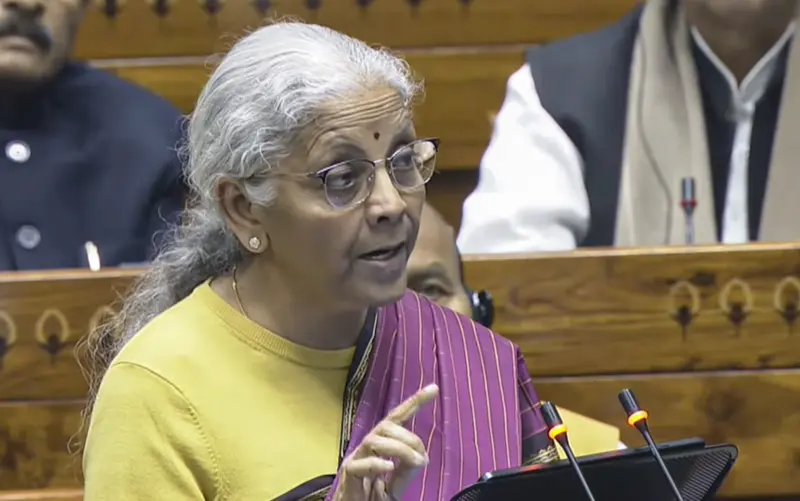
Presented by Finance Minister Nirmala Sitharaman in Parliament, the Budget pegs Chandigarh's allocation for 2026-27 at Rs 6,545.52 crore, a reduction of Rs 437.66 crore from the Budget Estimates of Rs 6,983.18 crore for 2025-26.
The cut comes against the backdrop of an aggressive demand by the Chandigarh Administration, which had sought an additional Rs 1,396.63 crore, taking its total requirement to Rs 8,379.81 crore, to fund projects in health, education, transport, and urban infrastructure.
Even a scaled-down internal estimate of around Rs 7,500 crore did not find favour, forcing the administration to recalibrate its plans.
At the top level, the Centre has defended the broader Budget direction. Punjab Governor and Chandigarh Administrator Gulab Chand Kataria described the Union Budget as forward-looking, saying it presents "a clear and strong roadmap towards the goal of 'Viksit Bharat @2047'."
His remark underlines the Centre's emphasis on long-term national priorities, even as local administrations grapple with year-to-year fiscal constraints.
A deeper look at the Chandigarh numbers, however, reveals why concerns persist on the ground. Revenue expenditure for 2026-27 has been fixed at Rs 5,939.52 crore, down from Rs 6,185.18 crore in the current fiscal, while capital expenditure - critical for development works and asset creation - has been cut sharply from Rs 798 crore to Rs 606 crore.
This reduction in capital outlay is widely seen as the most serious implication of the Budget, with likely spill-over effects on infrastructure projects, hospital expansion, school upgradation, and urban development works.
The Finance Ministry has pointed to a major structural change to explain part of the apparent contraction. Following the privatisation of the UT Electricity Department, the allocation under the energy sector has been slashed from Rs 877.39 crore in 2025-26 to Rs 156.95 crore in 2026-27, an adjustment of Rs 720.44 crore.
After factoring in this change, officials argue that the 2026-27 estimates actually reflect a net increase of Rs 282.28 crore, or 4.63 per cent, over the adjusted base. Yet for most departments, the practical comparison remains with last year's higher spending envelope.
Sector-wise, education has emerged as the biggest beneficiary, accounting for 19.79 per cent of the total budget with an allocation of Rs 1,295.38 crore. Housing and urban development follows with Rs 1,127.95 crore, police Rs 970.53 crore, health Rs 955.41 crore and transport Rs 459.51 crore. While these allocations signal continued emphasis on core public services, the thinner capital budget could slow the rollout of new projects.
On the political front, Congress MP Manish Tewari was quick to link the cut to administrative performance. He pointed out that Chandigarh failed to fully utilise its allocation in the current year, arguing that underspending weakens the UT's case before the Centre.
According to him, the reduced outlay for 2026-27 is less about fiscal prudence and more about a lack of focus and execution, with direct consequences for infrastructure, healthcare, and public services.
The Aam Aadmi Party struck a sharper note. Senior leader Prem Garg termed the reduction a "clear and worrying rollback of support" to Chandigarh, warning that the steep cut in capital expenditure would directly affect the quality of life of residents. He argued that a growing city with rising demands in healthcare, education, and transport cannot afford shrinking development funds and urged the Centre to revisit the allocation.
Amid the cuts, one clear relief measure has emerged for the cash-strapped Municipal Corporation of Chandigarh. Grants-in-aid to the MC have been enhanced significantly from Rs 625 crore in 2025-26 to Rs 850 crore in 2026-27 - a jump of 36 per cent.
The higher grant is being seen as a welcome step that could help the civic body stabilise its finances, meet routine expenses, and sustain essential civic services.
Taken together, the Union Budget leaves Chandigarh walking a fiscal tightrope. Compared to the current year, the administration will have less room to manoeuvre, particularly on development spending, even as expectations from citizens continue to rise.
While the Centre underscores its long-term vision under 'Viksit Bharat @2047' and has offered targeted relief to the Municipal Corporation, the immediate challenge for Chandigarh will be sharper prioritisation, better utilisation of funds, and demonstrable outcomes - if it hopes to strengthen its case in future Budgets.
Chandigarh Budget: Current vs Next Fiscal (Rs crore)
Financial Year Total Budget Revenue Capital
2025-26 6,983.18 6,185.18 798
2026-27 6,545.52 5,939.52 606
Grant-in-Aid to MC: Rs 625 crore (2025-26) → Rs 850 crore (2026-27) (+36%)