





Going by its history, location and the vibrant local culture, the Venice Biennale is the mother of all biennales. In spite of the controversy regarding the participation of Israel and Russia due to the ongoing wars, the subsequent resignation of the awards jury, the European Union pulling its financial support, the withdrawal of 100 artists from awards consideration, and a 24-hour strike forcing 27 of 100 pavilions to either partially or fully shut down, the Biennale refuses to lose its lustre.
I, for one, feel political decisions should not be allowed to interfere with art, literature, sports or other cultural events. On the contrary, efforts should be made to ensure the participation of conflicting nations in order to create possibilities for better understanding, and help build bridges among people already suffering at the hands of rogue politicians.
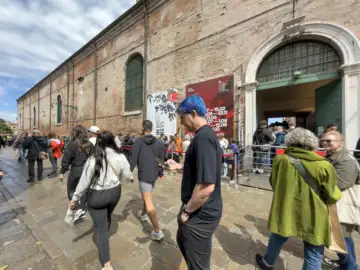
Visitors at Arsenale, one of the two main biennale venues. Photo by Diwan Manna
Even though most of the regular crowd of art aficionados, curators, gallerists, museum directors, journalists, collectors and artists had left after the preview from May 6 to 9, the venues at the Biennale, which continues until November 22, were bustling with visitors.
Themed 'In Minor Keys', this year's Biennale had tragically lost its curator, Koyo Kouoh, in May 2025. Despite this loss, its central exhibition was realised according to her curatorial vision.
Exploring the themes of transnationalism, Afro-Atlantic histories and community building, the main curated section is represented by 110 artists. The Biennale is further enriched by 99 national pavilions representing more than 100 countries - with 29 at Giardini, 25 at Arsenale and 45 scattered throughout the city.
Visiting the Venice Biennale is an experience of a lifetime. Surrounded by architectural beauty, combined with gondolas and vaporettos, meandering through the narrow pebbled pedestrian alleyways called calli, alongside canals and overbridges, amid the aromas of restaurants, bars and cafés, one suddenly finds a signboard announcing a national pavilion or a collateral exhibition. Much of Venice is dotted with these special exhibitions.
As is the case with most art events, it is always a mixed bag; some works challenge your senses, while many others are versions of what you have already seen somewhere, at some point of time. Stagnation permeating art events is a bitter pill that regular visitors have to swallow.
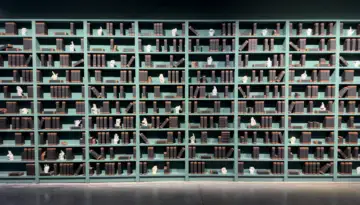
Kemang Wa Lehulere's 'I Bleach My Words for Your Comfort' is an allegorical library. Photo by Diwan Manna
This Biennale has its share of surprises. The pavilions from Malta, Austria, India, Egypt, Britain, Finland-Norway-Sweden (combined), Saudi Arabia, Morocco and Italy were exceptional in both the selection of their artists and the display and curatorial interventions.
The talking point is a show at the Austrian Pavilion, due to its unusual and daring approach to both content and presentation. It features 'Seaworld Venice' by choreographer Florentina Holzinger. The pavilion has been transformed into a closed-door ecological system. The work explores the intersection of the human body, rising sea levels and environmental crisis. Here, a bare-bodied performer is suspended upside down inside a large bell. In another work, visitors are encouraged to use toilets that filter human waste and feed the filtered water into a large glass cubicle in which a bare-bodied performer spends hours.
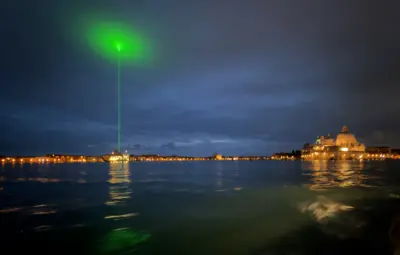
In another monumental public art installation, 'Higher Power', British artist Chris Levine projects a glowing green laser beam into the night sky over the Venice Lagoon, transforming the Venetian skyline. The artist's core artistic philosophy - Make Light, Not War - serves as a beacon of hope, unity and contemplation amid rising global tensions, encouraging people to look up rather than down at their screens or at conflict. The collateral exhibition 'Fondazione In Between' presents eight video projects titled 'Canicula'. It draws from the idea of extreme light and heat, a metaphorical framework subjecting people, matter and ideas to intense pressure, suggesting that image overload, information distortion, memory saturation, abuse of power and oppressive temperatures are pushing societies - and the Earth itself - to the brink of collapse.
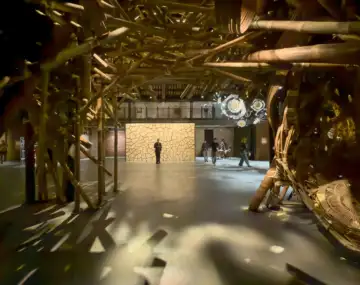
India Pavilion returns to the Biennale after a seven-year hiatus. Photo by Diwan Manna
While Sohrab Hura and Himali Singh Soin represent India in the main curatorial section, India Pavilion returns to the Biennale after a seven-year hiatus. Presented by the Ministry of Culture, in partnership with the Nita Mukesh Ambani Cultural Centre and Serendipity Arts Foundation, a show titled 'Geographies of Distance: Remembering Home' features five artists - Alwar Balasubramaniam, Asim Waqif, Ranjani Shettar, Skarma Sonam Tashi and Sumakshi Singh. Curated by Amin Jaffer, this is one of the must-visit pavilions. However, one does feel that, as one of the larger economies, India can now afford a bigger pavilion, allowing artists and the curator greater scope for innovation in both selection and display.
An immersive exhibition of Nalini Malani's works, presented by the Kiran Nadar Museum of Art, is a must-see. 'Archivio', at Archivio di Stato, is Dayanita Singh's showcase of her photographs, curated by Andrea Anastasio. I also saw a large and intriguing installation by Reena Saini Kallat at another collateral exhibition at Abbazia di San Gregorio, Dorsoduro. Anish Kapoor is hosting a monumental exhibition at Palazzo Manfrin. Two important multimedia installations by Amar Kanwar are being presented by Pinault Collection at Palazzo Grassi.
At the last Biennale in 2024, India had two collateral shows worth seeing. One was an immersive experience of MF Husain's works by the Kiran Nadar Museum of Art, and the other featured paintings and sculptures by Madhvi and Manu Parekh, supported by Dior.
In biennales and triennales, every country seems to be competing with one another to display its soft power, which, unfortunately, we do not seem to have realised. It would be appropriate to expect the Ministry of Culture to reinvent and restart Triennale India, first held in 1968, with a large number of countries participating. The 11th, and last, Triennale India was organised in 2005. Successive governments have ignored, or willfully avoided taking interest in this prestigious art event organised by the Lalit Kala Akademi every three years.
Is it not time that India became a part of the global story once again?
- The writer is an eminent artist and cultural administrator based in Chandigarh