
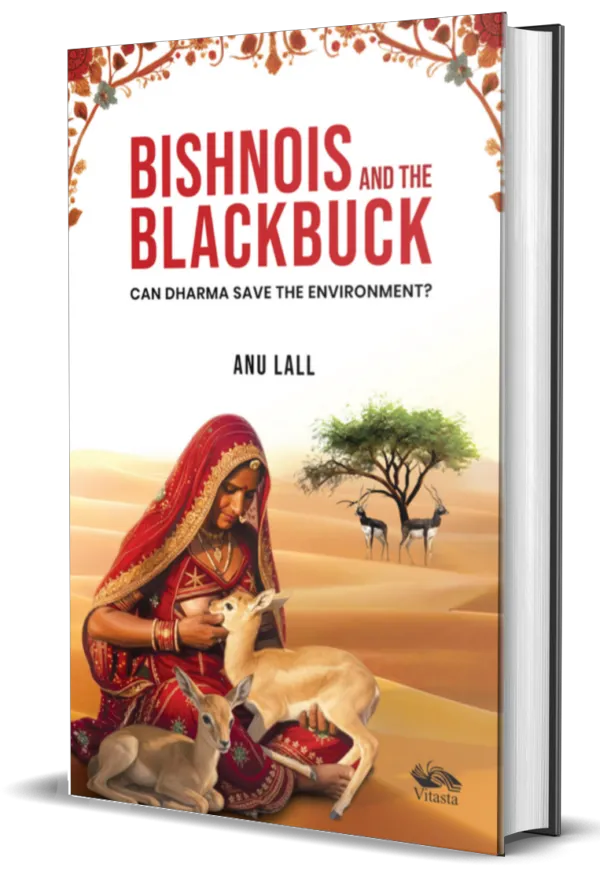

Anu Lall's 'Bishnois and the Blackbuck: Can Dharma Save the Environment?' tells the remarkable story of a community that turned faith into the world's longest-running conservation practice.
Excerpts:
The Rise of Lawrence Bishnoi
Another development that has unexpectedly brought the blackbuck case back into public memory is the rise of Lawrence Bishnoi. Bishnoi, charged in more than twenty cases ranging from attempt to murder, carjacking, and extortion to violations under the Arms Act in the Punjab-Haryana belt. He insists that he is being falsely implicated. He has issued a threat to actor Salman Khan, warning, "We do not have any enmity with anyone, but whoever helps Salman Khan, keep your accounts in order".
For many, this was the moment when the once-quiet name of the Bishnoi community was catapulted into the national spotlight once again, though under very different circumstances from their traditional association with ecology and non-violence.
Within the Bishnoi community itself, Lawrence Bishnoi's persona has become polarising. He is, at once, a symbol of defiance and a source of discomfort. During my travels, a young taxi driver, barely in his twenties, spoke with disarming conviction in Lawrence's defence. He saw him as a man delivering instant justice. His words revealed an undercurrent of generational frustration.
But not all Bishnois share that sentiment. Many elders, while empathetic to Lawrence's anger, are deeply uneasy with his methods. Some have urged Salman Khan to apologise for the alleged killing of the blackbuck; others argue that the matter belongs squarely to the courts, cautioning against taking justice into one's own hands. The community today stands divided - not over its core beliefs, but over how those beliefs should manifest in a world where law, celebrity, and emotion collide.
This division is telling. It reveals how even a shared moral compass can fragment under the pressure of modernity and media narratives. The spiritual philosophy of the Bishnois, rooted in compassion, restraint, and ecological guardianship - finds itself interpreted in starkly different ways: one invoking patience and legal process, the other claiming to act as nature's avenger.
In documenting this case, I have consciously chosen to step away from personality cults. The aim here is not to romanticise or vilify individuals, but to return to facts, law, and the deeper essence of Bishnoi thought. The community's legacy - born from Guru Jambheshwar's teachings within the larger frame of Sanatan Dharma - is not merely about protecting trees and wildlife. It is about sustaining the moral ecology of balance: between man and nature, justice and humility, passion and peace.
Poaching for Pride and Profit
While the celebrity cases drew intense media attention, poaching in India is a deeply human behaviour - wrapped in pride, tradition, and now, profit. For centuries, hunting wasn't merely about survival, but was a symbol of status and masculine prowess. Kings went on grand shikaar expeditions, flaunting their trophies, stuffed heads of blackbuck and deer, and tiger hides adorned palace walls. The meat from these hunts graced royal banquets and wedding feasts, a delicacy reserved for the elite.
Remnants of these beliefs persist even today. Animals like the blackbuck also have a fair degree of superstition involved. In some parts of India, displaying antlers, horns or animal hides on vehicles is believed to bring good luck - despite the fact that such possession and display can attract punishment.
In 2017, a sting operation exposed how deer meat could be ordered almost on demand, in the Shekhawati belt - covering Sikar, Jhunjhunu, and Churu districts. Hotels and resorts placed direct orders with hunters, turning poaching into a doorstep delivery service for 'exotic' meals.
Incidentally a separate study revealed a concerning decline in the density of Khejri trees in the Shekhawati region. The Khejri tree has a symbiotic relationship with wildlife.
Despite existing wildlife protection laws, enforcement remains weak, often compromised by corruption and apathy.
The demand for illegal game meat is so high that traffickers dealing in deer meat and animals parts make up to Rs 50,000 in profits. Fuelled by false claims that the meat is 'hotter' and more potent than regular meats like chicken or mutton. This dangerous myth continues to fuel the slaughter of these animals. While hotel owners discretely serve meat to clients, poachers cash in further by selling antlers and other body parts to smugglers. What was once a symbol of wildlife protection is now hunted for profit, under a veil of misinformation and greed.
The Impact of Legal Battles
What makes legal battles truly remarkable is their ability to put the spotlight on many aspects: hidden dimensions, unveiling deeper cultural nuances that society may have failed to see. Arguments presented in courts give us a lens to view things much beyond facts, laws, judicial precedents, and proceedings. They illuminate cultural nuances, long-overlooked traditions, and deeply held values. As the years rolled on, the Salman blackbuck case and the Pataudi case to a certain extent, did precisely this. They shone a light on the Bishnoi community, a small community from western Rajasthan - an ecological and spiritual sect largely unknown to most Indians. These cases not only brought national and international attention but also opened a window into the Bishnoi community's extraordinary worldview, while sparking broader conversations about the relationship between celebrity culture, privilege, and accountability in India's legal system.
While the government formally prosecuted these cases, it was the Bishnoi community that remained embroiled in a legal battle with unwavering determination, seeking justice, as protectors of the land and as witnesses in the legal cases. While many key witnesses turned hostile, witnesses like Chhogga Ram Bishnoi and Poona Ram Bishnoi remained firm on their testimony.
During the case proceedings, Chhogga Ram Bishnoi passed away. In the last twenty-six years, Poona Ram Ji has appeared in court over 68 times.
Beneath the media spectacle lies a sobering truth: India's wildlife protection enforcement is fragile. On the one hand, law demands proof beyond reasonable doubt, while on the other, the cases revealed just how difficult it is to meet that requirement. When investigation falters, procedures are delayed, and witnesses withdraw. Over the span of twenty-six years, the nation grew weary keeping track of the legal proceedings, but the Bishnoi community did not relent.
(Excerpted with permission from the publisher)