
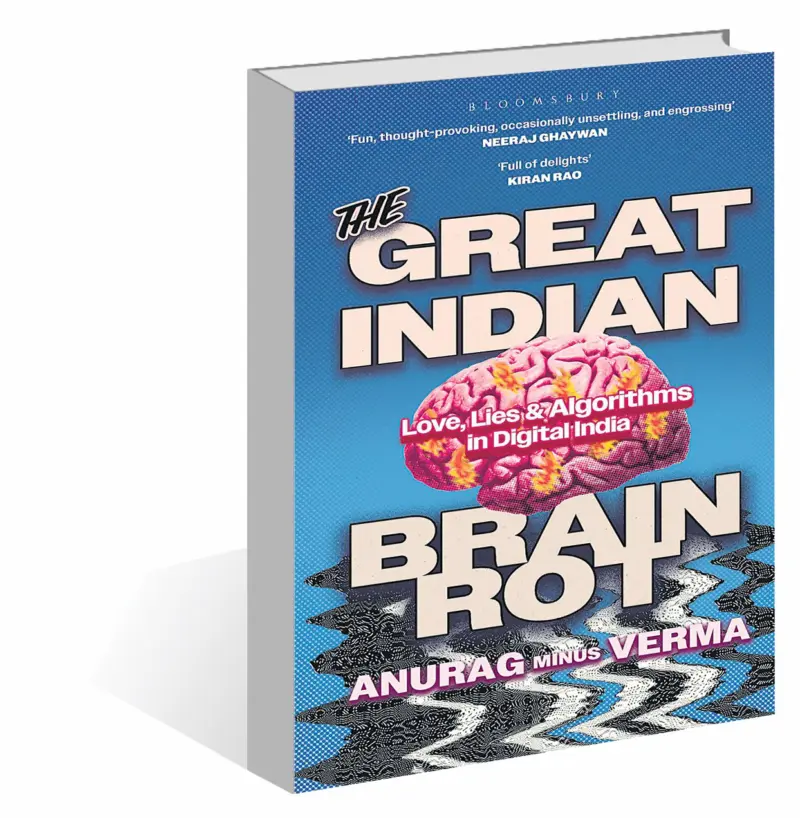

India's Internet didn't arrive as liberation. It arrived as infrastructure, monopoly, and promise, and 'The Great Indian Brain Rot' tries to make sense of that inheritance.
The book is lively, clever, and often painfully accurate about the absurdity of being an online subject in the country. But as the pages accumulate, it becomes clear that the book is not only documenting digital culture, it is shaped by its speed, its saturation, its spectacle, and its ideological blind spots.
The early chapters offer sharp glimpses of India's pre- and post-smartphone life: the cyber cafe with the sticky keyboard, the Orkut scraps and testimonials piling up, the tentative "ASL (age/sex/location)?" and the chaotic retail therapy of viral attention. Anurag Minus Verma writes with affection and embarrassment, and his point that loneliness is not an Internet invention but an inherited condition the Internet merely amplifies is one of the book's most grounded insights.
But the book repeatedly frames the "post-Jio era" as a neat historical turn, almost in the cadence of "post-colonial" or "post-liberalisation". It's a seductive conceptual shortcut, but also a premature one. We are not living after Jio. We're living inside it: inside a telecom monopoly that frames access as benevolence while consolidating data, capital, and influence. To call this moment post anything is to assume we've already metabolised its consequences. We haven't.
Language is another point of friction. The word 'content' appears so relentlessly that it begins to feel like the book is inhaling the same air as the platforms it critiques. Perhaps that's intentional, to show how the human brain has been flattened into marketing categories; but one wishes Verma resisted platform vocabulary instead of repeating it. If the word doesn't already exhaust you, the book may succeed in doing so.
Stylistically, the book leans toward accumulation: adjectives stack, thinkers flicker past, influencers and philosophers share sentences, and citations appear like rapid notification pings. There are moments when reading feels like scrolling a very ambitious internal feed that's restless, often packed with references but reluctant to dwell. It reflects a familiar neoliberal impulse that naming is equivalent to understanding. But many of the thinkers, platforms, and cultural figures invoked deserve more than a mere few words. They deserve analysis rather than cameo.
The chapter on podcast culture demonstrates this tension. Verma identifies the rise of the podcast bro: confident, male, often under-researched, yet algorithmically amplified. The observation is painfully accurate, but the critique stops short of structure. If India treated speech as a public good rather than a commercial playground, we would have strong public radio, cultural funding, media literacy, and editorial ethics - not ring-light sages monetising vagueness. These men aren't the root problem; they're the predictable outcome of a system where platform capital replaces civic infrastructure.
Chapter three, which focuses on the digital caste battlefield, is the book's intellectual core. Verma rightly argues that caste hasn't disappeared online, as it has mutated into fandom, virality, and algorithmic pride. Yet here, too, gendered absence is glaring. Women do appear in the book, but tellingly as spectacle, as national targets or, much later, in the penultimate chapter, as educators harassed and dissected by the male gaze of the feed. They exist in the text, but only as memes, cautionary tales, or labour. Never as architects, narrators, or theorists of digital culture. The book inadvertently mirrors the system it critiques: men perform and accumulate; women remain extractive surface.
The book is compelling, funny, and sometimes piercing, but flirts with critique rather than committing to it. It names the chaos without fully tracing the systems of capital, caste, platform governance, and patriarchy beneath it. It gestures toward power, but too often lets the algorithm remain the story rather than the machinery behind it.
Still, 'The Great Indian Brain Rot' matters. Not because it solves the question of what India's Internet has become, but because it reveals how urgently the question needs to be asked. If this is brain rot, the antidote will not be faster commentary, but slower thinking, public infrastructure and power redistributed away from the feed.
- The reviewer lives and works in Manchester, UK