
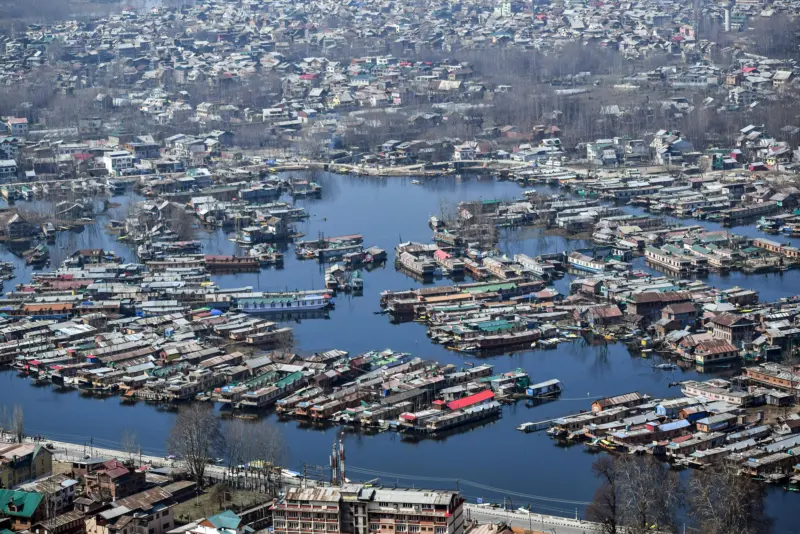

In a major ecological warning linked to fragmented governance and unchecked land-use changes, 518 out of 697 lakes in Jammu and Kashmir have either disappeared or witnessed a significant reduction in their area, according to a report by the Comptroller and Auditor General (CAG).
The report, citing data from the J&K Ecology, Environment and Remote Sensing Department (EE&RSD), noted that the total lake area in the Union Territory has declined by 2,851.26 hectares compared to the base year of 1967. The reference year for this assessment was 2014 for the Kashmir division and 2020 for the Jammu division.
Of the total lakes, 315 (45 per cent) covering 1,537.07 hectares have completely disappeared from official records. These include 80 lakes under the jurisdiction of the Forest Department and 235 under the Revenue and Agriculture departments.
The report warned that the disappearance and shrinkage of 518 lakes have led to ecosystem degradation, loss of water resources, food and biodiversity, and disruption of carbon, nutrient, and water cycles-heightening climate vulnerability in the region.
It further highlighted that shrinking lake areas contributed to the devastating floods in Jammu and Kashmir in September 2014, as lakes act as natural flood buffers. Studies by various state, Union Territory, and national-level institutions have also linked changes in land use of lakes to increased flood risk.
Titled "Conservation and Management of Lakes in Jammu and Kashmir for the period ended March 2022," the report was recently tabled in the J&K Legislative Assembly.
The report noted that administrative control of lakes in the region is spread across five departments-Forest, Revenue, Agriculture, Housing and Urban Development, and Tourism-leading to fragmented management.
The primary causes for the disappearance and shrinkage of lakes were identified as land-use changes within lakes and their catchment areas. Other contributing factors include deforestation, climate change, and altered catchment dynamics. The audit also pointed to deficiencies in conservation and management practices.
According to the report, government conservation efforts were limited to only six lakes-Dal, Wular, Hokersar, Manasbal, Surinsar, and Mansar-which were examined in detail. For the remaining 691 lakes, the Forest Department neither identified eligible water bodies nor formulated plans to seek assistance under schemes of the Ministry of Environment, Forest and Climate Change (MoEF&CC).
It also noted that only about one per cent (Rs 560.65 crore) of the J&K CAPEX budget between 2017 and 2022 was allocated to these six lakes.
The audit flagged several issues affecting Dal Lake, including land-use changes due to non-acquisition of land from dwellers, malfunctioning sewage treatment plants (STPs), ineffective de-weeding mechanisms, and inadequate monitoring and surveillance.
The CAG has recommended the establishment of a centralised and specialised authority equipped with adequate resources to ensure coordinated, accountable, and effective lake conservation and management. It also called for the deployment of skilled manpower, including environmental and hydrological engineers, wetland ecologists, limnologists, remote sensing and GIS specialists, ornithologists and microbiologists.