




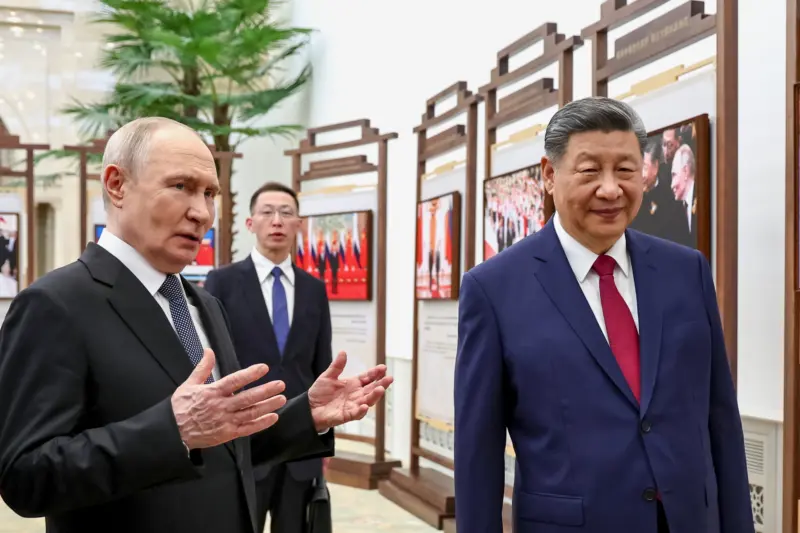

IN the past week, Beijing has stood at the centre of a geopolitical vortex as it received back-to-back visits by US President Donald Trump and Russian President Vladimir Putin.
While the American President’s visit was known well in advance, the timing of the Russian President’s visit was revealed only days before it took place. But there was a difference in the summits. While the one with Trump was about managing tensions between the US and China that peaked in 2025, the Putin visit was about demonstrating the close ties between the two countries.
But what the visits could be indicating is a new triangular dynamic between the world powers. China and Russia have issues with the US and they said so in the Xi-Putin summit, but there seems to be no mood for any two against one kind of collaboration that was a feature of the Cold War.
What they seemed to be seeking is a shared agenda between them, such as energy supply, cooperation in Arctic development, and the military application of AI. This is a result of the changed relationships between the US and Europe and China and the US. Trump actually proposed triangular cooperation against one of his bugbears – the International Criminal Court (ICC). The potential for triangular cooperation extends to cyber governance, outer space security and nuclear stability.
The salient outcomes were not necessarily gas deals (China and Russia) or investment announcements and purchases (US and China). Analysts looking for deals and deliverables after a summit are chasing shadows. Leaders don’t work out deals on the spot. This is often an ongoing exercise by officials delegated for the purpose.
Often, and this happens to be the case this time as well, what the leaders have done is set the political direction and framework upon which the still-emerging US-China reset will rest. Importantly, the main message is already out - after a period of confrontation, the US and China intend to stabilise and manage their relationship responsibly.
The triangular Russia-China-US relationship has zig-zagged through the international landscape in the modern era. They have fought each other (US and China in Korea), been hostile to each other and for brief periods, enjoyed friendship with each other. But they have largely remained wary of each other and have shifted uneasily between engagement and hostility.
In 2017, the US-China engagement strategy was brought to a halt by Donald Trump in his first administration. He blocked China’s key company Huawei and began to systematically deny technology and market access to China to slow its progress. There was talk of decoupling even as the Biden administration doubled down on the Trump policies.
China was the primary target of the US onslaught under the ‘Liberation Day’ tariffs of 2025. This finally persuaded China to use its brahmastra - restrictions on the exports of strategic minerals and magnets. Dependent on these for virtually all modern manufacture, the US folded. A truce was agreed on with a scaling back of the high tariffs and a gradual reopening of the supply of strategic minerals.
This has led to the latest reset in ties that is being shaped, beginning with the May 12-15 Beijing summit between Xi Jinping and Donald Trump.
Both sides put out their readouts and there were comments on what they emphasised and what they ignored from the point of view of the other side. But the important thing was that they did not contradict any of them. In essence, both were giving space to each other to put across their point of view.
So, the US emphasised the importance of investment and trade with China, something underscored by the galaxy of CEOs travelling with Trump. Besides, it stressed the importance of the fentanyl issue and Chinese purchases of US agricultural products. On Iran, they said there was a shared understanding that the Strait of Hormuz be opened without tolls, and that there was joint opposition to Iran possessing nuclear weapons.
As for China, it pitched its goal as the need for a stable relationship with the US and offered a new formulation that it should comprise “constructive strategic stability", whose three elements would be cooperation, managed competition and stability. Its main thrust was on Taiwan, warning that mishandling the issue would upset the whole applecart.
The Beijing summits, whatever its critics may say, represent a significant inflection point in one of the world’s most consequential relationships. The US and China have stepped back from the brink of a full-scale geopolitical rupture that would have shaken global markets and supply chains to their foundations.
As for China and Russia, the challenge was to show that their relationship was demonstrating tangible progress, which has already been proclaimed to be one “without limits." Here, there has been comment about the failure of Moscow to clinch an agreement for a new pipeline that would double the amount of natural gas it sells to China.
There is little doubt that Xi held the best cards. Unlike the other two who are bogged down in wars they want to exit from, China is able to present itself as a factor for global stability and an economic powerhouse. Not surprisingly, even as the US-China entente seemed to hold the potential for the so-called G-2 status where the two emerge as the main global players, the joint statement with Russia emphasised that the new type of relationship that China is looking for is multipolar. Indeed, in their joint statement from Beijing, the two countries denounced “attempts by a number of states to single-handedly manage world affairs."
History has shown that relations between Russia, the US and China are prone to sudden reversals. But for now, they appear to recognise the obvious - that in an already turbulent world, a managed and stable relationships between them is not merely desirable, it is indispensable.