
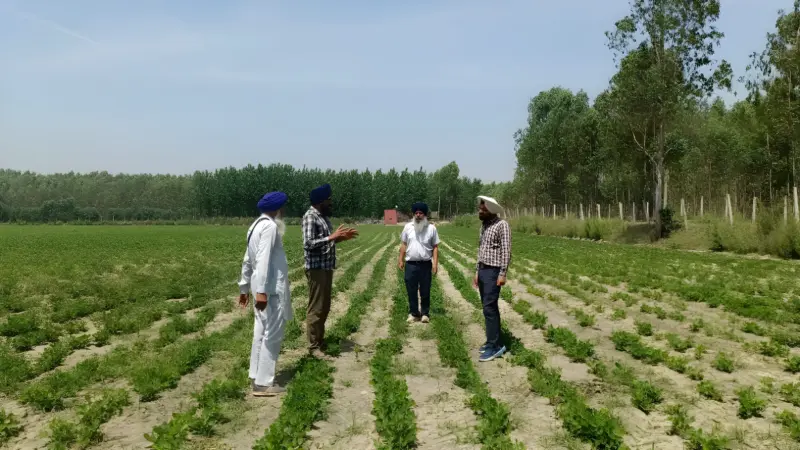

The Community Seed Bank initiative implemented by Krishi Vigyan Kendra (KVK), Kapurthala, under Punjab Agricultural University (PAU), has yielded encouraging outcomes in flood-affected villages, helping farmers restore their cropping systems and strengthen agricultural resilience.
The programme is being actively carried out in villages including Baopur Jadid, Sanghra, Baopur Kadim, and Ahli Kalan, where farmers are benefiting from timely access to quality seeds.
Dr Harinder Singh, in-charge, KVK Kapurthala, highlighted the importance of developing village-level seed banks, particularly for the PBW 872 wheat variety, to revive agriculture in flood-affected regions. He stated that community seed banks play a crucial role in ensuring the availability of quality seeds during critical sowing periods, especially in post-disaster situations.
Under the initiative, community seed banks have been established and strengthened with active farmer participation. These banks function as local repositories of recommended crop varieties, facilitating easy and reliable access to seeds.
Punjab Agricultural University, Ludhiana, distributed 725 quintals of seed of improved wheat varieties (PBW 826, PBW 725, PBW 869, PBW 766, PBW 677, PBW 824, and PBW Zinc 2), and five quintals of canola gobhi sarson (GSC-7) were distributed across seven flood-affected districts, including Gurdaspur, Amritsar, Tarn Taran, Kapurthala, Ferozepur, Fazilka, and Patiala.
Dr Mandeep Singh, Assistant Professor (Agronomy), provided technical guidance on seed conservation practices, including the selection of healthy plants, proper cleaning, drying, and safe storage to maintain seed quality and germination. In addition, Dr Gagandeep Dhawan, Soil Science expert at KVK Kapurthala, advised farmers on balanced and judicious fertiliser use based on soil health status. Systematic soil sampling was conducted in the adopted villages to assess nutrient levels and soil conditions affected by floods.
Based on the analysis, farmers received customised fertiliser recommendations for the PBW 872 wheat crop. Dr Dhawan emphasized that soil test-based nutrient management enhances productivity, reduces input costs, and sustains soil health. KVK scientists have been conducting regular field visits, training programmes, and awareness campaigns to strengthen farmers' knowledge of seed management and improved agricultural practices. The initiative also promotes farmer-to-farmer seed exchange, fostering community cooperation and resilience. The programme has shown positive results in wheat production, with farmers reporting good crop performance. The average yield of PBW 872 has been recorded at approximately 22 quintals per acre under local conditions.
Sharing his experience, Paramjeet Singh, a farmer from Baopur Jadid, said that timely access to quality seeds through the community seed bank enabled him to sow his crop without delay and achieve a yield of around 23 quintals per acre.
Farmers acknowledged that the initiative has significantly reduced reliance on outside seed sources, minimised sowing delays, and improved overall crop outcomes. They are also retaining seed of the new wheat variety PBW 872 for the next season. The initiative has strengthened local seed exchange systems and enhanced community preparedness against climate-related challenges. By ensuring the availability of quality seeds within villages, the Community Seed Bank initiative is contributing to sustainable agricultural development and improving the livelihood security of farmers in flood-affected areas.