
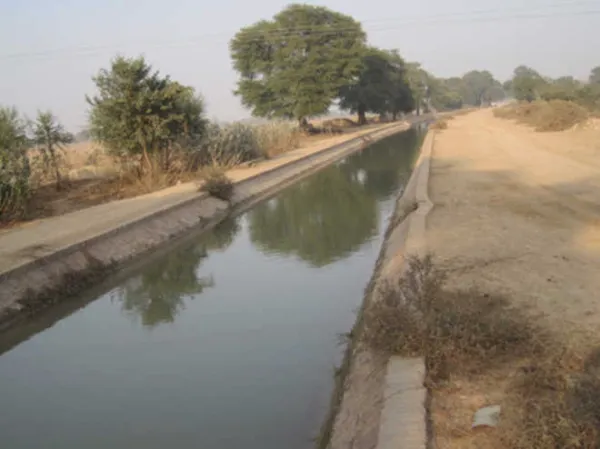

ON December 5, 2025, the Gang Canal quietly completed a century of service - 100 years of water flowing from Punjab to Rajasthan, 100 years of engineering triumph, and most remarkably, 69 years of unpaid bills accumulating to an estimated ?1.1 lakh crore.
What was planned as sneak celebration at Hussainiwala Headworks became instead a cancelled ceremony, a Central minister asked to pack his bags and a stark reminder that some anniversaries are best left unobserved since they open festering wounds.
The irony is almost poetic. A canal that has flowed uninterrupted for a century to become too controversial to commemorate. The water keeps moving, but the celebration stopped in its tracks.
A brief history
The story begins in 1920 when Maharaja Ganga Singh of Bikaner signed an agreement with Punjab for what would become the Gang Canal. It was a visionary project for its time – bringing water from the Sutlej river through Hussainiwala Headworks to irrigate the arid lands of Bikaner. The Maharaja, by all accounts, got this agreement approved at concessional rates from the colonial masters as a reward to services rendered in the First World War, anticipating a partnership that would outlast his own reign.
In 1956, when Bikaner merged into Rajasthan, the successor state did something remarkable: it unilaterally terminated the agreement. Not renegotiated. Not amended. Terminated. And yet, the water continued to flow. Rajasthan discovered what might be called the ultimate loophole – you can cancel the contract but keep the service, provided you are willing to ignore the increasingly frantic invoices.
For nearly seven decades, Punjab has been running what amounts to a massive, state-sponsored charity water service. At current calculations, the unpaid dues stand at approximately ?1.1 lakh crore – a sum that could fund multiple smart cities, transform rural infrastructure, or at the very least, pay for one extremely lavish centenary celebration.
A celebration cancelled
When a Central minister arrived in Punjab to mark the canal’s centenary, he encountered something unexpected: the prospect of uncomfortable questions. Punjab, understandably, wasn’t amused. The decision to cancel was swift, a masterstroke of administrative wisdom. Better no celebration than an awkward one. Better to avoid the Headworks than to face the hard work of addressing historical injustices. The minister’s retreat was less a cancellation and more a tactical withdrawal in the face of mathematical reality. One wonders what the original programme would have looked like. Ribbon-cutting ceremonies while protesters wave unpaid invoices? Speeches praising the neighbouring state’s liberal act while its own farmers calculate compound interest? A commemorative plaque reading: “100 Years of Water, 69 Years of Waiting"?
The larger questions
This incident is more than a cancelled celebration. It represents a fundamental crisis in Indian federalism – how do we resolve commercial disputes when one party simply refuses to acknowledge the terms of engagement?
The Punjab-Rajasthan water dispute exemplifies a troubling pattern. Agreements are signed by one generation, repudiated by the next and the consequences are passed along indefinitely and the greater thirst for more. The rivers, through manmade canals, eventually reach Rajasthan’s territory away from its basin; these bills seem destined to accumulate forever.
Punjab’s grievance is not merely financial, though Rs ?1.1 lakh crore is hardly trivial. It’s about the principle that agreements mean something, that successor states inherit both assets and obligations, and that you cannot simply enjoy the benefits of a contract while disclaiming its costs.
Rajasthan’s position, to the extent it can be discerned through the silence, seems to be a “breach of agreement signed between two states". But if this is so, why has no formal settlement been reached? Why does the dispute fester while the water flows? What accounts for Punjab’s benign silence?
The economics of evasion
Let us consider what Rs 1.1 lakh crore represents. It is more than the annual budget of several Indian states. It is enough to revolutionise Punjab’s agricultural infrastructure, fund comprehensive healthcare and education reforms, or create a sovereign wealth fund for future generations.
Instead, it exists as a ledger entry, growing larger with each passing year, a monument to bureaucratic inertia and political expedience. The interest on the interest alone could probably fund the centenary celebrations for the next century. From an economic perspective, this is less a dispute and more a massive, involuntary loan from Punjab to Rajasthan – interest-free, indefinite-term, and apparently, repayment-optional. No bank would offer such terms. No business would tolerate such an arrangement. Yet, between states of the Indian Union, it persists. It is a shape of new colonial with in the Federal Country.
The Gang Canal will continue its work regardless of whether we choose to celebrate it. Water, thankfully, is indifferent to politics. It flows according to gravity and engineering, not according to the convenience of governments or the comfort of ministers.
But we, who depend on these waters and who inherit these disputes, cannot afford such indifference. The cancelled centenary is a missed opportunity – not just for celebration, but for resolution. It is a reminder that some anniversaries demand not cake and speeches, but honest reckoning and genuine settlement.
As the canal enters its second century, one question persists: Will the 200th anniversary in 2125 mark two centuries of service or two centuries of unresolved conflict? The water will still be flowing. The only question is whether we will finally be ready to face it.
The minister who cancelled his visit did so fearing protests. Perhaps what Punjab – and Rajasthan, and India – need is not the absence of protest, but the presence of dialogue. The centenary has passed in silence. Let us hope the next milestone is not marked by more of the same.
Bigger questions!
1. Apart from the Gang Canal story, 11.2 MAF water from all the three rivers of Punjab flow into Rajasthan via manmade canals. A similar centenary celebration may be in waiting for the Indira Gandhi Canal too. It is not a canal, but full rivers flowing into Rajasthan. The Centre dishonouring its own secret note of January 29, 1955 (Clause 5 ) to make payment to Punjab worth Rs 9.5 lakh crore.
2. Isn’t Punjab state justified to abrogate the 1920 agreement, like Rajasthan did?