

THE idea of Bangladesh is a major polarising factor in India. We expect the entire nation to be grateful to us because our Army liberated them in 1971. And if some among them speak against India and in favour of Pakistan, we are incensed.
For those in the Hindutva camp, Bangladesh’s turn towards Islamic fundamentalism is a sign that religion can never be separated from nationalism and that India truly only belongs to Hindus.
The fact that Bangladesh has twice overtaken us in IMF per capita GDP calculations, including in the latest projections for 2026, is a matter of great shame for people on both sides of the political divide.
For those who oppose the BJP government, it is a sign that India’s economy has floundered during the Modi era. For those who support the BJP, it is an embarrassing data point which has to be explained away through technical arguments about currency fluctuations.
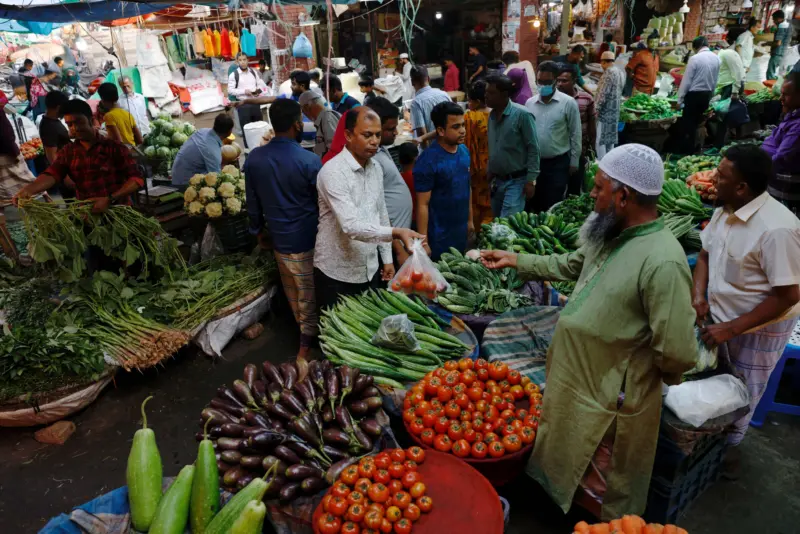
But behind these intense, and often acerbic, disputations over Bangladesh lies one common assumption - that Bangladesh represents the worst economic and social conditions in the Indian subcontinent. In fact, Bangladeshis are derisively called ‘kanglu’ on social media — a variation of the word kangaal or destitute, and there are thousands of reels and memes about how the ‘kanglu’ is still living in the age of bullock carts and mud huts.
Of course, there is a flipside to this: of scholars and activists who point to Bangladesh’s achievements in reducing infant mortality, extending life expectancy, improving access to health and education and even setting up radical systems to enable rural women to get easy loans. But, even here, the starting point is the belief that Bangladesh was far poorer than India, and depending on which side of the political divide you are, it has now crossed us, or else, is still a destitute nation.
Most of this is untrue.
Let us interrogate the point of immediate contention: that the IMF says Bangladesh will cross India in terms of per capita GDP this year. This is not the first time; it happened in 2020 as well, during the Covid recession. However, this comparison is based on a direct conversion of per capita GDP in local currencies to US dollars, using the current ‘market’ exchange rate. This tells us nothing about the actual purchasing power of the money people earn in their local currencies. So, the IMF has a tool called the International Dollar, which adjusts for local inflation and recalculates all data in terms of Purchasing Power Parity (PPP).
When we compare our per capita GDP with that of Bangladesh in PPP terms, we find that an average Bangladeshi will earn 17% less than an average Indian in IMF’s projections for 2026. Now you could say that this reflects badly on us, given that Bangladesh is a ‘kanglu’ nation and India is one of the world’s largest economies. That is a misconception. A look at the IMF’s PPP per capita income data shows us that Bangladesh was actually above us from 1980 to 1993. India moved ahead only in 1994, and it wasn’t till 1999 that the gap between our per capita GDP (PPP) and Bangladesh’s crossed 10%.
In the UPA period (2004-24), our average purchasing power maintained a roughly 18% gap with that of an average Bangladeshi. This trend continued till 2019, and then India’s per capita purchasing power collapsed in the first year of Covid, while Bangladesh’s increased sharply. Once the lockdowns were over, the gap gradually returned to the normal trend. The IMF projects that by 2030, India’s per capita GDP, in purchasing power parity terms, will be 24% higher than that of Bangladesh.
This shows that an average Indian continues to have more or less the same purchasing power advantage over an average Bangladeshi as it had during the time when Manmohan Singh was Prime Minister.
The Modi government has neither done better, nor has it fared any worse. More importantly, it also tells us that our idea of the ‘kanglu’ Bangladeshi is entirely false. Bangladesh’s per capita purchasing power might have trailed that of India’s, but it has been consistently higher than that of large Indian states like Bihar, Uttar Pradesh, Madhya Pradesh, and also West Bengal.
So, where does this image of the destitute ‘kanglu’ stereotype come from? It originates in the Bengali bhadralok ‘imaginary’ that the Muslims of East Bengal, who stayed on in East Pakistan after the Partition, were mostly poor peasants.
This, as the political scientist Partha Chatterjee showed 45 years ago, was largely a myth. In the Muslim-majority divisions of Bengal in 1911, there were more Muslims who earned a living from agricultural rent than there were Hindus. While the share-cropping peasantry was largely Muslim, many from the Muslim community were also big rent receivers.
The real difference between the Bengali ‘bhadralok’ upper-caste Hindu and their affluent Muslim peers lay in access to higher education, professional employment and jobs in the colonial government. It is here that Hindus had a clear advantage, and by the early 20th century, they had become more urbanised, and ‘modernised’ than their Muslim counterparts.
So, the old ‘rustic’ cultural and aesthetic practices, from which the bhadralok Hindu had gradually deviated, continued among the Muslim elite of East Bengal. This continues today in terms of language and attire.
In the post-Partition West Bengal, the Hindu refugees progressively gave up the eastern dialect or ‘Bangaal bhasha’ and the customary lungi. These were seen as ‘plebeian’ symbols not compatible with bhadralok society. Both of these are normal in Bangladesh.
It is these cultural practices of the Bangladeshi, identified as ‘low-class’ on this side of the border, that has fed into the image of the ‘kanglu’ Bangladeshi. The truth is that Bangladesh has never really been a destitute nation, despite its poverty, and there should be no shame if it catches up with us.