




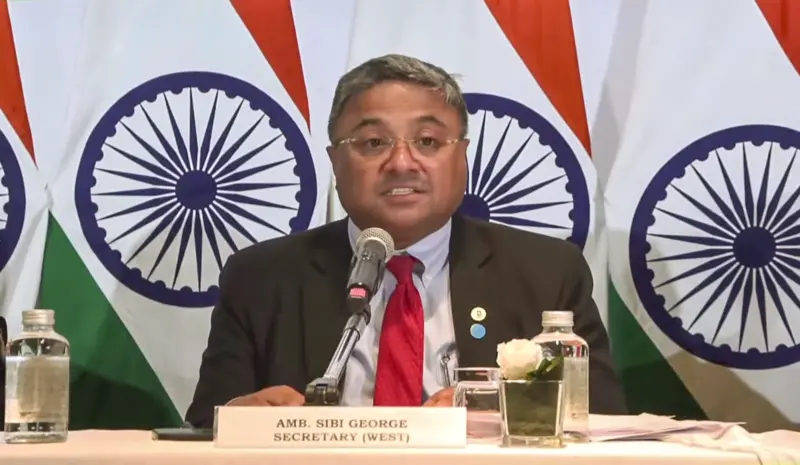

A Norwegian journalist, Helle Lyng, asked Sibi George, Secretary (West) in the Ministry of External Affairs, three questions during his media briefing in Oslo on May 18 - Why should India be trusted?
Can India promise to try to stop the human rights violations in the country? Will Prime Minister Narendra Modi start taking critical questions from the Indian press?
George did well not to answer the query regarding the PM. It is not for a diplomat to dwell on a political leader's way of dealing with the domestic and foreign media. Indian Prime Ministers have had different styles of media interaction. Some like Jawaharlal Nehru, Indira Gandhi and Atal Bihari Vajpayee dealt with the media comfortably and deftly. Others may not have shied away from the press, but they also did not seek it out. PM Modi only deals with the media in carefully curated setups. That is his choice, just as his predecessors made theirs.
Back in May 1981, I witnessed Indira's interaction with the media in Dubai. At the conclusion of her UAE trip, she addressed a press conference. After the journalists had gathered, a UAE official asked me if any of them was likely to cause an embarrassment to their guest; he informed me that the journalist concerned would be removed from the conference before the PM arrived. I said if Indira got to know that I was responsible for a journalist's ejection, I was likely to lose my job!
A British woman journalist from a Western wire service raised a question about the communal situation in India. This was obviously in the context of the Meenakshipuram conversions of 1981 and the distressing Moradabad riots of 1980. Indira responded briefly. Her basic thrust was that communal problems were not unique to India. She then asked, "What is happening in Northern Ireland"? Her words, tone and demeanour did not display any irritation or emotion, but her message to the journalist was firm and clear: don't try to put us on the mat. Instead, look within. There was no follow-up question from the journalist.
The way Indira handled that intrusive and difficult query was a lesson for Indian political leaders and diplomats in responding to such questions and observations.
Sibi George responded to Helle Lyng's first question - Why should Norway trust India? - with a peroration that spelt out the characteristics of a modern state. Thereafter, he asserted that India was a civilisational state whose contributions were visible everywhere. He then gave an account of Indian assistance to the Global South during the Covid pandemic; how India had reconciled competing interests of G20 members during a contentious summit (2023) and how it succeeded in getting the African Union to become a G20 member. George did not stop there; he referred to the 2026 AI Impact Summit in New Delhi, where PM Modi called for "human-centric" AI. He concluded that international trust in India was built through these activities.
Regarding the question about the human rights situation in India, George said, "We are one-sixth of the total population of the world, but not one-sixth of the problems of the world." He emphasised that citizens were guaranteed rights in India's constitutional democracy. They could approach the courts for the enforcement of these rights. He asserted that people had no understanding of India's scale. "They read one or two news reports published by some God-forsaken, ignorant NGOs and come and ask questions. Don't worry about it," he said.
George is an experienced diplomat. Surely, he would have known that he did not have to give such a long response to the "trust" question at a press conference. This is because the Norwegian media, let alone the Scandinavian media, could not have carried it in their reportage of PM Modi's visit. Hence, the inescapable conclusion is that George was trying to show to certain sections in India that he was giving a fitting reply to an impertinent Western journalist who was asking disrespectful questions about the country.
The trend of giving forceful responses to Western journalists was set in motion by External Affairs Minister S Jaishankar soon after he assumed office in 2019. He especially targeted the global liberal media. He wanted to show them the mirror. This appealed to many in India and earned Jaishankar great popularity.
A politician may seek popularity, but that cannot be the purpose of Indian diplomacy. Its purpose is to reach out to foreign opinion-makers through responses during media conferences and other means. Catering to sympathisers of the ruling dispensation in India can never be the primary object of Indian diplomacy.
That can be a product of diplomatic success achieved by India in the comity of nations. Naturally, in articulating the Indian position, diplomats have to resort to plain-speaking sometimes, but their audience must always be external.
This does not mean that Indian diplomats don't have to clarify foreign policy stances and positions to Indian institutions such as parliamentary committees and also to the media. But these situations are entirely different from what George faced at the media briefing in Oslo. Certainly, there is also a place for lectures in which diplomats can be expansive in their explanations, but responses at a press conference have to be worded differently.
Indian diplomats should not forget their basic objectives. They should resist the temptation of becoming the favourites of the faithful in India.