



AMONG the most striking sights of Navratri are the beautifully crafted idols of Goddess Durga; for nine days, they are the centre of devotion and celebration across the country.
An idol or a doll may be small enough to fit in a child's hand, yet it can hold within itself the story of an entire civilisation - its traditions, craftsmanship, cultural beliefs and creative imagination.
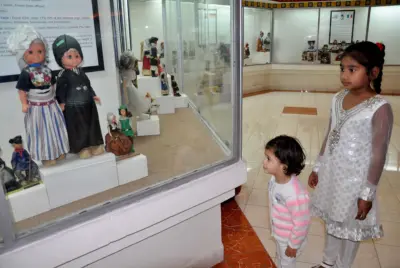
For me, the establishment of the International Dolls Museum in Chandigarh was the fulfilment of an idea that first took root in the 1960s. Later, during my travels around the world as a Rotary International director in the early 1980s, that idea returned with renewed force and a deeper sense of purpose.
I shared the idea with fellow Rotarians, and the Rotary Club of Chandigarh presented the first collection of 65 international dolls. The city administration gave the lot a permanent home at Bal Bhavan, Sector 23, where the museum was inaugurated on December 24, 1985. Among the objects closest to my heart is the German electric model train gifted by an old friend, Martin Gass.
When I became president of Rotary International in 1991-92, my wife Usha and I decided that, instead of accepting the customary gifts offered during our travels and official visits, we would ask for traditional dolls representing the countries or regions we visited. Each doll became more than a souvenir.
In October 1991, I visited the United Nations in New York to take part in a programme to mark 85 per cent worldwide immunisation of children against polio. Former US President Jimmy Carter and then UN Secretary-General Javier Pérez de Cuéllar were among the speakers, while movie legend and UNICEF Goodwill Ambassador Audrey Hepburn was the moderator. At the UNICEF headquarters, I saw a large Japanese Daruma doll, whose one eye is painted when a goal is set and the other when it is achieved. I painted one eye on behalf of Rotary, hoping that a future Rotary president would paint the second when the world was free of polio.
Over the years, I have come to regard dolls as time capsules. Japan's Hina, Russia's Matryoshka, Guatemala's worry dolls and Ukraine's Motanka reflect the heritage of their people.
India, too, has an extraordinary wealth of traditional dolls. Among the most fascinating is the Thanjavur dancing doll of Tamil Nadu. With its brightly coloured attire and gently nodding head, the doll seems almost alive. Another wonderful Indian tradition is found in the dolls associated with Navratri Golu in South India, where families showcase figurines depicting gods, goddesses, kings, dancers, musicians, etc.
Looking back, I could never have imagined that an idea inspired by dolls seen during my travels would grow into a museum that has delighted and educated generations of children. They are not merely toys - they are silent storytellers and cultural ambassadors.
The writer is former world president, Rotary International