





Can third time be the charm, or unnecessary fatigue? As Ajay Devgn's successful 'Drishyam', a remake of Mohanlal's franchise of the same name, races towards a decisive conclusion, it makes a departure too.
In interview after interview, Ajay has claimed that the triquel does not follow the Malayalam original. However, the makers, keenly aware of the truism 'don't change a winning combination', stay with its lead characters and actors.
Director of the second outing, Abhishek Pathak, is firmly in the saddle here as well. Needless to say, it's still the same case in which the police and the parents of the murdered boy had failed to collect any concrete proof against Vijay Salagonkar (Ajay Devgn). So why would they reopen the case? Reason number one unfolds early on. Tabu's Meera Deshpande is on the verge of a mental breakdown and her husband Mahesh Deshmukh (Rajat Kapoor) thinks only closure can bring her peace.
In walks the new SP (Crime), and who better than our hugely talented Jaideep Ahlawat to fit into the shoes of an indomitable police officer, Rajveer Singh Tomar. Trust him, however, to not do a Hathiram encore. The Haryanvi accent is missing but not the chutzpah or the dare. The actor who wowed us with the tale of Dharmaraj Yudhistra and his dog in 'Paatal Lok' comes up with yet another dog story. Effective and pertinent, told by Jaideep in his characteristic style, he never loses us. Nor does it make us miss Akshaye Khanna's act from the previous 'Drishyam' instalment. Besides, who can utter words like gaandiv so effortlessly?
Till the interval, he is the front and centre of the narrative. A face-off between him and Ajay is but obvious and when it happens, it's a bit improbable, a bit filmi. But here, too, he walks away with more than one brownie point to his credit.
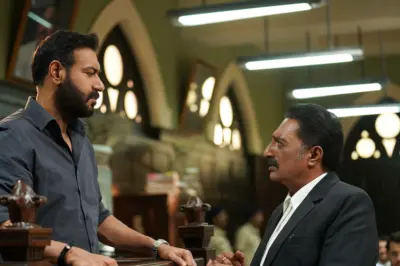
If the first half belongs to him and Ajay, in the second part emerges Prakash Raj, playing an ace lawyer arguing the case on behalf of the aggrieved parents.
On the face of it, there is mounting evidence against Vijay, two solid witnesses too. The question once again is not whether or not this chauthi-pass will hoodwink his adversaries, but how. The kernel of the idea is still the same: the lengths to which a man would go to protect his family.
However, director Abhishek, who is also credited with the story and co-writing the screenplay, along with Parveez Shaikh and Aamil Keeyan Khan, spares us unwarranted flashbacks. He assumes that the audiences walking into cinema halls for the third outing are clued in to the backstory. He infuses freshness by not only introducing two stellar actors, Jaideep and Prakash, but also keeping his prized hero in check. Ajay - restrained, unperturbed and unruffled once again - lets both Jaideep and Prakash enjoy their moments of glory.
Prakash is delectably over the top in the courtroom proceedings but to lend credibility to the film's tenor, he is soon reined in by the judge. Then there is peppering of interesting and relevant humour, with Kamlesh Sawant reprising his part of SI Laxmikant Gaitonde. He reminds us how he is the only permanent member of the law-enforcing machinery while officers before him have come and gone. If like us, you too are misled by Shriya Saran as Nandini and her hapless demeanour, watch her get her moment in the climax.
If Ajay remains in the character all through, the treatment maintains tonal consistency, though one wishes the background music had been toned down. Editing by Sandeep Francis moves between varying areas of action, ensuring tension sustains. Momentum and suspense are maintained, even though we know what will happen in the final scheme of things. Hasn't Murad Ali (Saurabh Shukla) already told us what is common in all of Vijay's stories is that the hero doesn't go to jail. And right up to the moment when the inevitable unveils and details are deconstructed, we are once again entrapped by this kahani of a semi-literate cine buff outdoing a bunch of highly educated people in the echelons of power.
Vijay tells us drishya (what we see) is more important than shabd (what we say), for words imbed lies within. Writing, especially dialogues by Aamil, is solid and packed with intelligent references. There are some loopholes, but 'filmon ka sach hona zaroori nahi, sach dikhna zaroori hai'. We see the cinematic truth through the lens of the makers and enjoy the line between truth and justice whose definition too changes depending upon who is telling the story.
If in the realm of poetic justice, the real gaandiv is not saboot or kanoon; what matters in filmmaking is intent, purpose and execution, very much in alignment here.