

Agricultural drones have taken off globally at remarkable speed over the past five years. Drone diffusion is enabling technological leapfrogging, but are Indian farmers ready to take the plunge?
Where does our government stand in pushing the farmers to ‘adopt’ and ‘adapt’ aerial mapping which helps in ending the guess game by putting forth credible visual patterns that can be acted upon?
Drone mapping makes it easy to identify crop stress, monitor health, analyse irrigation, and optimise fertiliser/pesticide application, reduce chemical use, and ultimately increase yields.
On the ground, farmers are wary because of the cost and economies of scale. The Ministry of Agriculture and Farmers’ Welfare, however, is aggressively pushing for an increased rate of adoption as well as multiple applications of drone technology among the farmers.
“We have been promoting drone technology since 2022 as part of the government scheme on mechanisation of agriculture. State governments have also been requested to promote the same at their respective levels. We are also involved in providing a purchase subsidy to the farmers," a senior official from the ministry told The Tribune.
The Centre’s subsidies on drones are primarily under the Sub-Mission on Agricultural Mechanisation (SMAM) and Namo Drone Didi schemes, offering financial assistance of 40 per cent to 100 per cent of costs or capped at up to Rs 10 lakh.
The subsidies are designed for farmers, women self-help groups and startups to promote precision agriculture and rural employment.
The senior official also said drones are predominantly used for spraying pesticides and liquid fertilisers, but the government is studying the utility of the technology for multiple functionality.
“For instance, we conducted recent studies which showed that drones can be used for feeding fish, application of medicines on waterbeds where humans cannot reach, and for detecting pests and diseases. But these drones will then require high-quality cameras which will increase the cost. The drones we are envisaging are priced at Rs 10 lakh or less," the official noted.
The official added that the multi-use of drones apart from spraying pesticides is still under study.
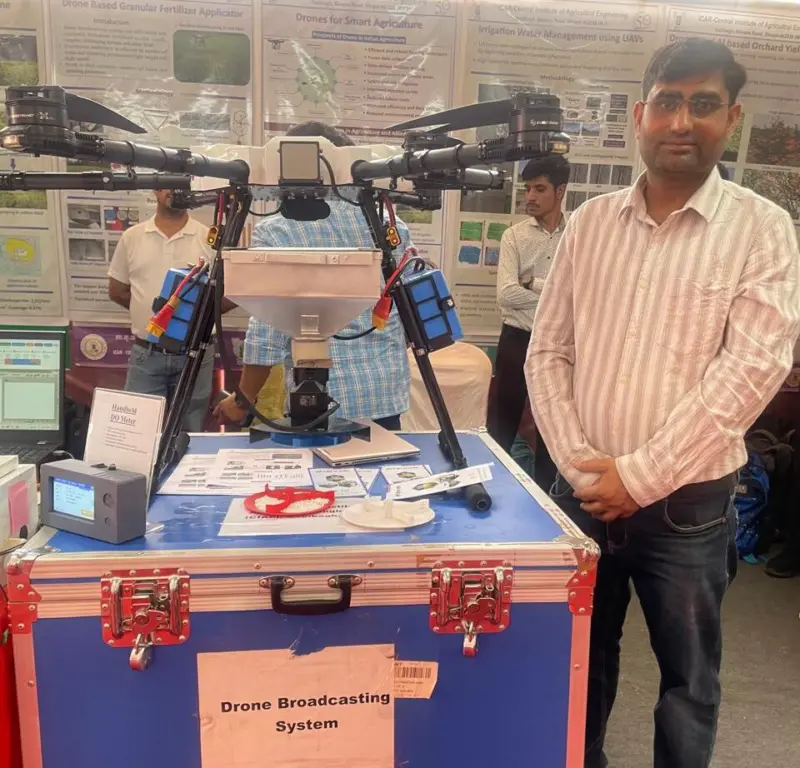
Scientist Satya Prakash Kumar from ICAR-Central Institute of Agricultural Engineering (CIAE), Bhopal said his institute has developed a ‘drone broadcaster’ for uniform broadcasting (or distribution) of urea across the field.
“Drone broadcasters are efficient in uniformly spraying urea in the entire field. Farmers can also customise it according to their needs by replacing the attachments of the drone. More importantly, it can prove crucial in irrigation and water management. It has cameras with powerful sensors that can take the images of crops and a farmer can make an informed decision. He can see which crops are nutrient deficient or need water," he told this newspaper on the sidelines of the recently-held ‘Unnat Krishi Mahotsav’ in Raisen in Madhya Pradesh.
But the question remains if the farmers can afford such an endeavour?
“Given the government’s push for high-tech agriculture, there are many schemes and subsidies in place for farmers who want to give this technology a try. Recently, we demonstrated how to use drones on 500 hectares of land for free in Bhopal. We got many inquiries after the show and farmers in the state of Madhya Pradesh are taking drones on rental basis. Many IFFCO companies are renting out drones and charging Rs 300 per acre," Kumar noted.
The scientist said drones can work wonders for farmers, especially in rainy seasons where it is difficult to recruit labour or get the tractors rolling. Even when it comes to crops like sugarcane, maize, or cotton which grow quite tall, drones are the best bet, he added.
Chandan Kumar from ICAR-CIFRI, Kolkata said local manufacturers need to come forward to scale up the production of drones and make them more affordable to the average farmers of the country.
He added that e-commerce giants like Amazon and Zomato are using drones to deliver food parcels under pilot projects, thus testing the technology in the post-production stage of agriculture as well.