
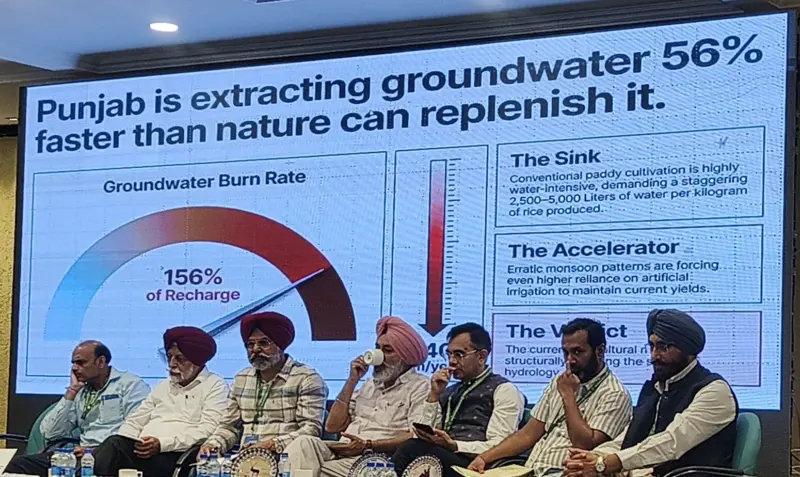

While the Punjab government is patting its back and claiming to provide water for tail-end users by giving a green signal to the 14-point action plan to preserve and replenish groundwater, it turned out that tube wells in neighbouring Pakistan may be pumping out the subsurface water to irrigate the field, thereby failing the efforts to stop the declining water table.
The concern was raised during an international symposium on "Advances in Ecologically Sustainable Rice Cultivation and National Food Security: Unlocking the Potential of Direct Seeded Rice (DSR) in Punjab".
Experts have called for a comprehensive study on transboundary aquifers to assess groundwater extraction and evolve strategies to curb its overuse in agriculture and industry.
Gopal Krishan, a scientist at the National Institute of Hydrology (NIH), Roorkee, said such a study should include neighbouring countries as well as neighbouring states, as groundwater systems transcend political boundaries.
He said the NIH, along with Punjab State Farmers Commission (PSFC), carried out a study in the south-western districts of Punjab that the natural gradient of aquifers is from north to south.
Krishan, who is part of a team studying wells in the border areas of Amritsar, cautioned that if neighbouring regions do not adopt similar water conservation measures, it could undermine efforts being made in India to reduce groundwater depletion.
He stressed the need for coordinated policies and data-sharing mechanisms to ensure sustainable groundwater management across regions.
"There are two kinds of water sources. One which could be seen, like a river, a canal, or ponds. But there is another source of water which cannot be seen. Using isotope hydrology helps us in understanding the life story of water and helps us comprehend the links between different water resources, particularly precious groundwater," said Krishan, while demanding a comprehensive study of water being used by industry.
As per the state government, the water table in the state had been declining at an annual rate of 0.7 metres due to the extraction of 5.2 billion cubic metres of groundwater per year.
As per the official data, 115 of 153 water blocks in Punjab are over-exploited. "However, 17 blocks managed to reverse the trend of falling water tables between 2022 and 2025. Eight of these blocks also achieved a balance between extraction and recharge," said Krishan.
Dr Sukhpal, Chairman of the Punjab State Farmer and Farm Workers Commission, also seconded the study of aquifers.
Guaranteed MSP on other crops can bring diversification: PAU VC bats
Punjab Agricultural University (PAU) Vice-Chancellor Dr Satbir Singh Gosal said diversification cannot be possible till the time guaranteed MSP is not offered for other crops. "The area under rice is not going to reduce, and we need to find out a way and means to save water," stressed Dr Gosal.