
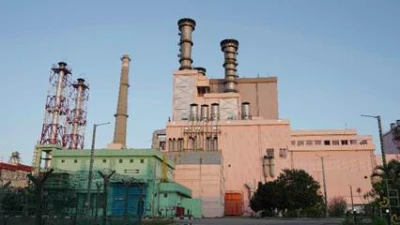

In a landmark achievement for India's nuclear energy programme, the 500 megawatt electric (MWe) Prototype Fast Breeder Reactor (PFBR) at Kalpakkam in Tamil Nadu successfully attained 'first criticality' on April 6.
This marks the start of the controlled fission chain reaction, a nuclear process where the reaction is maintained at a constant, sustainable level, allowing for a steady release of energy that can be harnessed.
With the achievement of first criticality, India moves closer to realising the full potential of its three-stage nuclear power programme, according to information shared by the Department of Atomic Energy (DAE). As India continues to expand its clean energy portfolio, fast breeder reactors will play a crucial role in delivering reliable, low-carbon, base-load power with higher thermal efficiency.
"Fast breeder technology forms the vital bridge between the current fleet of pressurised heavy water reactors and the future deployment of thorium-based reactors, leveraging the country's abundant thorium resources for long-term clean energy generation," a statement issued by the DAE read. "It is a historic step in providing long-term energy security and advancing indigenous nuclear technology capabilities."
What are fast breeder reactors
Fast Breeder Reactors are a cornerstone of India's long-term nuclear strategy. Unlike conventional thermal reactors, the PFBR uses Uranium-Plutonium Mixed Oxide fuel. The core of fast breeder reactor is surrounded by a blanket of Uranium-238. Fast neutrons convert fertile Uranium-238 into fissile Plutonium-239, enabling the reactor to produce more fuel than it consumes.
The reactor is designed to eventually use Thorium-232 in the blanket. Through transmutation, that is the process of the conversion of one chemical element or isotope into another, Thorium-232 will be converted into Uranium-233. This will fuel the third stage of India's nuclear power programme.
This unique capability, according to DAE, significantly enhances the utilisation of nuclear fuel resources and enables the country to extract far greater energy from its limited uranium reserves while also preparing for large-scale use of thorium in the future.
The criticality was achieved after meeting all the stipulations of the Atomic Energy Regulatory Board, which had issued clearance after a rigorous review of the safety of the plant systems. The reactor incorporates advanced safety systems, high-temperature liquid sodium coolant technology and a closed fuel cycle approach that enables recycling of nuclear materials, thereby improving sustainability and reducing waste.
The technology development and design of PFBR was indigenously done by Indira Gandhi Centre for Atomic Research (IGCAR), a research and development centre of the DAE, and was built and commissioned by Bharatiya Nabhikiya Vidyut Nigam Limited (BHAVINI), a public sector undertaking under the same department.
Beyond energy generation, the fast breeder programme strengthens strategic capabilities in nuclear fuel cycle technologies, advanced materials, reactor physics and large-scale engineering. The knowledge and infrastructure developed through this programme will support future reactor designs and next-generation nuclear technologies.
India's three-stage nuclear programme
Kalpakkam marks the commencement of Stage-II of India's 3-stage nuclear power programme, conceived in 1954 by Dr Homi Bhabha, the first chairman of the Indian Atomic Energy Commission (AEC) and secretary of DAE, to leverage India’s limited uranium reserves while exploiting its vast thorium resources, which are among the world’s largest.
The first stage involves pressurised heavy water reactors that use natural uranium and produce Plutonium-239 as a byproduct. The current second stage revolves around fast Plutonium-based breeder reactors and forms the launch pad for Stage III, which will employ advanced heavy water reactors or Thorium-based systems and use the accumulated plutonium to convert India’s abundant Thorium-232 reserves into fissile Uranium-233 for large-scale power generation.
Nuclear power generation in India
India’s nuclear power capacity at present is 8.78 gigawatts (GW), which is the fifth largest source of power and accounts for a little over three percent of the country's total electricity generation. India's nuclear roadmap calls for expanding this sector by three times by 2031-32 and reaching a capacity of 100 GW by 2047.
Prior to the Kalpakkam reactor attaining criticality, there were 25 nuclear reactors operational in seven nuclear power plants. These are at Tarapur in Maharashtra, Rawatbhata in Rajasthan, Chennai in Tamil Nadu, Narora in Uttar Pradesh, Kaiga in Karnataka, Kakrapar in Gujarat and Kudankulam in Tamil Nadu.
The construction of the first nuclear reactors in India commenced at Tarapur in 1964 and they began commercial operations in October 1969. At 210 MW each, they were then the largest power plants in the country and the first nuclear power plants in Asia.
At present, nine 700 MW reactors are under construction at Kakrapar in Gujarat, Rawatbhata, Kudankulam and Gorakpur in Haryana. Administrative approval and financial sanction have been obtained for another ten 700 MW reactors at various places and in-principle approval has been received for 28 more reactors with individual capacity of up to 1,650 MW, totaling close to 32,000 MW.