
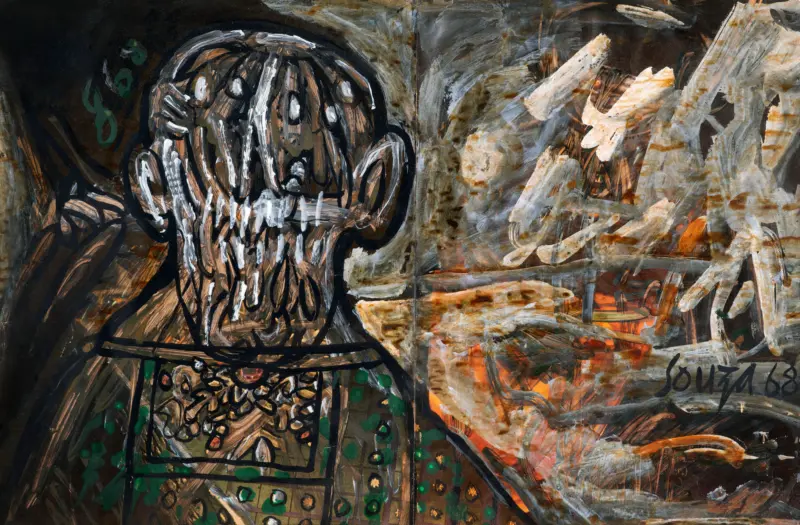

A new art show traces the evolution of the human face as a site of expression, power, and memory. 'Portraits in Time: Power, Presence, and Identity Across Centuries' brings together 50 works spanning centuries and geographies, creating a cross-continental, cross-century conversation on representation.
Curated by Sonali Batra, the exhibition approaches portraiture not as a fixed genre but as an evolving inquiry into identity and visibility. Presented by Great Banyan Art, it is on view at Bikaner House in New Delhi from until April 15.
Installed chronologically, the exhibition unfolds as a visual journey through time. From early European academic realism to modernist expression and contemporary reinterpretations of the human image, the works trace a trajectory from formal depiction to psychological depth and conceptual reflection, revealing how our understanding of the self has shifted across eras.
"What fascinates me about portraiture is how it transforms over time, from a symbol of authority to a space for psychological depth and personal expression. 'Portraits in Time' explores how identity is never fixed but constantly shaped by history, culture, and context," says curator Sonali Batra.
Historically, portraiture functioned as both record and symbol. In many early traditions, it served as a record of lineage and an instrument of authority. Court ateliers across Mughal and regional kingdoms in India produced portraits under royal patronage, where formal representation reinforced legitimacy and preserved dynastic continuity. These works were often confined to palace collections, accessible only to elite audiences, with the composed gaze of the sitter projecting stability and power.
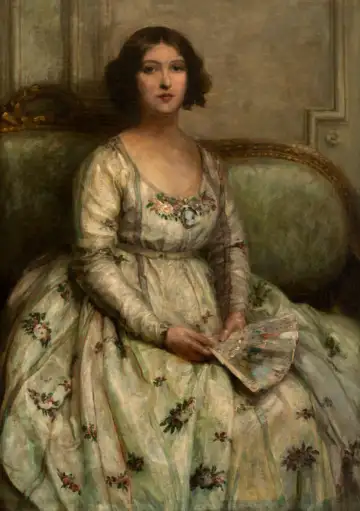
Rose Bonnor, 'A Young Woman on a Sofa with a Fan in Her Hand', 1911.
Across Europe, portraiture developed within academies and studios where the artist's reputation increasingly carried prestige alongside that of the sitter. Artists such as Jean François Portaels, Édouard Frédéric Wilhelm Richter, Hugues Merle, and Rose Bonnor exemplified a composed academic tradition in which dignity was articulated through posture, drapery, gesture, and gaze. Within the Indian context, artists including KR Ravi Varma, Abalal Rahiman, Hemendranath Mazumdar, and MF Pithawalla adapted these conventions while negotiating colonial encounters and emerging ideas of modern identity.
By the mid-twentieth century, this visual certainty began to fracture. Modernist artists such as FN Souza, Krishen Khanna, and Anjolie Ela Menon moved beyond resemblance toward revelation. Distortion replaced flattery, colour intensified, and line became charged with emotion. The portrait shifted from recording outward likeness to excavating interior states.
In the works of Rabin Mondal, Maniklal Banerjee, and others, the human figure acquired existential weight, reflecting the anxieties of modernity, displacement, and social change. Portraiture became psychological terrain, concerned less with surface appearance than with emotional and intellectual presence.
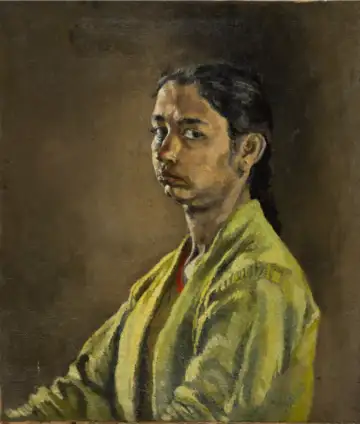
Shobha Broota, Self Portrait, 1962
The contemporary works in the exhibition extend and complicate this trajectory. Artists such as Shobha Broota, Tom Vattakuzhy, Terry Turrell, Kaori Someya, Pavel Bulva, and Francesca Schiffrin revisit portraiture as a layered and fluid space shaped by memory, migration, and cultural hybridity. Here, identity appears increasingly dynamic, shaped by shifting cultural contexts and personal narratives.
"Portraiture is not only about resemblance. It is about presence. And presence is always shaped by power, memory, and the time in which we live," adds Sonali Batra.
Significantly, the exhibition also includes works by unknown and attributed artists. In many Indian court traditions, painters remained anonymous, their identities secondary to the authority of the sitter or patron. In contrast, European portraitists increasingly cultivated individual reputations, and the artist's name became integral to a work's prestige. These differing histories complicate our understanding of authorship and visibility, reminding us that portraiture has long negotiated not only likeness but power – determining who is remembered and who remains unnamed.
Across centuries and continents, one truth endures: a portrait is never merely a mirror. It is a map of self and society, tracing the aspirations, hierarchies, and identities that shape both.
On view till April 15