




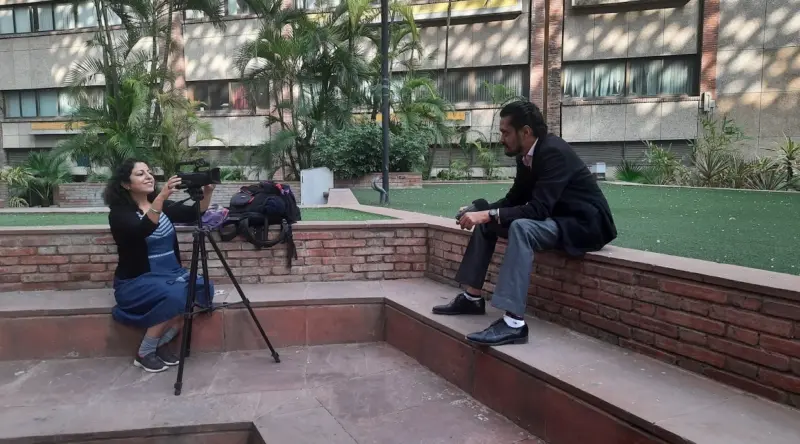

BARELY a week before she came to know about the President's National Award for Best Investigative Film for her documentary '1984, When the Sun Didn't Rise' in 2018, film-maker Teenaa Kaur Pasricha was diagnosed with breast cancer.
Life for her has mostly been in the roller-coaster mode, yet the award-winning director has turned around every challenge that has come her way into an opportunity to learn. "I have always looked at hardships with a positive attitude," says Teenaa. Before going into surgery, she had already told her surgeon that her next documentary would be on breast cancer.
Released last year, 'What If I Tell You', which is doing the film festival rounds, explores the social consequences of surviving breast cancer - what it means to live, love, and long afterwards. After her treatment, Teenaa decided to turn the camera to herself, not to document her survival journey but to probe the silence around this dreaded disease.
"When people enquired about my wellbeing during the treatment phase, no one would even say the 'C' word, including my mother. So, I wanted to understand the journey after cancer. How do family, society or prospective partners perceive you?" says the documentary maker, whose inward gaze won her grants from the Bichitra Collective, US, and Bangladesh-based Dhaka DocLab for this film.
The raw, unfiltered film was selected for the South Asian Film Festival of Montreal and the National Indian Film Festival, Australia, last year. The 52-minute film, screened recently in Mumbai at Cinema Collective, National Centre for the Performing Arts, has some candid conversations between Teenaa and her parents as well as some prospective grooms.
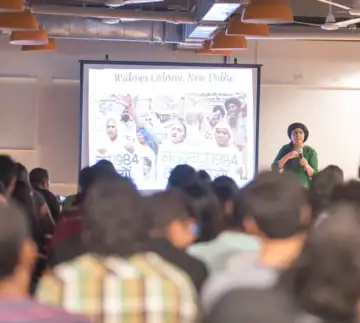
At the screening of her documentary '1984, When the Sun didn't Rise', which won the National Award.
As a filmmaker, Teenaa does not lose objectivity even when the subject is her personal life, and captures awkward pauses and difficult questions with brutal honesty. In a couple of scenes, her mother questions why she is filming such private moments, but the filmmaker simply tells her that "one in eight women are getting detected with breast cancer. There's nothing private about it. As a filmmaker I have a voice, if I don't speak about it, who will?"
In the past, too, Teenaa has used her voice to bring out uncomfortable truths. Her award-winning film '1984…' documents Sikh widows who survived the massacre. The film is about the women living in the 'Widows Colony' at Tilak Vihar, Delhi. It is a story of resilience and how people seek closure and justice in the face of adversity.
This documentary also arose from her personal space, an 'inheritance of anger' from her mother. "For years, I grew up on the stories of 1984. During the riots, my Mamaji was dragged out of a train and his hair was chopped. He lived, but the loss of his identity sent him into depression."
Like her recent documentary, which is about rediscovering identity after a life-altering event, '1984…' had a similar quest - search of identity in a communally divisive world.
"This massacre was not part of any history book. '1984…' was my attempt to fill this gap. Because if you do not talk about political or ethnic violence, then we keep repeating the mistakes. That's why we need to bring it up for public discourse, and deconstruct it, so politicians are not able to take advantage of people," says Teenaa.
Born and brought up in Ajmer, this storyteller's own journey from an engineering graduate to a filmmaker is full of twists. Like most Indian girls, Teenaa had a protected upbringing, and followed a path charted by her parents - engineering and then MBA. "I did what was expected of me, but when talks about my marriage started, I realised that the 'good-conduct badge' that I had been wearing, will have to go. A documentary on mining and its effect on miners from my childhood days had stayed with me. I wanted to do something similar, bring out stories which no one pays attention to."
She shifted to Delhi, found a job and started learning filmmaking in the evenings. Marriage did happen but didn't last as it was an abusive relationship. "That was the lowest point in my life. I decided to shift to Mumbai to see if life could still offer me something."
It was while struggling with pain, loneliness and survival herself that Teenaa felt a kinship with the widows of 1984. "I wondered that despite being educated if I was having such a tough time, what must these women who had lost everything be going through?"
'1984…' went on to receive international awards as well as the prestigious Busan International Film Festival's Asian Network of Documentary Fund.
Fifteen years and seven non-fiction films later, Teenaa's next project, 'Maujj', is a feature film - a love story based in the cancer belt of Punjab, Malwa. The film's script was selected for mentorship under the prestigious National Film Development Corporation of India script lab, whose earlier selections include 'The Lunchbox', 'Lipstick Under My Burkha', and 'Titli'.