





In every fashionable eatery these days, diners encounter Indian food in exotic incarnations. What appears on the plate is confusing fusion blending Indian with foreign ingredients
We were nonplussed when our young granddaughter asked us to explain what these terms meant.
We could only mumble that whatever is not traditional is lumped in these categories. Ever since the fundamental question has persisted - what is traditional in the Indian culinary context?
Tradition is often juxtaposed to contrast with the modern and the contemporary. However, tradition is not a fossil, but a live stream that enriches our lives in the realm of cuisine, costume, music, or arts.
We were reminded of this not long ago when we walked into a restaurant called Aure Heer in Malviya Nagar in the Capital. Heer is the celebrated beloved of Ranjha, who was smitten by her. Heer is a very popular genre of folk singing with spiritual undertones in all of Punjab.
The restaurant is based on the unique concept that there are many as yet undiscovered gems in the realm of traditional cooking chefs, who have risen from the ranks and acquired skills that can humble many celebrity chefs who are strutting the stage.
Here, at Heer ki Rasoi, Chef Mahavir hailing from Tehri Garhwal is the face of the restaurant. He firmly believes that nothing can replace the traditional classics. At the same time, he emphasises that food is never static and even the timeless classics are constantly reinterpreted. What he cooks in Heer ki Rasoi are time-tested perennial favourites from Punjab.
This gifted Pahari chef, after working for years with the legendary food impresario Jiggs Kalra, has honed his skills, opening and operating a very popular Punjabi eatery in Dubai.
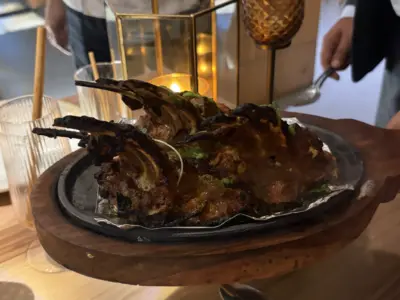
For starters, he presented an absolutely breathtaking 'legacy' chaamp. Marinated overnight and then slowly pot-roasted lovingly on low flame, the meat is perfectly done. Having imbued the flavours of the marinade, it is ready to fall off the bones as soon as the spoon, or better still, the fingers touch it.
We learned during the course of our conversation that the chef doesn't use raw papaya, vinegar, lime juice or kachri (wild cucumber) as tenderiser. He sprinkles finely grated nutmeg powder to accomplish this. The spice mix that makes this traditional chaamp droolworthy is his trade secret spice blend.
Artisanal cook extraordinaire Mahavir is candid that it is inspired by the aromatic garam masala and the sprinklers used by bawarchis in Awadh and in the princely kitchens of Punjab.
We have great pleasure in sharing the purloined recipe with our dear readers.
You may take shortcuts, if you please, like using a pressure cooker but our advice is to be patient with marination, substituting your own freshly home-ground garam masala for Mahavir's magic mix. The homemade garam masala can be prepared with green and brown cardamom seeds, cinnamon and clove powder, cumin seeds, star anise, dried ginger powder, fennel seeds, a pinch of grated nutmeg and a few blades of mace. It is well worth the effort.
Mutton chaamp
Ingredients
Mutton chops 1 kg
(culled from a goat weighing approx 10 kg;
4 chops in all with meat clinging to 4 bones)
For marinade
Ginger paste 1-1/2 tbsp
Garlic paste 1-1/2 tbsp
Nutmeg (grated finely) ¼
Red chilli powder 1 tsp
Black peppercorns (freshly ground) 1 tsp
Degi mirch 1 tsp
Homemade garam masala 1-1/2 tsp
Kewra water (optional) 1 tsp
Mustard oil 1/2 cup
Salt To taste
Method
Wash, pat dry and trim the chops. Don't remove the fat.
Prepare the marinade mixing powdered spices, except garam masala, with ginger and garlic paste and grated nutmeg, adding 1/2 cup of water.
Blend well and apply this massaging gently to the chops and keep in a fridge/cold place overnight.
Heat oil in a thick-bottomed pan and when it reaches smoking point, gently lower chops in it to sear and seal the juices. Add the marinade with a
cup of water.
When it comes to boil, add salt to taste, cover the pot with a tight lid. Cook on very low heat till meat is done to taste.
Uncover, sprinkle the garam masala and stir well and simmer for 2-3 minutes.
Sprinkle kewra water, if using, just before serving.
- The writer is a food historian