




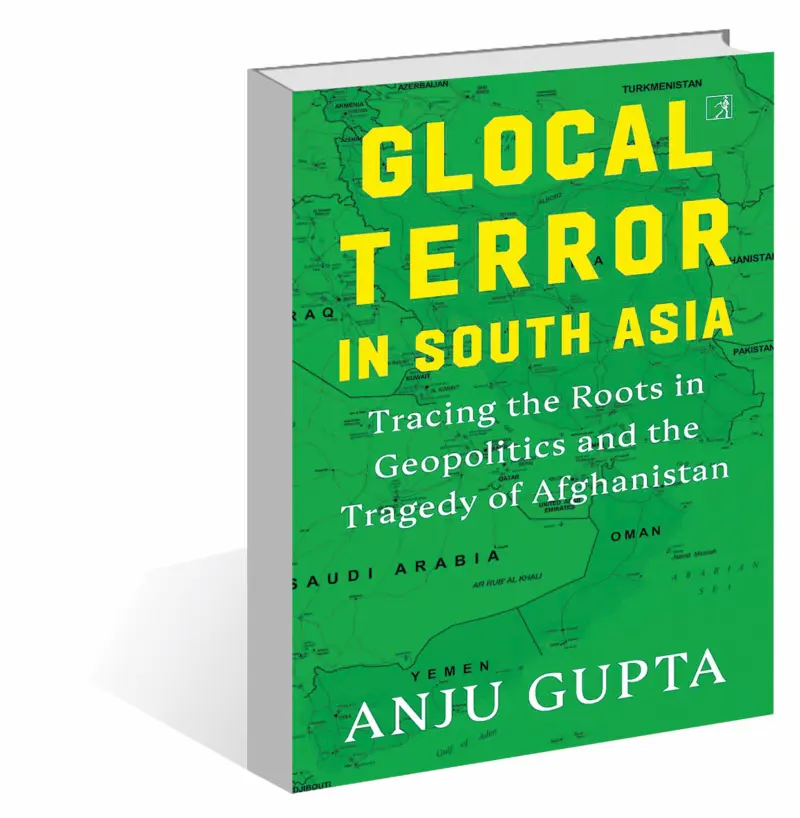

Anju Gupta's 'Glocal Terror in South Asia' is a timely and insightful survey of the connections between global terrorism and local assertions of the phenomenon in the Indian sub-continent and Afghanistan.
Gupta has relied extensively on US official records in assessing the poor performance of the Afghan security forces to successfully combat the Taliban. In this context, a study of the shortcomings of the Republic's political leadership to build its foundations would have been useful. The Republic's security forces were bound to fail if its politics did not cohere.
The author's quest to connect global and local Islamic extremist groups and personalities has naturally led her to look at the theologies nurtured in the Arab world and developments since the establishment of Israel. It is here that the seeds of global jihad were sown through particularly Egypt's Muslim Brotherhood's rejection of the notion of secular states, and a return to Islamic political entities.
It is creditable that Gupta dwells on the seminal significance of Syed Qutb, who died in 1966 but was, and continues to be, an inspiration for generations of Muslim extremists.
She competently goes into detail on how Arab theologians, ideologues and activists - Abdullah Azzam, Osama bin Laden and Ayman Zawahiri - all touched by Qutb's thoughts impacted the Afghan desire to throw out the Soviet Union, which invaded Afghanistan in December 1979. The Arabs imparted a local jihad with global dimensions. This process became intertwined with the US Cold War objectives. It also gave a channel to Saudi Arabia, under domestic challenge from extreme Wahhabi elements and fearful of Khomeini's revolution, to channel Islamic energies abroad, especially towards Afghanistan.
For Pakistan's General Zia-ul-Haq, the Afghan jihad meant an opportunity to promote Islamism domestically and gain international legitimacy. Gupta weaves these complex interconnections with clarity and skill.
The past six decades have been a period of turmoil amidst vast political changes in the area stretching from North Africa to West Asia to India's immediate western neighbourhood. This region has witnessed the despair of the Palestinians, the rise of oil rich countries of the Arab peninsula, the changes in Iran and the continuing tragedy of Afghanistan. It has seen ideological contestation between the forces of Islamism and nationalism and communism.
The Islamists imbued with zeal accepted the doctrines which justified violence and also sharper mazhabs. This manifested itself in the formation of local and international terrorist entities which posed a great challenge to the region. These groups included Al Qaeda and ISIS as well as the 'Harkat' and 'Salafi' Pakistani groups which were India and Afghanistan-oriented.
Gupta's work gives an excellent account of the groups, their leaders and activities. Countries tried to combat them in different ways. Pakistan sought to promote them to further its foreign and security policy objectives. It is a measure of how much Islamism and terrorism grew in its belly that all whom the book describes as their poster boys in the Pak-Af region were nurtured there. They included Ramzi Yousef and Khalid Sheikh Mohammed (the main planner of 9/11) who were Al Qaeda operatives. They also included Pakistani terrorists who are household names in India - Masood Azhar and Hafiz Saeed - and those who are not - Umar Sheikh, Headly, Rana and Ilyas Kashmiri - but did great harm to India nevertheless. Azhar and Saeed established the Jaish-e-Mohammed and Lashkar-e-Toiba.
Future editions of the book could do with a more rigorous fact check. The account of the departure of President Ashraf Ghani from Kabul on August 15, 2021, is not entirely accurate. More distressing is the statement that Jammu and Kashmir became an integral part of the Indian Union on August 15, 1947! J&K joined the Union after Maharaja Hari Singh signed the Instrument of Accession in October 1947. Later editions would also benefit from a full discussion on jihad, considering the insufficient understanding of these concepts in India.
Gupta deserves appreciation; hers is a very fine addition to the body of Indian work on terrorism. It should be read widely.
- The reviewer is India's former Ambassador to Afghanistan