

Preet Nagar, conceived in the 1930s by eminent writer and scholar Gurbaksh Singh Preetlari as Punjab's first community-led artist township, has, over the decades, acquired a quiet yet enduring heritage status.
A township shaped by love and imagination, it lies a few kilometres from the India-Pakistan border at Attari in Amritsar, and has served as a shared sanctuary for some of the most luminous names in Indian literature and the arts - among them Sahir Ludhianvi, Amrita Pritam, Noor Jehan, Balraj Sahni, and Faiz Ahmed Faiz.
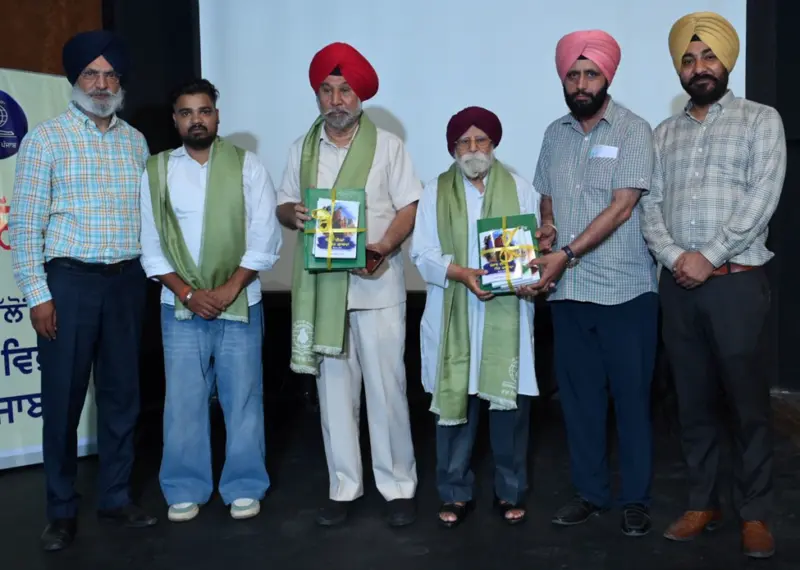
In remembrance of its layered legacy and its founding visionary, the Language Department of Punjab recently marked Preetlari's birth anniversary at Preet Nagar - the brick-and-mortar legacy of his cultural ethos.
Writers and literary enthusiasts from across Punjab gathered at the township - often described as the "Shantiniketan of Punjab" - under a 'Preet Yatra', revisiting its spaces, and exchanging memories and stories of its unique spirit of patronage and creation.
The discourse was inaugurated through theatre artiste Kewal Dhaliwal's documentary film Supneyan Di Dhari.
"Preet Nagar is a living cultural space that thrives on creativity and diversity. For decades, it has embodied the idea of a united Punjab, and even after Partition, its legacy has endured. In today's times, however, it urgently needs preservation," Dhaliwal said.
Writer and Language Department Director Jaswant Singh Zafar observed that Preetlari's work carried forward a message of harmony, beauty, wisdom, truth, and dignity.
"Preet Nagar, born of this very ethos, stood at the cultural centre of Punjab before Partition. Yet, owing to narrow political and communal thinking, this place - as significant as Shantiniketan - now finds itself pushed to the margins," Zafar added.
Speaking on his father's life, Preetlari's son Hirdepal Singh said: "Despite difficult circumstances, his life was happy and fulfilling. He studied in the United States and, upon his return, established Punjab's first planned socio-cultural township in the form of Preet Nagar. In line with its multi-cultural and inclusive identity, he did not construct any religious place within it. Its residents, instead, celebrated all festivals together."
Punjabi writer and thinker Harbhajan Singh Bhatia, while speaking on "The importance of being Gurbaksh Singh Preetlari", reflected on what he described as a modern tragedy - the widening gap between thought, speech, vision, and action in contemporary life.
"Preetlari stood in stark contrast to this fragmentation. He thought, saw, spoke, and acted in complete alignment with his ideology, which he never compromised. In 1970, as many as 18,000 copies of the Preetlari magazine were published - a remarkable achievement. His intellectual canvas drew from Chinese, Greek, Jain, Buddhist, and Sikh philosophies, all of which found expression in his writings," Bhatia added.
Over time, Preetlari evolved into an iconic publication, read across the spectrum of society - from villagers to city-dwellers, and from granthis, shopkeepers and shepherds to farmers and housewives - becoming a defining landmark in Punjab's literary and cultural history.