




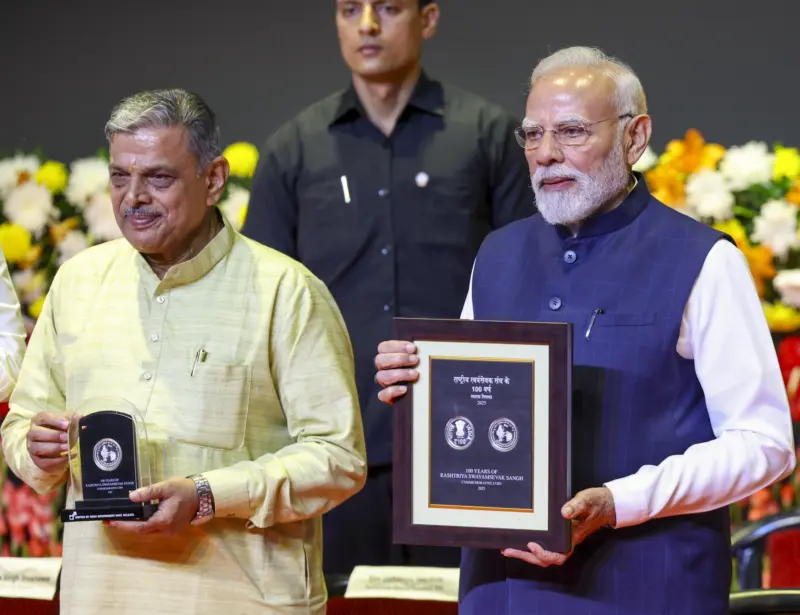

THERE is an ancient and reassuring saying that when God closes a door, He opens a window. Dattatreya Hosabale, a senior functionary of the Rashtriya Swayamsevak Sangh (RSS), has opened that proverbial window for a dialogue between India and Pakistan.
All doors in this relationship between neighbours have remained shut since the Pulwama terror attack in 2019.
Hosabale has now said that India should keep a window open for dialogue with Pakistan while firmly tackling cross-border terrorism. There is nothing new about this formulation. This has been said before by many. What is new is that this time the call has come from a member of the so-called 'Sangh Parivar'.
When Prime Minister Manmohan Singh sought to engage President Pervez Musharraf in a composite dialogue seeking resolution of several outstanding issues that bedevilled the bilateral relationship, the mantra chanted by the RSS, the Bharatiya Janata Party (BJP), several retired diplomats, police officers and armed forces' brass used to be that "talks and terrorism cannot go hand in hand".
Hosabale's observation, since endorsed by the Narendra Modi government, amounts to an acknowledgment of Manmohan Singh's view that even while Indian security forces deal with cross-border terrorism, the two governments should remain in diplomatic contact and facilitate civil society interaction.
After the November 2008 terror attacks in Mumbai, the Manmohan Singh government succeeded in establishing Pakistan's direct involvement by capturing a terrorist alive, subjecting him to a fair trial and then sentencing him to death. Many in the present RSS-BJP dispensation have repeatedly mocked Dr Singh for his handling of the Mumbai attacks. The fact is neither in Pulwama nor in Pahalgam has the Modi government convincingly established Pakistan's official culpability. The party's support base may have been convinced but not the international community.
Yet, there has been much grandstanding after 2019. The Modi government imagined that the termination of Article 370 of the Constitution, an altered status for Jammu and Kashmir and a 'muscular response' to Pakistani perfidy was all that was needed. The Union Home Minister and the External Affairs Minister declared that the only remaining item on India's agenda was to reclaim Pakistan-occupied Kashmir. Talk is easy.
From Pulwama in 2019 till after Pahalgam in 2025, there was virtually no contact at any level between the two governments and the people. It was left to the Americans and Europeans to fund what are termed 'Track-2' dialogues. However, till recently, Indian participation in these Track-2 dialogues was neither officially authorised nor welcomed.
In 2019, I was invited to an India-Pakistan Track-2 that met in Bangkok and was funded by a Canadian outfit. When I discovered that the Indian participants included the late SK Lambah, a retired diplomat and Manmohan Singh's 'back channel' to Musharraf, the Congressman Mani Shankar Aiyar and the academic Happymon Jacob, I suggested to the hosts that they should have someone from the Sangh Parivar to make any such dialogue meaningful. At our host's request, I reached out to a senior RSS functionary. The Modi government did not encourage his participation. That dialogue achieved nothing.
Last year, after the Pahalgam attack and US President Donald Trump's activism in South Asia, there was a sudden revival of India-Pakistan Track-2 in which retired diplomats and others known to be close to the BJP participated. These were funded by US and British organisations. This was the first signal of a change in approach. Clearly, Prime Minister Modi has been under considerable pressure to change the Indian approach to Pakistan after the sensational diplomatic goals that the latter scored in the United States and around the world.
Once referred to as a 'failed state', a 'pariah', a 'dalal' and so on, Pakistan has to be acknowledged as a neighbour that one should have a means to deal with. Hit them hard when necessary but keep a range of channels open to facilitate not just a dialogue but a change in behaviour.
It is against this background that one must view Hosabale's intervention suggesting resumption of people-to-people contact. The hope clearly is that they can help reduce tensions and improve relations. Interestingly, his remarks were soon echoed by the former Chief of the Army Staff, Gen MM Naravane, a distinguished and wise soldier, suggesting that even the armed forces would like to see that diplomacy and civil society play their part in maintaining balance in the bilateral relationship.
The Indian armed forces view kinetic action as the last resort. They are not trigger-happy adventurers. It is only when diplomatic and other forms of contact fail that military solutions should be resorted to. A very different approach from the one that Prime Minister Modi has followed since 2019. To be fair to Mr Modi, he did try his hand at diplomacy with Pakistan but was unable to establish trust with his interlocutors.
What are the compulsions - diplomatic, economic and political - that have now forced the RSS and BJP to retreat from their earlier stand and advocate restoration of people-to-people contact, signalling a willingness to move to diplomatic contact? Various theories are being aired in the media, ranging from India's need to seek restoration of overflight rights for Indian airlines that are losing business to foreign competitors, to a recognition that if the world and India's neighbours are doing business with Pakistan how can India shut its doors?
Hosabale's remarks are wide-ranging and define a new approach to Pakistan from a government that has not only claimed to have made Pakistan a marginal player in world affairs, but also bad-mouthed its diplomacy and promoted movies that demonise the neighbour and promote malicious lies about the Manmohan Singh government, its senior ministers and security administrators. Political grandstanding at home will never deliver the results India needs from its relations with Pakistan. Civilised people-to-people contact and mature diplomacy have a better chance.