

IN the bad, old days when ordinary Indians and ordinary Pakistanis were allowed to meet each other for lunch in Lahore, dinner in Patiala, weddings in Karachi and funerals in Qadian, you often heard - interspersed with tidbits about Omar Sheikh, the London School of Economics-educated terrorist released for the IC-814 hijacked passengers, and his favourite Islamabad bookstore - Pakistanis reflecting on the deep, strategic tie between Pakistan and China.
The "all-weather relationship" between the two countries, they said, "was higher than the Himalayas, deeper than the seas and sweeter than honey."
In today's mixed-up world, this could be a line straight out of Dhurandhar 3, the sequel - make no mistake, Aditya Dhar is already making detailed notes about India's continuing obsession with Pakistan, despite the fact that we have zero official ties with our western neighbour. The fact remains that street talk often explains foreign affairs jargon much better than the jargon itself.
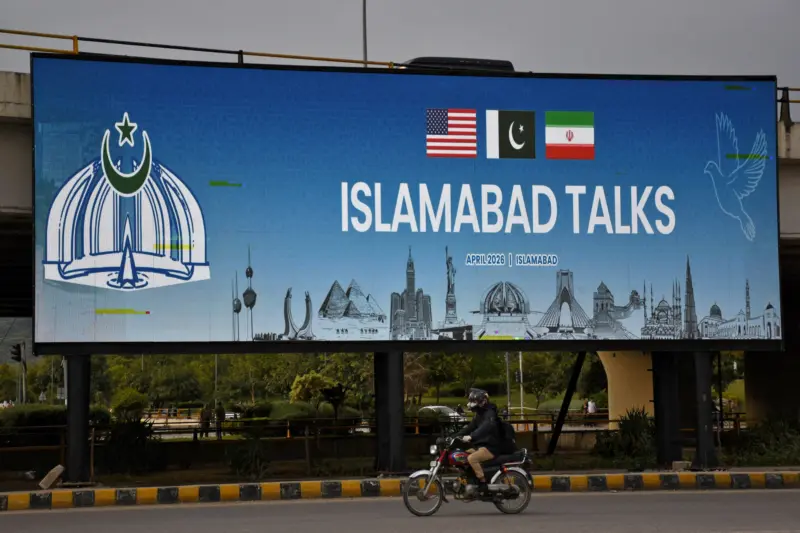
So while there will only be three countries represented today in Islamabad's Serena Hotel, the venue for the face-to-face peace talks between the US and Iran at the end of the 39-day-long war - the almighty Americans represented by US Vice-President JD Vance, the battered but undefeated Iranians led by Speaker Mohammad-Bagher Ghalibaf (most leaders are either dead, like Ali Larijani, or wounded, like the Supreme Leader Mojtaba Khamenei) and the Pakistanis, likely led by Trump's "favourite Field Marshal" Asim Munir - there are a few other nations in the shadows who will play more than a supporting role in this movie.
China, Russia, Israel, Lebanon, Saudi Arabia, the UAE. Look carefully at these names, dear Reader, and note how the global order is being shaken and stirred in a hotel managed by the Aga Khan Development Network - the first Aga Khan, only old-timers with a penchant for history will remember, was Indian.
The reason China is not in the room is because it is playing a powerful role outside - backing Pakistan. China has bailed out Pakistan for several decades, year after year, and built its roads and highways and ports and invested in its military, its air force, its nuclear and missile programme - the Pakistanis will admit, off-the-record over coffee in a F-6 restaurant in Islamabad, that they are a client state of their "all-weather friends." But even China would not have been able to play this key role in the peace negotiations if Pakistan did not already have relationships with all the players.
That's why there are two clear lessons from the war in West Asia. The first, be humble, never arrogant. (Deng Xiaoping said it beautifully with his 24-character guideline, 'taoguang yanghui,' meaning, 'hide your strength, bide your time.') Certainly, it's not just the US and Israelis who have been forced to eat humble pie by a far weaker Iran. Closer home, External Affairs Minister S Jaishankar's evocative characterisation of Pakistan as a "dalaal," or broker, may come to haunt India, as the "dalaal" brokers the most important global negotiations in decades.
Many colleagues in the media are tying themselves up in knots wondering how to describe the Pakistani role today - is it a powerful mediator, an irrelevant messenger, a backroom boy, or just a weak nation living on the edge, being pulled apart by famine, war and terrorism? Perhaps it's all these labels or none of them. As Dhurandhar 2 crosses Rs 1,000 crore at the box office in India, perhaps the real question is, Why is India so obsessed with Pakistan when we are supposed to hate it so much?
The second lesson from the West Asia war is that Tier Two nations like India and Pakistan cannot afford to take sides. Now India already seems to have learnt that lesson on the West Asia crisis, as it tries to claw back to the centre after having swung early in the direction of Israel. That's why it boggles the mind why Jaishankar is in the UAE on the day Pakistan is brokering a truce between Iran and the US - the UAE were a favourite target of Iran in this war, because they were seen to be allied with the US, and therefore Israel.
Significantly, India has learnt that lesson well with China. It recognises the fact that China is a far more powerful enemy than Pakistan - back in 1998, Brajesh Mishra, national security advisor to then PM Atal Bihari Vajpayee named China as the reason India crossed the nuclear threshold - and despite the more recent Galwan face-off in 2020, when 20 Indian soldiers died, China has returned to being India's largest trading partner.
India has learnt to swallow its China spit and look at the big picture - realising that others may see the same story differently.
That's why the Pakistan-brokered talks in Islamabad today are so important. China is not in the room, but it is the most important player in the conversation. If it were not for China, Pakistan's ability to offer to mediate would have little value. Trump recognises that. And so it allows Pakistan its happy charade of being a "dalaal."
India also recognises that. But because the Ministry of External Affairs has tied itself up in knots over what to do with Pakistan - basically, no conversation until cross-border terrorism comes to an end, which essentially allows Pakistan's military establishment which controls the terrorists, to have a veto on the relationship, thereby reducing India's own leverage - the China puzzle will always remain unnecessarily elusive.
Certainly, Pakistan punches above its emaciated weight - it flatters the Americans, allies itself with the Chinese, sells itself to the Saudis and courts the Iranians - that's clear for all to see.
The bigger question is, why does India punch below its potential? Especially when its key rival China, it's also clear to see, is trying to use the Iran war and Pakistan's role in brokering peace to emerge as the pre-eminent power in the world.
Why is India's magnificent obsession with Pakistan limited to Pakistan, when China is the real power behind the throne of the Islamic Republic?