




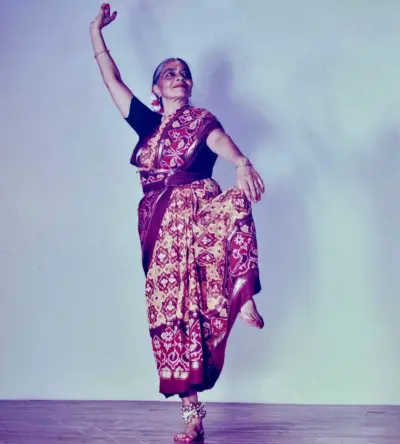

Indu Mitha died in Dublin on August 31. She was 96. The wire services will not carry the news, and no minister will issue a condolence.
But somewhere in that fact lies the whole shape of the subcontinent's unfinished business - a life that began in undivided India, bent itself around a border that had not yet been drawn, and ended, decades later, in a city with no stake in any of it.
I met her only once, in November 2024, in the sprawling bureaucratic quarter of Islamabad known as Chak Shahzad - grander, if I am honest, than our own Sainik Farms in Delhi. She was 94 then, moving about her farmhouse-like home with the easy confidence of a much younger woman, a raconteur with a memory so sharp on the distant past that she could still summon Lahore's streets in vivid detail, and so unreliable on the present that she asked me, more than once in two days, whether I was a visitor from India or one of her Pakistani neighbours. It seemed a fitting confusion for a woman whose life had never quite settled the question.
She was born in Lahore in 1930, into a Bengali family transplanted westward by her father's career - Gyanesh Chandra Chatterjee taught philosophy at the famed Government College, Lahore, in the years when that institution still produced the subcontinent's shared imagination before it turned into separate nations. Indu grew up Bengali by blood but Lahori by instinct; when we spoke, 70-odd years and a partition later, it was in fluent, unhesitating Punjabi.
I had, in fact, met her family before I met her. In 2019, in Lahore, at a friend's house, I fell into conversation with her daughter. Yameema - in her printed salwar-kameez, indistinguishable from any well-heeled Delhi woman of her generation - was then deep into a doctoral thesis on Hindi cinema, a subject we discovered we both loved, she from academic interest and I from simple devotion. We talked for hours. She told me she had visited India often, that she had cousins on both sides of her family, her mother's Bengali relations and her father's as well.
Her father, she said, had been a Memon from Bombay who joined the Pakistan army and rose to the rank of General - and who, for that reason, could never in later years see the family he had left behind. Yameema herself had managed, over the years, to visit India and meet those cousins. But she said something that stayed with me: that since 2014, even with an Irish address and an Irish passport in hand, it had become almost impossible for her, a Pakistani by birth, to get an Indian visa. I filed it away as one more small, needless cruelty visited upon families who had already paid Partition's price once.
Five years later, both of us happened to be in Pakistan at the same time - Yameema visiting her mother, I on my own travels - and so I finally sat across from Indu Mitha, born Chatterjee, and heard the story in her own words. It is a story that is, in equal measure, romantic and merciless.
At Partition, the Chatterjees did what most non-Muslim families in Lahore did: they crossed to the Indian side. But fate had something else in store for her. She had met and fallen in love with a young man named Aboobaker Mitha, commissioned into the British Indian Army in 1942, who chose to go to the new Pakistan.
She finished her studies in Delhi in 1951, and then did what her heart, rather than her geography, demanded: she went back across the border she had once reluctantly crossed, to marry him. It is worth pausing on the sheer nerve of that decision, made by a young woman in the rawest, angriest years after Partition, when the border was still bloodied with the memory of what had made it.
Her elder sister Uma took the opposite road, marrying the film director Chetan Anand - himself born in undivided Punjab, elder brother to Dev Anand, and a man who chose Bombay as decisively as Indu chose Lahore. Two sisters, two nations, one Partition: it is the kind of detail that would seem overwrought in fiction and is merely factual in the subcontinent's family histories.
In Pakistan, Indu became an accomplished Bharatanatyam dancer, carrying a classical South Indian form into a Punjabi-Bengali life lived entirely on the other side of a new border - itself a small act of quiet defiance against the tidiness with which nations like to sort culture along their frontiers. After her husband's death in 1999, she founded a school to teach it, and passed the art to her second daughter, Tehreema Mitha, who is today a well-known Bharatanatyam dancer in her own right in Pakistan.
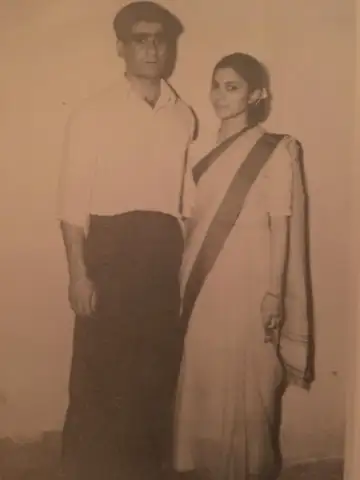
Indu Mitha with husband Aboobaker Mitha.
Sitting with her in that farmhouse, I found myself thinking of two other sisters divided by the same history - Zohra Sahgal and Uzra Butt, one who stayed in India and became one of its most beloved actresses, the other who crossed to Pakistan and became one of its finest. The Uma-Indu sisters and the Zohra-Uzra sisters are, in that sense, mirror stories: families in which Partition did not simply draw a line on a map but ran directly through a living room, separating a sister from a sister, a father from the family he was born into, an old woman from the right to visit the city she calls her own in her own language.
Indu Mitha's death in Dublin - a third country, belonging to neither of the two that shaped her - feels almost like the story insisting on its own moral. She did not die in Lahore, where her heart had always been, nor in the Bengal of her ancestry, nor in the Delhi where she once completed her degree. She died far from the divided land, surrounded by the love and warmth of her daughter and grandchildren, having spent a lifetime trying to hold together what 1947 tore apart - and having succeeded, in the end, only in her own memory.
It was a memory that, by the time I met her, could no longer always tell an Indian visitor from a Pakistani neighbour, because to her, perhaps, the distinction had stopped mattering long before either government would ever admit as much.
How many more such families are there, quietly running out of time to see each other, waiting for visas that will not come?
- Sukirat Singh Anand publishes under the name Sukirat