
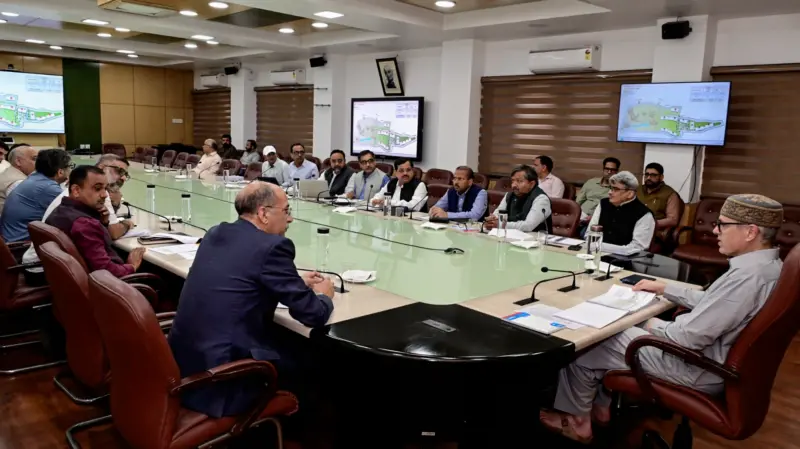

Chief Minister Omar Abdullah on Tuesday chaired a high-level meeting to review the progress of construction work on the new High Court complexes for the Jammu & Kashmir and Ladakh High Court at both Srinagar and Jammu wings, stressing the need for speedy execution of these key judicial infrastructure projects.
During the meeting, the Chief Minister highlighted the importance of timely completion and effective coordination among departments, directing all concerned agencies and executing bodies to accelerate the pace of work. He also urged early administrative approval for the Jammu wing at Raika, which is planned as a modern, integrated judicial facility.
The project, being carried out by the National Buildings Construction Corporation Ltd (NBCC), includes shifting the existing High Court from Janipur to a purpose-built campus at Raika, designed to meet the increasing needs of the judiciary. The proposed complex will feature state-of-the-art courtrooms, judges' chambers, administrative blocks, facilities for litigants, parking spaces, and digitally enabled court systems, in line with modern standards of judicial functioning.
The meeting was attended by Advisor to the Chief Minister Nasir Aslam Wani, Chief Secretary Atal Dulloo, Additional Chief Secretary to the Chief Minister Dheeraj Gupta, Additional Chief Secretary PWD, Divisional Commissioner Jammu Ramesh Kumar, Divisional Commissioner Kashmir Anshul Garg, Commissioner Secretary Law Achal Sethi, Director General Codes Mahesh Das, Director General Budget, senior officials, and NBCC representatives.
Officials from NBCC informed the meeting that the project is being implemented in multiple phases-Phase I, II, and III-to ensure systematic development and efficient use of resources. A detailed presentation outlined the site layout, area distribution, zoning plan, and phased construction approach, along with timelines and execution-related challenges.
The Chief Minister also reviewed proposals for redevelopment of the Lower Court Complex in Srinagar, aimed at upgrading existing judicial infrastructure in Kashmir. These initiatives are expected to enhance accessibility, improve case management efficiency, and provide a better experience for litigants.
Emphasising the importance of strong judicial infrastructure, the Chief Minister directed officials to strictly adhere to timelines, maintain quality standards, and ensure transparency in execution. He called for continuous monitoring and timely resolution of bottlenecks, particularly in approvals, fund flow and coordination on the ground.
The Chief Minister noted that modern court infrastructure is vital for efficient delivery of justice and strengthening public confidence in the legal system, reaffirming the government's commitment to enhancing institutional capacity across both Jammu and Kashmir divisions.