




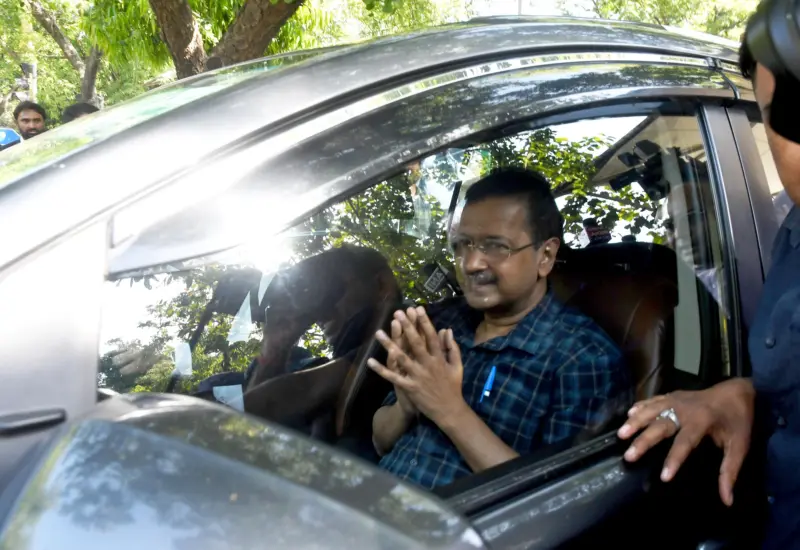

A tense hearing unfolded in the Delhi High Court on Monday as AAP chief Arvind Kejriwal sought the recusal of Justice Swarana Kanta Sharma from the excise policy case, citing a reasonable apprehension of bias based on past judicial orders and her participation in an event linked to the Rashtriya Swayamsevak Sangh's legal wing.
The court reserved its order after over four hours of arguments.
Appearing in person, Kejriwal told the court that previous orders passed by the judge had consistently favoured the Enforcement Directorate (ED) and the Central Bureau of Investigation (CBI). He argued that submissions made by the agencies were routinely accepted and reflected in judicial orders, creating a pattern that raised doubts about fairness.
Justice Sharma briefly intervened, and said she did not follow the line of argument. Kejriwal then referred to the trial court's February 27 order discharging him and other accused after detailed hearings over three months. He pointed out that parts of that order were set aside by the High Court after brief proceedings, particularly findings relating to approver statements. According to him, the change in view after limited hearing formed a key basis of his apprehension.
He also pointed to the judge's attendance at an event organised by the Akhil Bharatiya Adhivakta Parishad, associated with the RSS, arguing that this too contributed to his perception of bias.
Relying on a previous judgment in a case involving Satyendar Jain, Kejriwal submitted that the law on recusal focuses on whether a litigant has a reasonable apprehension about getting a fair hearing, not on questioning the integrity of the judge. He argued that a similar plea by the ED in that case had been accepted and sought equal treatment.
"All I am asking is parity," he told the court, adding that the test was whether a litigant's concern was reasonable.
Opposing the plea, Solicitor General Tushar Mehta, appearing for the CBI, objected strongly. He said such applications could not be used to create pressure on judges or influence proceedings. Referring to judicial precedents, he argued that recusal pleas based on perception must be examined carefully and rejected if they are found to be motivated.
He also submitted that mere attendance at a seminar could not be taken as proof of ideological bias. The apprehension raised, he argued, did not meet the legal standard required for recusal. CBI also told the court that accepting applications filed by Kejriwal and others seeking recusal, will set a bad precedent.
The hearing saw repeated interruptions and sharp exchanges as both sides contested the scope of recusal law, whether it should turn on litigant perception or judicial record.
As the proceedings concluded, Justice Sharma observed that it was the first time such a request had been made before her and that the arguments had provided insight into the law on recusal. She then reserved orders.
The case arises from the trial court's decision to discharge Kejriwal and 22 others in the excise policy matter, which is under challenge before the High Court. The ruling on the recusal plea is expected to shape the course of further hearings.