
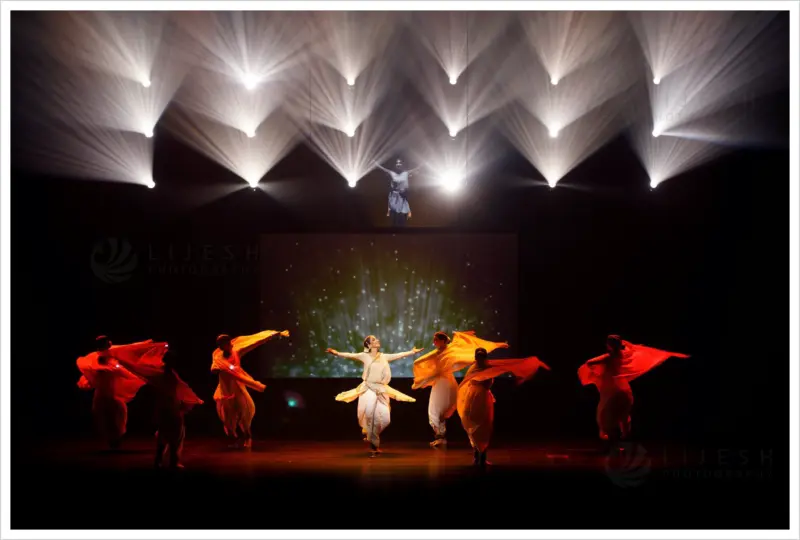

There is a word in Punjabi - laatu. It means a light bulb. In the 1990s, in rural Punjab, people who would set up lights and sound for small events were often fondly called Laatu Singh or Laatu veere.
They were masters of jugaad - people who knew how to create magic with limited means, how to improvise, how to make something glow against all odds.
At that time, no one really imagined that lighting design would one day become a full-fledged profession in India, let alone a deeply respected artistic field. And yet, here we are in 2026, when lighting design is not merely a support service, but a sought-after and increasingly vital creative discipline.
My own connection with the world of dance began much earlier than my professional life. A close family friend was a Bharatanatyam dancer. I believe he was among the first Sikh dancers to gain admission to Kalakshetra in Chennai, one of the most prestigious institutions for Bharatanatyam in India. I was deeply affected by his presence, by the way he performed, and even more by the way he lived.
Classical dancers do not simply learn dance; they absorb a philosophy of living - rooted in devotion, discipline, grace, and a profound connection with the body.
I came from a theatre family, and later spent three years at the National School of Drama, studying and practising theatre. NSD gave me rigour, vocabulary, dramaturgy, and an understanding of performance as a living, breathing language. But after graduation, when I began working with Aditi Mangaldas in Delhi, a new world opened up - the world of dance.
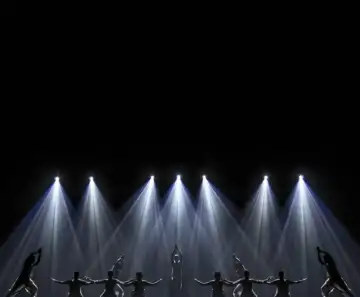
'Anjaneyam' by Singapore-based Apsaras Arts.
I began to encounter dancers, choreographers, musicians, and gurus whose relationship with art was not professional alone - it was spiritual, embodied, and all-encompassing. Somewhere in the middle of that journey, I realised that I felt at home in this world. Even though, many times, I was the only North Indian in the group, let alone the only Sikh, I never felt like I did not belong. If anything, I felt held.
The next few years took me especially to the south of India - to Chennai, Bengaluru, and many other places - where I designed lights for classical dance productions as well as for contemporary work. For me, this journey was also personal. I was a young Sardarji born and brought up in the North, but I instinctively felt drawn to the cultural life of the South. I loved everything about it - yes, the dosas, idlis, and my favourite medu vada dipped in sambar - but also something deeper than food. I was moved by how deeply South Indian artistes seemed connected to tradition, ritual, family, and faith. There was an underlying devotion.
Their practice did not begin and end in the studio; it extended into how they dressed, how they prayed, how they respected their gurus, and how they offered themselves to their form.
I was fortunate to work with some of the most respected gurus and performers in Indian classical dance - Leela Samson, Malavika Sarukkai, Madhavi Mudgal, Kumudini Lakhia, Ananda Shankar Jayant, Rama Vaidyanathan, to name only a few. What I received from them was not merely work. It was trust, affection, acceptance. My relationship with many of them gradually became more than that of designer and choreographer; it began to feel like that of disciple and guide.
I often say that the arts do not simply give us careers. They give us values. They give us a way of seeing. They can even give us a way of praying. I saw so many parallels between Sikhism and the Bhakti traditions that are deeply woven into Indian classical dance - the surrender, the humility, the love of the divine, the longing to merge with something greater than oneself. Once, someone asked me what I really get out of being in the arts. My instinctive answer: I am not in the arts because I want to be. I am in the arts because I need to be. It has given me a way of living, a way of loving, and a way of feeling close to the almighty.
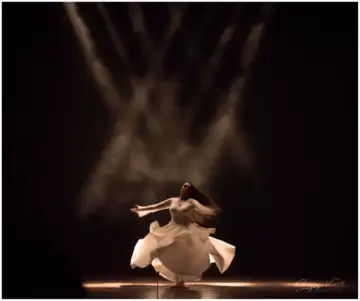
Sanjukta Sinha in 'Id', choreographed by Aakash Odedra, London.
As a lighting designer, dance offered me a freedom that theatre had not. In theatre, one is often bound to realism - to the physicality of time and place, to the logic of rooms and streets, to the architecture of the world as we know it. But in classical dance, there is a wonderful permission for abstraction. A body can be a river, a hand can be a bird, a glance can become longing, and a pause can hold centuries. In that landscape, lighting has the possibility of becoming far more than illumination. It can become atmosphere, memory, metaphor, rhythm. It can become a fellow traveller of the dancer.
This is perhaps why I slowly began to feel that lighting, in dance, could become a co-dancer - a silent performer sharing the stage. The gurus I worked with gave me the freedom to explore. My background in theatre, dramaturgy, and scripting became useful. I was not merely placing light on movement; I was reading the emotional architecture of the work, and trying to let light respond.
Bharatanatyam dancer Christopher Gurusamy expresses this beautifully: "To not think or ideate about lighting while developing choreography I feel is like a painter not using all his brushes and colours - though arts can still be made, the effect and impact of the work can be more with good lighting." That thought stays with me, because it captures precisely how the role of lighting has changed in Indian dance.
When I first entered the dance world, lighting was still, in many places, thought of as a technical necessity rather than as an equal creative collaborator. But over time, that perception has changed, and dramatically.
One, audiences themselves have become more visually aware. We are living in an age saturated with images. The eye of the audience has evolved. It notices nuance. It recognises visual composition. Two, dancers and choreographers today are increasingly exposed to interdisciplinary practices. They are thinking of production as a total experience - movement, sound, costume, scenography, light, and technology speaking to one another. Three, the availability of newer technologies has expanded the creative vocabulary.
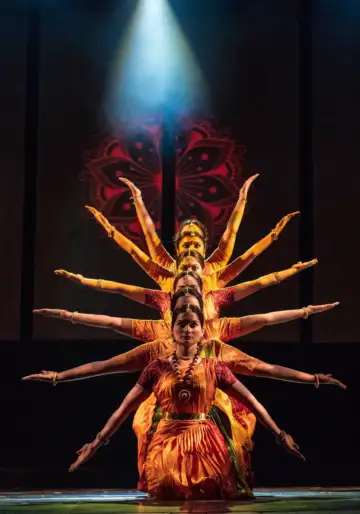
'Tales of the Bull and the Tiger' by Ananda Shankar Jayant.
Over the years, I too began to engage with video projection mapping, intelligent lights, and newer visual tools. But what interested me was never technology for its own sake. It was always about asking: what can deepen the emotional experience? What can honour the form while opening new possibilities? How can light remain sensitive to tradition, and yet alive to the present moment?
Odissi dancer Madhur Gupta offers a profound historical perspective on this shift: "For most of its history, Indian classical dance was lit by the diya - a flicker that witnessed the body but never shaped it. The proscenium changed that, and today the best lighting designers for classical dance are dramaturges, not technicians. They read abhinaya the way a sitarist reads silence." I find this deeply moving, because good lighting for dance is not about making things look pretty. It is about reading the inner score of a performance. It is about understanding where the breath changes, where stillness becomes narrative, where darkness is needed as much as light.
Many choreographers now think of light from the very beginning of creation. They recognise how direction, colour, intensity, shadow, and timing can alter the emotional temperature of a piece. A slight side light can make a sculpture of the body. A soft amber can create memory. A sudden isolation can reveal vulnerability. Darkness, too, becomes expressive - not emptiness, but suspense, anticipation, or inwardness.
As Kathak dancer Shivani Verma puts it: "Lighting sets the mood for the performer and the audience. It is the aspect of presentation that takes me away from the everyday reality into that magical space of performance." That magical space is, in many ways, what all performance seeks. Dance begins in training and labour, yes, but on stage it must cross into something more - transformation. Lighting helps carry us there.
And perhaps that is why its relevance has grown so significantly in India. Dance performances today are not only being staged in auditoriums but also in festivals, site-specific spaces, heritage locations, black box theatres, and international collaborations. The visual demands are changing, and with them the possibilities. Yet, even amidst all this change, the essence remains the same: light must serve the spirit of the performance.
On International Dance Day (April 29), as we celebrate dancers and the traditions they carry forward, I also want to honour the growing place of stage lighting in Indian dance. Not because light wants attention for itself, but because it has become one more way in which dance can speak more fully, more deeply, and more truthfully.
From the old laatu to the carefully sculpted performance spaces of today, the journey of lighting in India has been one of expansion. If dance is the body remembering, then light is the air around it remembering too. And when the two meet in sincerity, something sacred happens on stage.
- The writer is a stage lighting designer whose work spans theatre, classical dance, and contemporary performance