




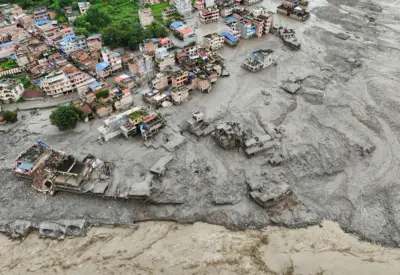

A powerful landslide involving ice and rock, rather than an earthquake, triggered the deadly flash floods that swept through parts of Nepal and Tibet, the United States Geological Survey (USGS) said, clarifying an earlier report of seismic activity.
“No earthquake had occurred," the agency said.
The USGS said additional analysis of the long-period seismic waves indicated that the tremors were generated by a glacial collapse and debris flow.
“This event was initially reported as a magnitude 4.4 earthquake. Additional analysis of nearby seismic stations, long period seismic waves, and satellite imagery led to the determination that the seismic event was instead a glacial collapse and debris flow, and that no earthquake had occurred," the USGS said in an update to its note on the event.
It also upgraded the magnitude of the seismic event to 5.2 from the 4.4 assessed earlier.
“The USGS determined that the seismic event was a glacial collapse and debris flow that caused subsequent catastrophic impacts downstream," it said.
Daniel Shugar, an Associate Professor of geomorphology at the University of Calgary in Canada said the flash floods were triggered by a glacier that rolled off a cliff at 5,200 meters.
Shugar compared the satellite images of the region taken on Wednesday and Tuesday, a day before the natural disaster struck Nepal.
“Comparing satellite imagery from yesterday and today, the glaciers in the vicinity do seem to have lost a fair bit of snow in the last 24 hours," Shugar was quoted as saying by the New Scientist magazine.
“My guess is that snow melt, and glacier ice melt as well, injected a lot of liquid water into the glacier, which percolated down to the bed and lubricated it. That was enough for it to collapse," he said.
Reuters, citing an initial analysis of Planet Labs satellite imagery, reported that a landslide of ice and rock sent a massive debris flow into the Lhende Khola River, triggering a flood laden with mud and debris. The river, which flows from Tibet into Nepal, is a tributary of the Bhote Koshi.
The exceptionally powerful landslide generated seismic energy equivalent to an earthquake measuring about 5.2 magnitude, according to the assessment.
Death toll rises as rescue efforts continue
At least 157 bodies have been recovered in Nepal, with authorities warning that the toll could rise as rescue teams search through mud and debris.
The floods devastated parts of Rasuwa, Dhading and Nuwakot districts after the torrent surged through the Bhote Koshi River at around 9 a.m. local time. Homes, vehicles and trees were submerged or buried, while damaged hydropower infrastructure left many communities without electricity.
Nepalese police and military personnel have been conducting rescue operations, while helicopters have been deployed to evacuate survivors and deliver assistance. Officials said some areas remain inaccessible to helicopters until floodwaters recede.
Prime Minister Balendra Shah has pledged to deploy all available government resources to the relief and rescue effort.
Hundreds of tourists reported missing
The disaster also disrupted travel in the region. Nepal’s tourism authorities said more than 400 tourists, including hundreds of foreign nationals, were initially unaccounted for after the floods.
Those reported missing included Indian, Australian, British, Malaysian, Dutch, Portuguese, South African, South Korean and U.S. nationals. Indian nationals made up a significant share of those reported missing, including pilgrims believed to have been in the affected region.
Residents from Nuwakot and Dhading gathered outside a Nepal Army training centre serving as a base for helicopter rescue operations, seeking information about relatives whose whereabouts remained unknown.
Police recorded names of missing people outside the barracks, at times using mobile-phone flashlights as the surrounding area remained without power.
Tibet also hit by deadly floods
The disaster extended across the border into Tibet, where China’s state broadcaster reported three deaths and 265 people missing in Gyirong. Authorities said the reported deaths were still being verified and rescue operations were continuing.
Security footage from the Nepal-Tibet border showed people fleeing moments before a torrent of rocks, mud and water swept through the area, destroying buildings and vehicles.
India, UN step up support
The disaster also prompted flood alerts in neighbouring India. About 5,000 people were evacuated in Bihar after authorities warned of rising water levels.
The United Nations said it was mobilising supplies and personnel to support affected communities. India said it was coordinating with Kathmandu on rescue and relief operations, while South Korea was preparing to send a rapid-response team.
Rescue workers are continuing to search for survivors and recover bodies as heavy deposits of mud and debris complicate operations across the affected areas.
Inputs from Reuters