




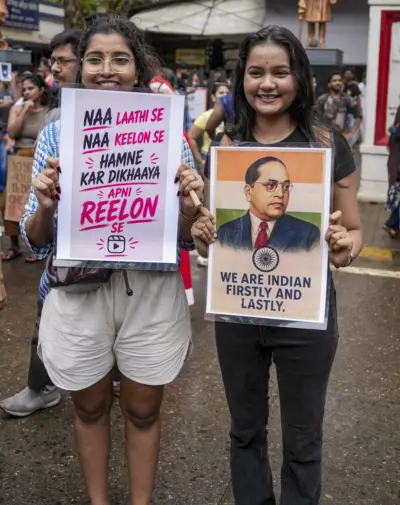

SOMEWHERE between Shakespeare's thou and GenZ's bro, we seem to have misplaced something - not language, but context. From thou to you, from "Yours sincerely" to "Seen", from carefully constructed sentences to " vasteguna huiya " - a playful exclamation with no literal meaning, popularised during the GenZ protest at Jantar Mantar - language has travelled a long distance.
That is what makes language fascinating. It refuses to stay still.
Shakespeare's Elizabethan English, with its elaborate flourish, was once perfectly natural to its audience. Centuries later came letters, emails, WhatsApp, memes, GIFs and emojis. Today, vocabulary can emerge on social media and become mainstream before dictionaries catch up. This linguistic revolution is no longer confined to the young. Millennials use GenZ slang. Parents use it. Even generations that once complained about "kids these days" now use words first encountered on Instagram.
And why not? Every generation invents its own shorthand and inside jokes - sometimes meaningful, ironic or gloriously absurd. It may bewilder one generation while perfectly capturing a moment for another. That is the beauty of evolving language. But is it evolving faster than etiquette?
There is nothing wrong with slang, abbreviations or emojis. They have made communication quicker. But an emoji is also a caricature - it simplifies and exaggerates an emotion. That is why context matters.
I once received a condolence message accompanied by a crying emoji. The intention was compassionate, yet the emoji felt strangely out of place. Grief is solemn. Condolences are among those moments when communication needs quietness. A crying face, perfectly acceptable in casual conversation, suddenly felt informal and almost unserious. The message wasn't offensive, but it reminded me that digital fluency does not automatically translate into social intelligence.
We talk about social media literacy in terms of misinformation, cyber safety, privacy and responsible posting. All are important. But perhaps there is another dimension: knowing how to behave. When is slang appropriate? When does humour become insensitive? When does an emoji add warmth, and when does it trivialise an emotion? When does informality turn into disrespect? These are questions not of grammar, but of judgment.
Every generation has its language. What one considers rude, another may find refreshingly casual. Neither is entirely wrong. The answer is not to make one generation speak like another, but to learn code-switching - not merely between languages, but between contexts.
You can say "OMG" to a friend and "I am deeply sorry for your loss" to someone grieving. Communication is not merely about what we say. It is about what the moment deserves.
Beneath all the new words, abbreviations and emojis, let us hold on to the one thing that should never need an update: Grace. Because words will keep changing. Our sense of when, where and how to use them should not.
The writer is a Punjab Civil Services (PCS) officer