


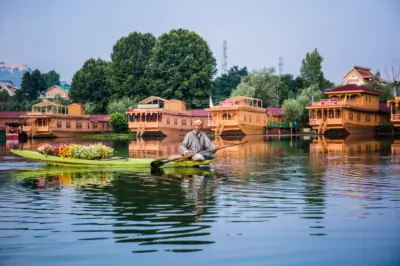

We want two incompatible things from travel: to go somewhere, and to remain comfortably where we are. We want adventure, but preferably with our own bathroom.
We want unfamiliar horizons and familiar tea. We wish to escape our lives without misplacing the charger. The Kashmiri houseboat understands.
It offers the emotional satisfaction of a voyage without insisting on departure. You wake up surrounded by water, with all the romance of having gone somewhere, while your suitcase remains exactly where you abandoned it. Most boats have a destination. These have an address.
On Dal Lake, I began to suspect that movement was overrated. From the verandah, the world came past at a perfectly acceptable speed. A shikara crossed the water. There was always something happening, but mercifully little of it required me to pull on my fashionable leather high boots and parade along the Dal promenade.
Prized property
This paradox, movement without motion and stability without soil, began as a legal workaround. Under the Dogra Maharajas, outsiders could not own land in the Valley. The British, who had made something of a career out of owning other people's land, found this deeply inconvenient.
So they looked at the lake. The land law stopped at the shoreline. A boat moored on the Dal was not real estate; it was, technically, transport that had lost interest in travelling. If you cannot own the ground, float above it and call it a houseboat.
The Hanjis, Kashmir's people of the water, had long lived and traded on the lakes in doongas and bahatch cargo boats, and it was Hanji hands that stretched these vessels into floating drawing rooms. Srinagar also remembers Pandit Naraindas, whose shop burnt down, who moved his stock onto a Hanji doonga, sold the improved boat to an admiring European, and realised he was in the wrong business. He became Naav Narain, and his first houseboat was christened Kashmir Princess.
By 1906, hundreds lined the waters, each a little piece of England afloat, prized property to be bought, sold, inherited and quarrelled over without technically touching Kashmir. Few loopholes have aged so gracefully.
England and Persia
At the windows hang intricate Victorian lace curtains, frilled and faintly scandalised, as if a Surrey aunt had been posted to the Himalayas and decided to make the best of it. Then look up. The ceiling is khatamband, from the Persian for joining polygons into an endless pattern: hundreds of slivers of fir, deodar or walnut fitted into stars and hexagons by joinery alone.
Tradition credits Persian artisans who came with the Sufi saint Mir Sayyid Ali Hamadani in the 14th century; others name Mirza Haidar Dughlat, in 1541. Either way, it keeps out the cold and can be dismantled and reassembled elsewhere, a fitting talent for a home on water.
Below it, the walnut walls bloom. Chinar leaves, lotus, iris and vine curl across the panels, as if a Kashmiri spring had agreed to stay indoors for the winter on condition that it be carved. The British supplied the lace; Kashmir supplied the forest, the garden and the patience.
There is an older reason we love them. A houseboat rocks. We all began life being rocked: in the womb, in arms, in a cradle while someone sang about boughs breaking, an alarming thing to sing to an infant. We never outgrow the longing; we merely become too dignified to ask, and buy rocking chairs instead.
The Dal does it for free. Under a quilt the weight of a small relative, the boat sways and something very old in us settles. It is maternal love outsourced to a lake. And unlike the nursery rhyme, nobody worries about the cradle falling. This one has been moored for over a century.
When the cradle freezes
Then comes Chillai Kalan, Persian for "the great forty", the harshest 40-day stretch of Kashmir's winter. It runs every year from December 21 to the end of January, and the lake ices over at its edges. The rocking stops. The houseboats stand still in white, like cradles whose mother has finally said, "Enough. Go to sleep."
Inside, the bukhari takes command. Its name comes from bukhar, Persian and Urdu for heat, vapour and, yes, fever: quite literally, the thing that gives a room temperature. The kangri, an earthen fire pot in a wicker jacket, turns out to be not a souvenir but a survival strategy. Years ago, much younger and very proud of my first kangri, I tucked it under my sweater and settled down to chat with a friend. Something, I noticed, was burning. It took me a while to figure out that the something was me. I went straight to the bucket. That is how I learnt why kangris, my dear, are to be held under a very loose pheran.
This is why winter is the season to bring family. Summer scatters a family across gardens and itineraries; winter gathers it around one stove. Storming out is discouraged, the only exit being a lake. Families don't need to come back happier. Coming back closer is enough.
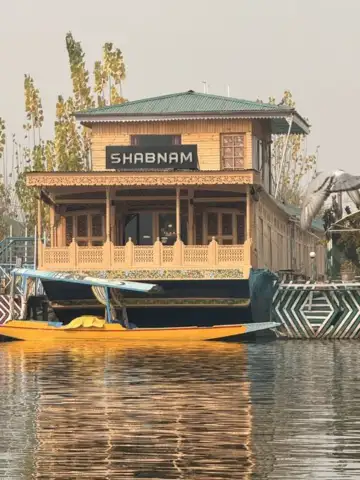
From England to France to Switzerland to local origins, houseboats have been given all kinds of names - Derbyshire, Geneva, Monalisa, Laila Majnoo, Mehbooba, or Shabnam. Photo by the writer
Our boat was Shabnam, Urdu for dew, a brave name in a season when dew arrives as frost. In a single row you may pass Derbyshire, an English county that has slipped its moorings; Geneva, presumably neutral in family arguments; New Athena; King Fisher and Fairy Land. There is a Piano, which I hope nobody tries to tune, and one called Monalisa, her smile as mysterious as the extra charges. My favourite was Laila Majnoo, offered to honeymooners in cheerful defiance of a love story in which the couple never quite got together.
New Dilruba, Mehbooba, Young Beauty Star. The waterfront reads like a matrimonial column: fair, homely, good family, with younger sisters moored alongside. Not one boat admits to being wheatish.
On Shabnam, Mushtaq, the caretaker, became my island of hope, an impressive feat given that we were already afloat. His family lives in Gulmarg; he works on the lake. My escape was his workplace.
On this trip, I brought him a box of sweets. He received it the way some people receive medals. That evening, in his shikara, we passed chicken kebabs between the cushions while he paddled us into the sunset, smoke from the kebabs drifting over the water. Hospitality usually travels one way, from host to guest. For one smoky, laughing hour, it went round in a circle, and the lake carried it as though it had done this many times before.
Shopping without legs
The market, meanwhile, refuses to float about. Meena Bazaar sits mid-lake, a row of shops selling papier mâché, saffron, shawls and everything you did not know you needed. It does not move. You do. To reach this stationary market, you must stay afloat, bargaining from a cushioned shikara while the shopkeeper stands on firmer footing, a distinct tactical advantage.
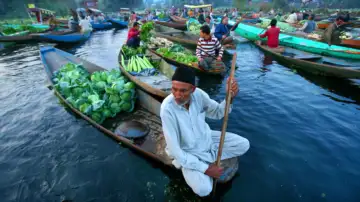
Besides the popular Meena Bazaar, Dal Lake also has a floating vegetable market selling fresh produce. Photo: Mukesh Gupta
The rest of the market comes to you. Sit on the verandah long enough and a steady procession of shikaras draws up alongside, as regular as a family WhatsApp group. First the phool wallah, his boat heaped so high with marigolds and dahlias that he appears to be rowing a garden. Then the namda wallah with felted woollen rugs, the zevar wallah with silver that catches the winter light, and the pheran wallah, who takes one look at your coat and diagnoses a deficiency. Each unpacks with ceremony, which is how one acquires purchases in the category "It looked different on the verandah".
And if you buy nothing, nobody sulks. The seller smiles, folds everything away and says, "Koi baat nahi", no matter, with such humility and grace that you almost buy something out of remorse. Vendors in other parts of the country, who can take a polite no as a family insult, could do worse than spend a winter on the Dal taking lessons.
Our Venice, with a twist
Srinagar is often called the Venice of the East, a comparison that flatters both. Venice sits in an Adriatic lagoon; the Dal, many geologists believe, is a leftover of the vast prehistoric lake that once filled the whole Valley. One is a child of the sea; the other, a grandchild of the Ice Age.
Venice's gondoliers, in their striped shirts, look like a 19th-century American chain gang that escaped and took up singing 'O Sole Mio'. Our shikara wallahs wear pherans, negotiate first and then, with little encouragement, launch into 'Yeh Chand Sa Roshan Chehra' from 'Kashmir Ki Kali', as though Shammi Kapoor might leap out of the next boat.
A gondola ride probably costs more than the shikara itself, and the shikara comes with kahwa and someone's uncle who sells saffron. Venice frets about sinking; the Dal about shrinking. And Venice has no kangri. Picture a gondolier with a pot of hot coals tucked under that striped shirt. He would learn about loose pherans even faster than I did.
Yet it is not the grand houseboat that stays with me, but the shikara, the only road to it. A friend once rang me from the Dal promenade, luggage in hand: "Main kaise aaon?" How do I get there? Swimming, of course, I said. In January. The silence could have brewed kahwa. Then a shikara came. It asks little: sit still, let someone else row. You surrender direction and speed to another person's oar, and discover that being carried is not the same as being helpless. Each stroke pushes water behind so the boat can move ahead, which is perhaps what Kashmir has long done: carrying its past and moving anyway.
We mostly talk about Kashmir from the shore, through headlines and arguments. The shikara insists on another vantage: at water level, in a Kashmiri's boat, trusting a Kashmiri's hands. From there, the Valley is not a problem to be solved but a place that keeps quietly carrying strangers home, even in winter, even across ice.
We remained moored, but hardly untouched. The kahwa arrived. And for once, I had no compelling reason to be anywhere else.
- The writer is the founder-director of the Himalayan Institute of Cultural & Heritage Studies