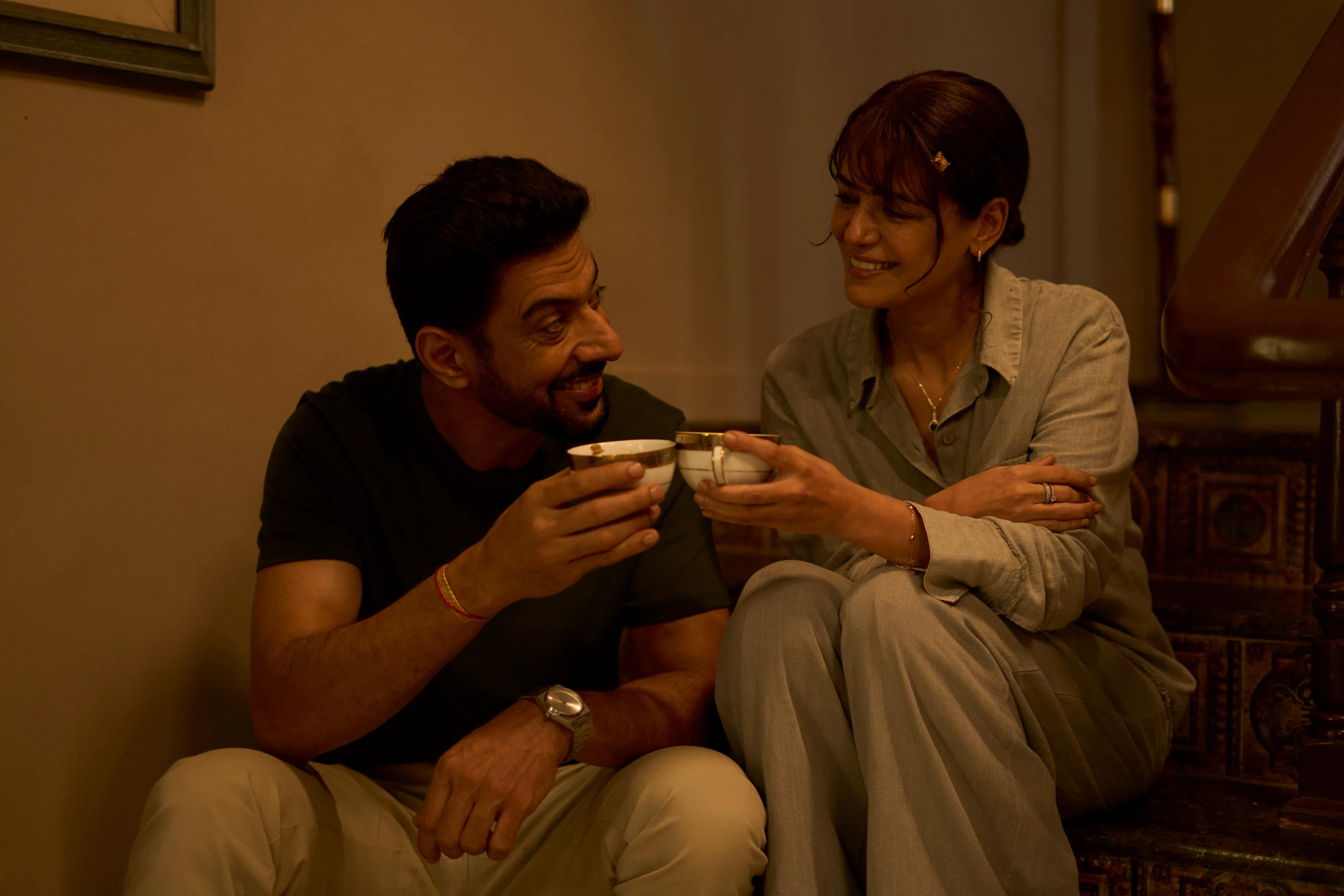

"Yeh sahi hai, koi bhi Gen Z word kahin bhi daal do," says Agastya (Mihir Ahuja) to his mother Vinita (Mona Singh) early on in the unfortunately-named 'Maa Ka Sum'.
It is meant as a throwaway line. It ends up being the most honest thing the series has to offer.
Because the eight-parter feels guided by that exact philosophy, flinging "delulu", "normies" and "no cap" into conversations with such misplaced confidence that the writing nearly circles back to accidental genius, only to miss the mark every single time.
The story follows Agastya, a 19-year-old mathematics prodigy, who decides to algorithm his way into finding the perfect partner for his single mother. It is a premise with potential. The series, however, buries it under overwriting, convenient arcs and dialogue that rarely rises above the obvious.
It answers only one question: how do people with chronic back pain imagine Gen Z speaks?
We first meet Agastya as he thwarts a heartbroken college student's suicide attempt using statistics to argue that there are other fish in the sea.
Armed with this sense of righteousness, and after watching his mother endure a string of bad dates, he sets out to "solve" love using mathematics. The lesson he eventually arrives at is one most people grasp without coding: matters of the heart do not follow formulae.
His relationship with Vinita is framed as unusually close, often tipping into invasive. Over time, he shifts from a well-meaning son to a controlling man-child. Ahuja charts this decline adequately, while Singh does what she can trapped in an overstated, middling narrative.
At times, the writing veers into the baffling. In one of the makers' attempts to sound youthful, a friend mocks Agastya's reliance on mathematics with a crass metaphor about him swinging from the subject's genitalia.
The series sure has a way with words; the way, unfortunately, being a one-way potholed street with a dead-end sign.
Then there is Ira (Angira Dhar), a Harvard-educated professor introduced in a bookshop where Agastya attempts to deduce the next book she'd buy by stalking her choices. What is likely aimed to signal eccentric intelligence comes off as distinctly creepy.
Ira fares no better, casually bending professional ethics by letting him attend her class in exchange for house-hunting help, even inviting him to join her recee in her convertible car.
The show registers none of this as odd.
Elsewhere, the writing appears half-baked: On a date, Vinita, a real estate agent, takes offence at being called a broker, even though the term typically denotes greater experience, and would more likely apply to her superior. One of Agastya's friends speaks in an unconvincing Haryanvi accent, serving as a rural caricature, while simultaneously dressed in early 2010s emo black tees and a lone earring.
The rest of the young cast fare no better, styled with a kind of shrug, as though they were asked to assemble "Gen Z" outfits by rummaging through a costume box while blindfolded.
Most disappointing is how little mathematics amounts to. The promised algorithmic quest reduces to Agastya hacking a dating app and tweaking his mother's profile for better matches.
There is merit in the attempt. The series does explore a rarely seen mother-son dynamic and addresses, without coyness, a middle-aged woman's search for love.
Even so, I would rather reappear for my mathematics board exam than sit through it again.