


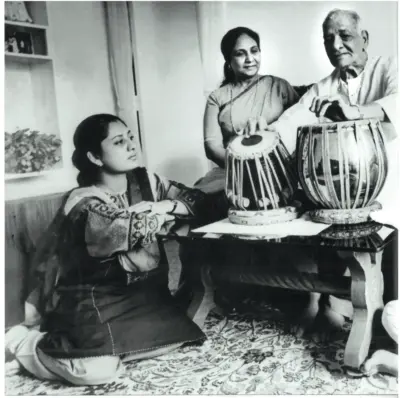

Roshan Kumari Faqir Mohammad was one of the foremost exponents of the Jaipur gharana of Kathak. On stage, she was like a brilliant shooting star, sparkling with mesmerising energy and disappearing until the next performance.
Her unique style of dancing brought the strength, rhythm and earthiness of the Jaipur gharana to the stage with a dignity that was entirely her own. She passed away on October 5 in Mumbai at the age of 81, leaving behind a legacy that spans seven decades of performance, teaching and choreography.
Roshan Kumari was born in Ambala. Her father was Ustad Faqir Mohammad, a maestro of tabla and pakhawaj, and her mother was the celebrated classical and playback singer Zohrabai Ambalewali, the voice behind immortal hits like 'Akhiyaan Milake Jiya Bharma Ke' from 'Rattan'. She lived in Bandra, Mumbai, in a home where music was not entertainment but prayer. Her disciples called it a 'mandir', a temple dedicated to her parents, with their photographs adorning the walls.
Didi, as we called Roshanji, was initiated into the world of dance at the tender age of three. She began her training with Guru KS More, and then learnt from the Jaipur gharana stalwart Pt Sunder Prasad. Many years later, she learnt abhinaya from Ustad Ghulam Hussain Khan of Patiala and Guru Hanuman Prasad of Jaipur. Unusual for a Kathak dancer of her time, she also trained in Bharatanatyam under Guru Govindraj Pillai and Guru Mahalingam Pillai, which gave her abhinaya a rare fluidity. Her interest in dance was such that she also learnt some bit of Kathakali, Manipuri and folk dance, which shaped her vision as a choreographer.
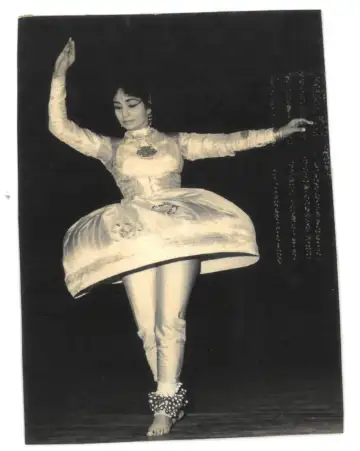
Roshan Kumari exuded grace, speed, intricate layakari, rhythmic complexity and amazing precision in pirouettes.
The Jaipur gharana Kathak is known for its tandav ang - strenuous and energetic, with an emphasis on nritta, pure dance, sheer technique, speed, characterised by precise pieces of dance, jumps and pirouettes (chakkars), leading to a fluid rhythmic wizardry. Riyaaz was her magic word, and she practised for 10 to 12 hours a day. She would say: "An unquenchable thirst for knowledge, God's grace, determination, and single-minded devotion lead to lofty heights."
Her father played a major part in her life as a dancer. As soon as her guru taught her something and left, her father would make her practice it and perfect it. He always said: "Jhootha kare toh sach, sachcha kare toh khuda"; in other words, riyaaz never goes waste. She would practice her footwork on a heap of sand placed in the corner of her room!
Roshan Kumari's performances were stunning. Her art was unique also because she danced to tabla bandishes created by her father. She exuded grace, speed, intricate layakari (footwork), rhythmic complexity, amazing precision in pirouettes and her overall presentation left an unforgettable mark on the audience's memory.
To watch her dance was to watch strenuous technique in fluid motion. She proved that a woman could command the stage with the power usually associated with male dancers. She kept the Jaipur style - with its mathematical precision, strong body posture and bhava combined with layakari - alive and respected, without losing femininity.
As Saira Banu, a disciple and friend, said, "To watch Roshanji dance was to watch the entire room come alive around her. She didn't merely occupy the frame, she owned it with her charisma."
At a very young age, she had the rare honour of being accompanied on tabla by stalwarts like Pt Kishan Maharaj, Ustad Alla Rakha and Pt Samta Prasad. She performed at numerous conferences, sharing the stage with legends like Ustad Bade Ghulam Ali Khan, Ustad Amjad Ali Khan, Pt Shiv Kumar Sharma, Pt Birju Maharaj, Sitara Devi and many more. She performed for Prime Ministers Jawaharlal Nehru and Indira Gandhi, and world leaders such as Nikita Khrushchev, King Hussein of Jordan, the King and Queen of Iran, among several others.
While most dancers wore light ghungroos, Roshan Kumari wore 1.5 kg on each foot. Few performers can carry such a heavy weight while dancing. Her footwork would thunder like a pakhawaj, yet her upper body remained graceful - the hallmark of the Jaipur gharana.
In Mumbai, she founded the Nritya Kala Kendra in Bandra, one of the most respected Kathak academies in India. She never married and dedicated her life to her art and students. I stayed with her for 12 years. She was a strict disciplinarian and a perfectionist. Even in hospital, a few days before her passing, she asked her student about her riyaaz, admonishing her to practice properly before a programme.
She was still very young when she was invited by Bimal Roy to perform a Kathak number in his classic 'Parineeta' (1953). This opened the doors of cinema to her, but she never became a film star in the conventional sense. Her most iconic screen appearance was in Satyajit Ray's masterpiece 'Jalsaghar' (1958).
Ray wanted a Kathak performance that was not decorative but central to the story of a fading zamindar. On the suggestion of sitar maestro Ustad Vilayat Khan, Ray visited her house. Roshan Kumari recalled, "When Ray sahab came, my father told him he needn't have come to our house himself… Ray sahab replied: 'The artiste lives here, so I need to visit and request.'" The result was a nine-minute uncut chaturang, a musical composition, in front of a giant ornate mirror, shot with four cameras. Her headgear came undone during the take, but she did not stop. That imperfection still remains in the song and shows her dedication.
Her other major films include Sohrab Modi's 'Mirza Ghalib' (1954), 'Basant Bahar' (1956), 'Waris' (1954), and Bimal Roy's films. Later, she became a choreographer for meaningful cinema - 'Gopi' (1970), 'Chaitali' (1975), Gulzar's 'Lekin' (1990) and Shyam Benegal's 'Sardari Begum' (1996). In 1970, the Films Division of India featured her in its landmark documentary on Kathak alongside Shambhu Maharaj, Damayanti Joshi and Uma Sharma. She was honoured with the Padma Shri in 1984.
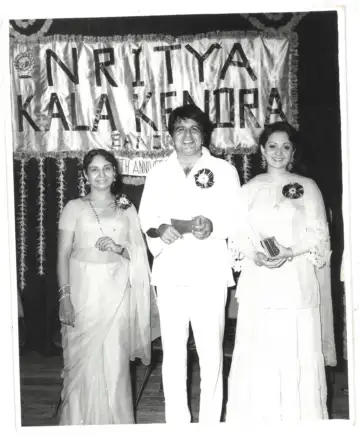
Roshan Kumari with Dilip Kumar and Saira Banu. Photo courtesy: The writer
Perhaps her most famous student outside the classical world was film star Saira Banu, who learnt Kathak from her in the 1960s and remained her lifelong friend.
In her moving tribute, she wrote: "Some goodbyes are impossible to write… Roshanji came into my life as my Kathak guru, but over the years, she became so much more - a confidante, a friend, an elder sister-like presence, and eventually, family… Her footwork could thunder, her chakkars could mesmerise, and yet there was always an unmistakable grace and dignity about her."
Roshan Kumariji lived as she danced - with discipline, devotion, and dignity. She never sought public life; in fact, she was quite shy of it. In her later years, she was happy to be quite a recluse, much to the disappointment of her many fans and admirers. She had a great sense of humour and enjoyed cooking and gardening. She also loved dogs.
With her passing, India has lost an incredible artiste.
- The writer is based in Chandigarh