
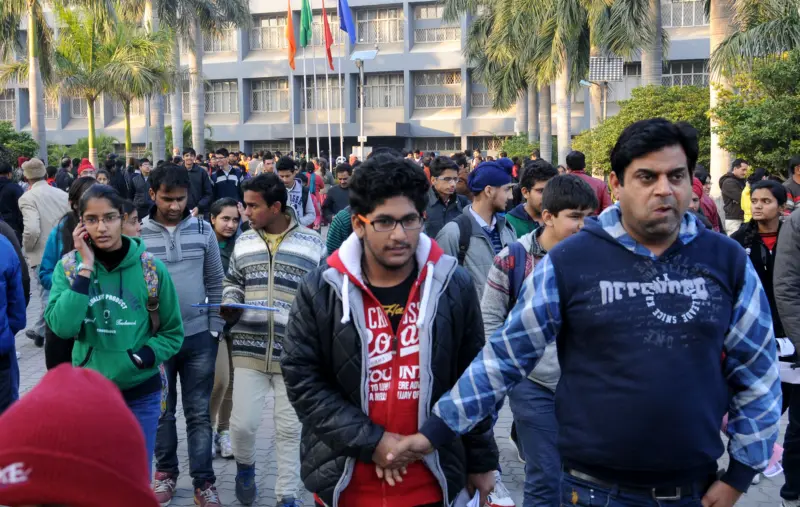

India's premier institutions, long regarded as incubators of the country's brightest minds, are witnessing a sustained outflow of talent as students increasingly pursue education and careers abroad.
Experts warn that this trend could have long-term implications for India's innovation ecosystem, economic growth, and self-reliance.
A 2025 report by NITI Aayog prepared in collaboration with IIT-Madras, the Association of Indian Universities, and global education services firm Acumen has highlighted the scale of the imbalance in student mobility. In 2021-22, India hosted just 46,878 international students, while more than 11.59 lakh Indian students went overseas for education - a number that rose to 13.36 lakh by 2024. The report notes that outbound students outnumber inbound students by nearly 25 times, pointing to a deep structural disparity.
The migration of top-performing students from elite institutions, particularly the Indian Institutes of Technology (IITs), has added to concerns. A 2023 study titled 'Top talent, elite colleges, and migration: Evidence from the Indian Institutes of Technology' by the National Bureau of Economic Research found that around 36 per cent of the top 1,000 students from the 2010 cohort of five leading IITs - Kanpur, Kharagpur, Madras, Bombay, and Delhi - had moved abroad by 2018.
Top rankers opt out
High-ranking candidates in competitive exams such as JEE Advanced are increasingly opting for foreign universities over IITs. Several toppers have chosen institutions like the Massachusetts Institute of Technology (MIT), foregoing admission to India's top engineering colleges.
This pattern is not new. Historically, many IIT-JEE toppers have pursued higher education or careers abroad. Over the years, several high achievers have left IITs mid-course or declined admission altogether to enrol in leading global universities. Recent examples further illustrate this pattern. Devesh Bhaiya, who secured All India Rank 8 in JEE Advanced 2025, chose to forgo admission to the IITs and instead enrolled at the MIT in the United States. Similarly, Ved Lahoti also opted for MIT after securing the top rank in JEE.
This is not a new phenomenon. In 1998, out of the top 10 IIT-JEE rank holders, nine moved abroad. After topping the exam, Abhinav Kumar didn't go to IIT but joined MIT. The rank 2 holder, Jayant Kumar Kannan, pursued engineering from IIT-Madras and then moved to the US.
In 2020, Chirag Falor left IIT after two years to join MIT. Earlier, in 2014, Chitraang Murdia moved to MIT after spending a year at IIT-Bombay; he later went on to earn a PhD from the University of California, Berkeley. Mahit Gadhewala scored rank 9 in the exams but left IIT-Bombay in a year to join MIT.
Economic & innovation challenges
After gaining Independence in 1947, India's primary focus was on nation-building. As a result, the scope of internationalisation in education remained limited during this period. Notably, the establishment of IITs and Indian Institutes of Management (IIMs) drew international attention and elevated India's status in the global academic community, especially in science, engineering and management education.
The outflow of students is not just an academic concern - it also has economic consequences. India's total trade deficit stood at nearly $94 billion in the 2024-25 financial year. According to the NITI Aayog report, expenditure on overseas education by Indian students in 2025 is estimated to be equivalent to nearly 75 per cent of this deficit.
"This trend underscores the growing foreign exchange burden on the Indian economy due to the demand for overseas education," the report stated, calling for stronger efforts to internationalise India's domestic higher education system.
Experts also warn that the migration of skilled students and researchers weakens India's research and development capabilities. This, in turn, increases dependence on foreign technologies and limits the country's ability to address its own socio-economic challenges through indigenous solutions.
Demographic dividend at risk
India, with an average age of 28.4 years, stands at the cusp of a demographic advantage. However, policymakers caution that continued outmigration of educated youth could undermine this potential.
"The continued outflow of talent will hinder India's ability to fully leverage its demographic dividend," the NITI Aayog report noted. In response, the government has introduced measures to strengthen domestic higher education and attract global collaboration. The University Grants Commission (UGC) has introduced regulations allowing foreign universities to establish campuses in India, aiming to make global education more accessible and affordable within the country.
Additionally, policies introduced in 2022 enable Indian institutions to offer twinning, joint, and dual-degree programmes in collaboration with foreign universities.
Officials say these initiatives are part of a broader push to promote "internationalisation at home", which includes global faculty engagement, joint research programmes, and credit transfer systems.
Signs of progress
Recent data suggests India is making strides in research and innovation. A study by Stanford University found that 6,239 Indian researchers featured among the world's top 2 per cent scientists in 2025, marking a 17 per cent increase from the previous year.
India has also improved its global standing in artificial intelligence, climbing to third place in Stanford's 2025 Global AI Vibrancy Tool, up from seventh.
Government officials remain optimistic. "India is emerging as a stable and attractive destination for higher education," a senior Education Ministry official said, adding that reforms and investments in emerging sectors such as AI, quantum technology, and clean energy are strengthening the country's academic ecosystem.
In 2023, the UGC came up with 'Setting Up and Operation of Campuses of Foreign Higher Educational Institutions in India Regulations', which allow the entry of higher-ranked foreign higher education institutions (HEIs) into India. It enables Indian students to obtain foreign qualifications at an affordable cost and makes India an attractive global study destination.
The UGC also came up with a set of regulations in 2022 which laid down the minimum standards for academic collaboration between Indian and foreign HEIs to offer twinning, joint-degree and dual-degree programmes. These regulations apply to Indian higher education institutions which are intending to collaborate with foreign institutes leading to award of degree.
Mamidala Jagadesh Kumar, chairman, Review Committee for NEP 2020 Implementation, Ministry of Education, told The Tribune, "The UGC is enabling top global universities to establish branch campuses in India, and new pathways for joint, dual, and twinning degrees. Indian students can now access world class international education while staying close to home. At the same time, India now has many national scientific missions in areas such as quantum technologies, AI, semiconductors, space, clean energy, and biotechnology, as well as a rapidly expanding startup and innovation ecosystem."
He said that India today is creating one of the strongest environments for students to study, innovate, and contribute to the growth of the country. "The number of students opting for high-quality education in India is likely to increase. Therefore, the movement of talented youth to other countries will naturally reduce when India becomes the place where the world's best work is happening. With rapid reforms in higher education, we are moving exactly in that direction," Kumar said.