




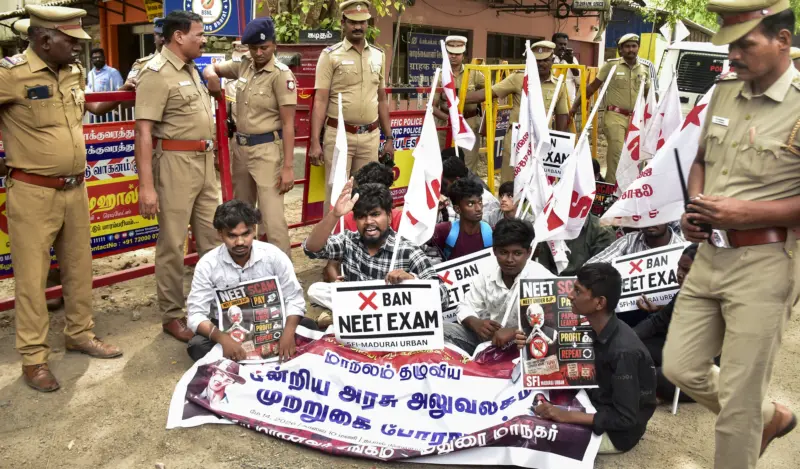

A few days ago, the National Testing Agency (NTA) cancelled the medical entrance examination NEET, which was held on May 3. Over 22 lakh students across the country had taken the exam, which selects students for MBBS and other medical courses.
The NTA admitted that there was a paper leak. A guess paper had been available for sale for at least two days before the exam, containing nearly 140 questions which were also part of the actual paper. While the CBI has started investigating the case, on May 15, Union Education Minister Dharmendra Pradhan acknowledged a “breach in command" and said that NEET would be a computer-based test from next year instead of a pen-and-paper test.
Students prepare for NEET for two years, often in coaching centres which charge hefty fees. Some students take the exam even four-to-five times. Any breach in the integrity of the exam is a psychological trauma for students and their parents, apart from the financial burden. It demoralises and demotivates them, raising doubts about the fairness of entrance exams in the country, more so when it happens repeatedly.
In 2024 too, NEET had faced allegations of paper leaks, result irregularities and examination centre malpractices. There have been many instances of frauds in medical entrance exams - from paper leaks, impersonation, use of Bluetooth devices to communicate with external agents, fixing seating arrangements in examination halls and ‘capturing’ the examination centres. The most glaring was the VYAPAM scam in Madhya Pradesh, which lasted over two decades and was detected in 2013. Over 3,000 people were implicated. In 2004, the Delhi police seized a floppy disc containing leaked CBSE entrance test papers, which were traced to a coaching centre that trained students using the questions as a ‘model paper’, akin to what has happened this time.
Till the early 1970s, admissions to state medical colleges were based on marks obtained in the plus two exam and, to a handful of Central colleges, through individual entrance tests. Later, each state introduced its own entrance test and many deemed universities held their own tests, making it difficult for examinees to take all tests.
In 1988, the All India Pre-Medical Test (AIPMT) was instituted by the CBSE to help students. To streamline it further, NEET was initiated in 2013 and it fully replaced the AIPMT in 2017. The NTA was established in 2017 under the Ministry of Education to conduct entrance exams like NEET in a more efficient, technology-based and transparent manner by a specialised organisation.
The NTA conducts over a dozen high-stakes tests, including NEET-UG, JEE Mains, CUET, UGC-NET and CMAT. There have been controversies over many of these tests. Following paper leaks, the UGC-NET in 2024 had to be cancelled and reconducted and some other exams had to be postponed.
After the NEET 2024 controversy, the government constituted a seven-member Radhakrishnan Committee, which pointed out inadequacies in the functioning of the NTA. It called for structural strengthening of the NTA, tighter oversight of outsourced resources, multilayer access control, real-time audit, enhanced surveillance and computer adaptive testing.
There is no doubt that conducting a test for over 22 lakh candidates in over 5,000 centres is a huge task, but that is precisely what the NTA was constituted for. Many reports suggest a shortage of regular manpower and the outsourcing of many of its operations. Repeated paper leaks suggest vulnerability at the paper-making or paper-distribution levels. Question formulation is outsourced; the papers are typed and translated into 13 languages and then transported to different states and finally to individual centres. A pen-and-paper exam has these vulnerabilities that can be exploited.
The entrance test process must be made above board so that the faith of aspirational youth in fair professional opportunities is restored. If India can conduct a foolproof census of 140 crore persons at the household level or hold fair elections at the booth level, it can certainly conduct honest and transparent entrance exams. After ensuring organisational infrastructure is revamped, technology can be used to have the pen-and-paper test in a hybrid manner - that is, question papers should be compiled just before the exam, encrypted and electronically transferred to the exam centres in each district to be printed a day before the test.
This can be done till the NTA moves to a fully computer-based test, as was also suggested by the Radhakrishnan Committee. In a welcome move, the Education Minister has agreed to a computerised test from next year. The NTA had expressed difficulty in doing so earlier as it could examine only two lakh candidates in one session while the number of candidates is 10 times more.
However, the same agency conducts the JEE Mains which involves nearly 14 lakh students. The JEE Mains is spread over six sessions and held twice a year. If the NTA can double its capacity for a computer-based test, the same can certainly be done for NEET. Secondly, the exam can be held more often like the JEE Mains, with the best score to be considered, which will ease pressure on the students and make the testing batches smaller. It will also reduce the financial rewards for scamsters.
The NTA has to ensure that system crashes, software glitches and server issues are taken care of. Risks of hacking, software manipulations or cybersecurity are the other potential factors needing attention. Enhanced security, surveillance and accountability are needed.
Even the most advanced system fails if insiders are compromised. Fast-track courts are needed for people caught in exam scams, a lifetime ban on students or coaching centres found involved and criminal liability for officials or institutions found guilty. Delink testing operations from policymakers and audit testing agencies regularly. The government must ensure that our youth are not let down again.